





“Pole and Hungarian brothers be,
good for fight and good for party.
Both are valiant, both are lively,
Upon them may God’s blessings be.”
There is a Hungarian saying that describes Hungary and Poland as a pair of good friends who share wine and fight wars together. The proverb’s origins may be traced to the 14th century, reflecting a long history of cooperation shaped by shared monarchs, political alliances, and cultural ties, despite the two countries not sharing a border. During the twentieth century, both states experienced communist rule and later faced the challenge of transitioning toward democracy, and by the 2010s, both states had been accused of drifting toward illiberal tendencies within their governance.
In recent years, however, some have begun to question whether these long-standing friends have become foes. This raises the question: How has the relationship between the two countries evolved since Donald Tusk’s recent election? To answer the question, it is essential to explore the origins of the Polish-Hungarian relationship. Understanding the historical context will provide insight into how the current situation has evolved, as well as identify the key players who will shape the future dynamics between the two states.
The Common Enemy
Hungary and Poland both joined the European Union in 2004 as part of one of the largest EU enlargements. An article by Frank Schimmelfennig and Florian Trauner examines this process in depth, highlighting the accession criteria states had to fulfill to join the EU, including the transition from autocracy to democracy, the transition from a planned economy to a market economy, and from multinational to independent statehood. At that time, these conditions were particularly appealing for former members of the Soviet Union and Soviet bloc, especially considering the significant hardships these states had to face following the collapse of the USSR.
At the time, both Hungary and Poland seemed particularly eager to align with the EU acquis; however, after becoming members of the EU, they ultimately fell short in several key areas, including environmental standards, labor protections, anti-discrimination regulations, and border and migration controls. This positioned both countries quite similarly within the Union. Despite these shortcomings, however, both countries received significant funding to help address their implementation gaps.
While the years following EU accession were defined by adaptation and compliance challenges, by 2010, a new phase began for the two countries in which domestic political shifts and evolving EU dynamics started to reshape their roles within the European Union. Hungary joined the EU in May 2004 under the leadership of Péter Medgyessy. In September 2004, Medgyessy was succeeded by Ferenc Gyurcsány, who represented a coalition of the Hungarian Socialist Party and the Alliance of Free Democrats. Gordon Bajnai took over in 2009, following significant domestic political turmoil sparked by Gyurcsány’s infamous speech in Balatonöszöd.
These controversies, along with the fallout from the 2008 financial crisis, contributed to the victory of the Fidesz-KDNP party, led by Viktor Orbán, in the 2010 elections. Interestingly, at that time, according to an article by Politico, the Hungarian prime minister had a closer relationship to the now Polish prime minister Donald Tusk than to former prime minister Jarosław Kaczyński, the foundation of their relationship being established on common experiences of being in the Soviet bloc, membership in the same party within the European Parliament, and a shared passion for football.
What could have possibly driven these two apart? One explanation may be the two states’ divergent stances regarding the EU. While Viktor Orbán’s rhetoric has portrayed Brussels as an incarnation of malice, Tusk strove to stand at the EU’s center.
Before exploring the shift in Orbán’s political alignment from Tusk to Kaczyński, it is important to examine the political landscape in Poland during the late 2000s and early 2010s. After Poland’s accession into the European Union in 2004, Polish politics were characterized by a heated rivalry between the conservative Law and Justice (PiS) party and the liberal, pro-EU Civic Platform (PO). This dynamic featured significant leadership transitions, starting with the Kaczynski twins’ emergence in 2005, followed by nearly a decade of centrist governance under Donald Tusk, who emphasized European integration and economic stability.
A pivotal event that shaped national identity was the 2010 Smolensk air crash, which resulted in the tragic loss of President Lech Kaczynski and triggered a prolonged period of political polarization and investigation. On the international front, Poland reinforced its alignment with the West by securing US missile defense agreements and advocating for a bolstered NATO presence in light of Russian aggression in Ukraine. The political landscape shifted dramatically in 2015 when Law and Justice regained the presidency and achieved a historic first: a single-party majority in the Polish parliament, marking a decisive turn to the right in the country’s post-communist trajectory.
When Hungary’s Orange Met the Polish Eagle: Orbán and Kaczyński
As Donald Tusk became more immersed in Brussels politics, Viktor Orbán intensified his confrontations with European institutions. In 2015, the Law and Justice party (PiS), led by Jarosław Kaczyński, defeated Tusk’s Civic Platform, giving rise to a government that closely mirrored Orbán’s party, Fidesz, in ideology. Following his ascent to power, Kaczyński aimed to replicate Orbán’s model of governance, famously expressing his desire to transform Warsaw into Budapest by seeking greater control over the media and judiciary, despite encountering more significant domestic opposition than Fidesz faced in Hungary.
As a result, both Poland and Hungary became central to the EU’s concerns about democratic erosion, which, in turn, solidified their political alliance in resisting scrutiny from Brussels. The EU’s apprehensions can also be quantified: an article from the London School of Economics by Adam Holesch and Anna Kyriazi highlights a statistic from Freedom House, a non-profit organization that assesses various aspects of freedom within states. This statistic serves as an indicator of the level of freedom in each country.
Figure 1: Freedom House democracy score in Hungary and Poland from 2010-2020
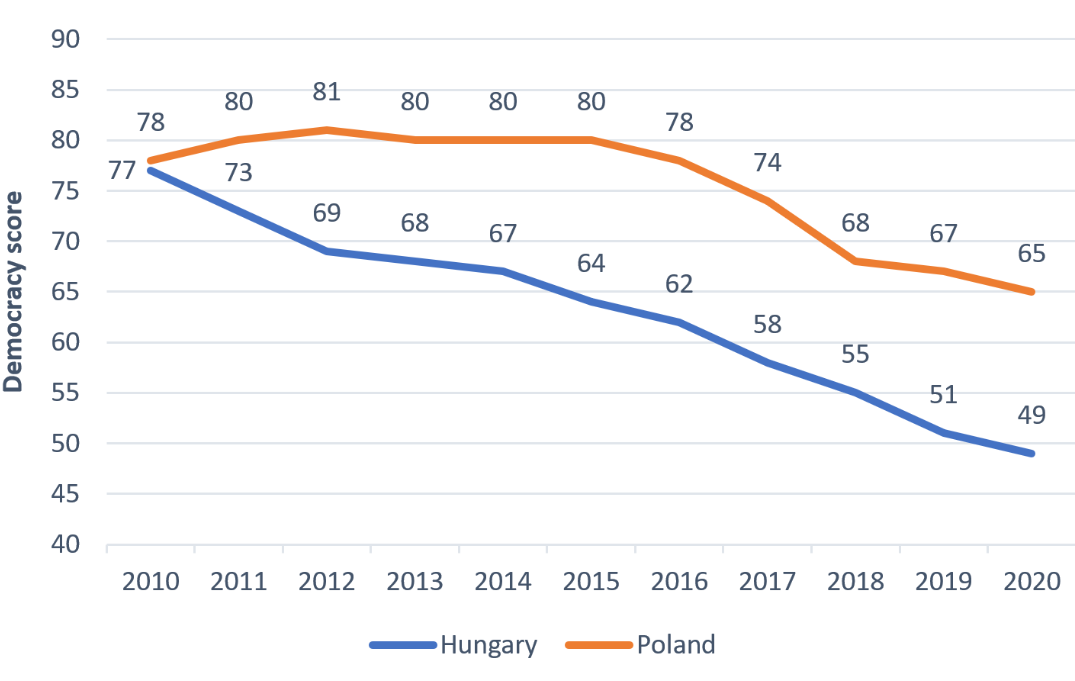 Since 2010, Hungary has seen a noticeable decline in democratic quality, a trend that also became evident in Poland starting in 2015. These developments are closely intertwined with key political events: in 2010, Viktor Orbán won re-election in Hungary, while in 2015, Jarosław Kaczyński made a notable return to power in Poland, having briefly served as prime minister in 2006. The authors argue that the Hungarian and Polish leaders have consistently relied on each other to sustain their arbitrary political decisions, even when confronted with significant opposing pressures and the emergence of democratic backsliding. They assert that while domestic factors initiate a state’s path towards it, international cooperation plays a crucial role in maintaining this process.
An example of this is the way Hungary and Poland have exploited the EU’s rule of law framework, utilizing the principle of unanimous decision-making to provide each other with a protective veto that safeguards their interests. The partnership between Orbán and Kaczyński, however, extends beyond the confines of the EU. Kaczyński’s political party, PiS, has drawn extensively from Orbán’s Fidesz, adopting strategies such as undermining independent courts, manipulating state-controlled media, and domestic legitimation.
One might wonder why these two states have formed such a close alliance. While the Hungarian and Polish leaders emphasize a friendship rooted in shared identity, the underlying reality is driven by their similar ideologies, where similar ends justify similar means.
The Man in Blue and Gold: Donald Tusk
In 2023, former president of the European Council, Donald Tusk, became Poland’s prime minister. Before delving into the specifics of his governance, it is important to first consider a pivotal event that preceded his rule and marked one of the initial fractures in the Polish-Hungarian relationship: the Russia-Ukraine conflict. Tensions grew significantly following the Russian invasion of Ukraine in 2022.
As Poland became one of Ukraine’s most fervent supporters, actively providing political and military assistance, Hungary adopted a more cautious, often Russia-tolerant stance. Prime Minister Viktor Orbán’s government prioritized its ties with Moscow, leading to a stark contrast in foreign policy approaches between Warsaw and Budapest. Hungary’s reluctance to fully support sanctions against Russia and its calls for dialogue frustrated Polish leaders, who saw this divergence as a betrayal of shared values.
Despite being led by Kaczyński at the time, Poland rallied strongly behind Ukraine. The differing strategies highlighted the challenges of maintaining unity among allies in the face of external threats, ultimately straining their once-strong relationship. It is essential to emphasize that the two countries not only diverged in their responses to the situation in Ukraine, but also in their perspectives on NATO. This divergence has been evident throughout the period of PiS governance, but it intensified during Tusk’s leadership.
Tusk’s governance began with making important promises, such as repairing Poland’s institutional structure, strengthening the Polish rule of law, and holding PiS accountable for its actions while in power. Though widely celebrated, according to Stanley Bill and Ben Stanley, during his first year in power, Tusk struggled to make significant progress due to a rift within the Polish government, largely stemming from the then-president Andrzej Duda’s affiliation with Kaczyński’s political party. Tusk’s solution to the problem was the implementation of the concept of militant democracy.
Militant democracy is a concept that involves legally authorized, exceptional restrictions on specific political rights. Its purpose is to marginalize those who threaten to undermine liberal democratic institutions preemptively. By doing so, it aims to prevent anti-democratic forces from exploiting democratic means to overthrow democracy itself. The prime minister’s interpretation of militant democracy is as follows: given that PiS continues to hold significant influence over Polish institutions, the state must prioritize efficiency in decision-making.
This necessity, however, often comes at the expense of certain democratic procedures. In practice, this led to a state of legal dualism, where the government and the PiS-aligned opposition recognized two different, often contradictory, sets of court rulings and authorities. This is especially interesting in light of the 2025 Polish presidential elections, where once again, an affiliate of the Law and Justice party won, despite Tusk’s prime ministerial election 2 years prior.
The race was close: 50.89% to 49.11%; however, PiS’ candidate, Karol Nawrocki, triumphed over Rafał Trzaskowski, who was an early favorite in the election race. Though Tusk’s government aimed to swiftly and legally counter the forces of illiberalism, it often faced challenges in achieving this goal. The coalition tended to take minimal action or resort to questionable measures.
Another case worth mentioning here is the grant of political asylum to Zbigniew Ziobro and Marcin Romanowski. Zbigniew Ziobro, former Polish Justice Minister, sought political asylum in Hungary in January 2026 after facing 26 charges, including embezzlement and leading an organized criminal group, citing “political persecution” by Donald Tusk’s government. Marcin Romanowski, former Deputy Justice Minister and aide to Ziobro, also fled to Hungary and was granted asylum in December 2024 amid a related investigation.
In fact, the Polish politician resides in Hungary to this day and is the head of the Hungarian-Polish Freedom Institute. This deep-seated nature of illiberalism has created institutional traps that are difficult to dismantle without employing similar tactics. This inaction risks leaving underlying issues unaddressed and could demotivate supporters, while effective solutions might require compromising with illiberal strategies. Ultimately, the restoration of liberal democracy in Poland appeared largely symbolic, as the illiberal trend persists.
Rising tides: Péter Magyar and the Tisza Party
In 2022, Hungary entered its fifth term of Fidesz as the ruling party, marking the beginning of nearly 16 years of Viktor Orbán’s leadership. While Orbán’s political party has faced numerous opponents during its time in power, only one has truly posed a significant challenge: Péter Magyar.
A former member of Hungary’s governing party, Fidesz, Magyar is also known as the ex-husband of former justice minister Judit Varga. Speaking of Varga, it is worth mentioning that she can be linked to the previously mentioned defector, Zbigniew Ziobro, as both were involved in the notorious Pegasus scandal. Magyar gained nationwide attention in February 2024 when he publicly announced his resignation from all government-related positions amid a pardon scandal. This move came after he expressed deep dissatisfaction with the way Fidesz was governing the country. As a result, he founded the Tisza Party and is now widely viewed as Viktor Orbán’s main rival and a significant challenger for the 2026 parliamentary elections.
Figure 2: Republikon Institute’s February 2026 party preference analysis (entire population)
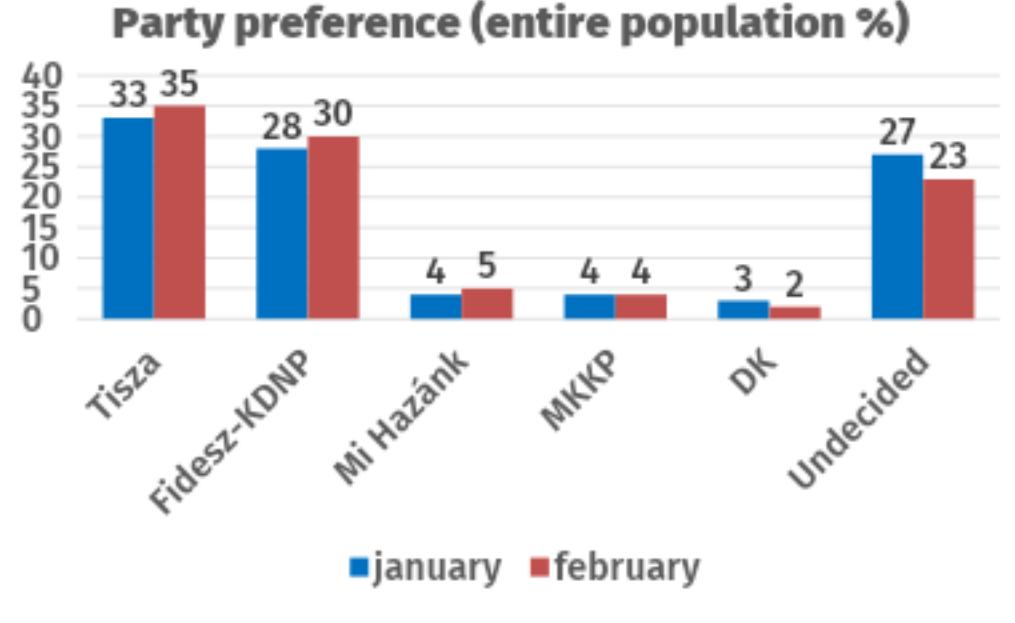
In a podcast episode produced by a Hungarian news outlet, Telex, journalists Gábor Török, Balázs Cseke, and András Mizsur discuss the status of the election campaign 46 days before the 2026 parliamentary elections. A recent poll by the think tank Medián shows the Tisza party’s popularity at 42%, consistent with findings from the Republikon Institute. While poll results vary, many indicate similar support for Magyar’s party, leading some to believe the elections favor Tisza. Prime Minister Viktor Orbán disagrees, stating such an outcome is unlikely, while others argue it is too early to make conclusions.
What Does All This Mean for the Polish-Hungarian Relationship?
The Polish-Hungarian relationship appears to be entering a transitional phase rather than a complete break. For nearly a decade, the two countries cooperated closely, united by the politics of Viktor Orbán and Jarosław Kaczyński. Following Poland’s political shift after the 2023 elections, this partnership has ultimately weakened. The future of their relationship will likely rely more on the evolving domestic politics of the respective countries, rather than on their historical ties.
The evolving dynamics between Poland and Hungary present a complex narrative. One potential scenario is that as Poland gradually reestablishes its standing within the EU, potentially resulting in drifting further away from Hungary. The Tusk administration’s emphasis on rebuilding trust with EU institutions and reinstating rule-of-law principles could steer Poland toward the EU’s political core, thereby strengthening its ties with established powers like Germany and France.
This trajectory risks leaving Hungary more isolated, especially if it persists with its confrontational stance against Brussels. Such a shift could diminish the political relevance of the Polish-Hungarian alliance. This scenario is especially likely if prime minister Viktor Orbán remains in power following the upcoming parliamentary elections in Hungary. However, the internal political landscape in Poland, particularly the significant influence of the Law and Justice party, complicates this transition. While the broader objective is to restore democratic norms, ongoing tensions may hinder a complete severance of ties with Hungary. This scenario might lead to more limited interactions, rather than an outright political divergence.
Should Hungary undergo a political transformation, perhaps with an opposition leader like Péter Magyar stepping into power, it could significantly alter its relationship with the EU. Such leadership could signal an intention to align more closely with European partners, reminiscent of Poland’s current balancing act within the Union. In the case of a win by the Tisza party, such a situation is quite likely, as Magyar’s candidate for foreign office, Anita Orbán, has particularly highlighted an incentive to restore the Hungarian-Polish relationship in her campaign.
In fact, Péter Magyar himself has also shared this sentiment in a negotiation with European leaders in Munich. In this new framework, rather than opposing Brussels, Hungary and Poland might collaborate more constructively, tackling regional challenges while engaging in broader EU discussions. This shift could reassure both nations as they address key concerns like economic development, security, and the interests of Central European states. Shifting from contention to cooperation could pave the way for a positive partnership grounded in mutual benefits.
This approach not only has the potential to strengthen the relationship between Poland and Hungary but could also influence the Visegrád Group (V4), which includes Poland, Hungary, the Czech Republic, and Slovakia. Given the upcoming elections in Hungary (2026), Poland (2027), and Slovakia (2027), the dynamics within the group could experience significant changes in the coming years.
In conclusion, the trajectory of Polish-Hungarian relations will likely pivot less on historical bonds and more on the domestic political climates shaping both countries. The alliance that once united Warsaw and Budapest thrived due to ideological commonalities and shared objectives within the EU. As these factors evolve, we may witness a reconfiguration of their relationship rather than a complete dissolution. The critical question remains: Will the two countries continue to drift apart, or can they forge a new foundation for collaboration? The answer may largely depend on Hungary’s political evolution in the aftermath of the 2026 elections.