




Facebook warriors, digital civic circles, and who knows what other groups will lead Fidesz’s campaign ahead of the 2026 elections. But why has the ruling party turned to these tools now, and what results can it expect from them?
“DPK”, “HK” and Their History
On May 8, Viktor Orbán and his fellow politicians held the first conference of their newly established Fight Club (“Harcosok Klubja” or HK). Party members, ministers, party sympathizers, and civilians all joined together for Fidesz’s first attempt not just to mobilize its voters, but to ignite them so much that the party truly has its own “digital warriors.” The speeches were all about the usual topics: war against peace, Brussels against Hungary, and the potential outcome of the 2026 election, which, if not won by Fidesz, would lead to chaos. After this, the Fight Club’s main platform became Facebook, but then it was quickly ruined by opposition voters and internet trolls.
The next attempt for a party community was the Digital Civic Circle (DPK). The announcement for this came in a truly honest way, Orbán said in his year-opening speech at Tusványos, that the Fight Club has failed and we need to make these civic circles because “not everyone is fit to fight.” A DPK circle can be established by anyone, for example, there are circles for fun, sport, economy, abused women, and even one with the name Zebra, referring to the animal that allegedly lives on the private property of Lőrinc Mészáros.
But Orbán and the Fidesz party are not really using a new recipe here. Back in 2002, after they lost the election, despite the polls giving a 6% lead to Fidesz, the party and its voters were shocked. Orbán’s next step was to ask their sympathizers to rise and form the first civic circles across the country. Back then, the right-wing political swing did not have much of a platform to voice their opinions and after the shock of the election, the voters desperately turned to the only way to establish their community. The civic circles opened a way to have party discussion and, at the same time, build and repair the Fidesz community. This method was then used by the left-wing parties too, with less success.
But why is Fidesz turning his twenty years old tactic to find voters outside of its bubble? We still see posters on the streets, advertisements on social media, and fear-mongering television shows on the government channels, but now Fidesz has a new way to establish a platform for the interested.
The question is, does this method work? Back then, before the appearance of social media, it was easier to reach out this way, by organising events and having face-to-face discussions. Now it is the other way around, people get more and more exposure to political content, but usually these contents only get our attention for a couple of seconds, at max a minute. But because of the number of hits that we get from these ads, memes, reels, TikTok videos, and tweets, we are constantly receiving shockwaves through our devices. In the 2000s, a civic circle meeting was not anything like this experience, but we certainly can’t size it down too.
Changes in Political Advertisement
October 2025 brought a change in the political advertisement of both Google and META platforms. The corporations decided to completely ban political ads, which will most likely have a major effect on Hungarian political campaigns, especially on the side of Fidesz. In August, Orbán spent more than 100 million forints on advertising on his Facebook page. The National Resistance Movement, which is a website created by Fidesz, spent nearly 120 million forints on AI-generated videos and government propaganda, while the official Fidesz Facebook page reached more than 22 million people through its advertisements.
Banning political ads from Facebook pulls the rug out from under Fidesz’s leg, considering it its biggest political media platform. However, they have already established a support circle, which now stands at 1.3 million followers on Orbán’s page (it is worth noting that the follower count can’t be directly converted to voters/sympathizers) and on the Fidesz page, 418 thousand followers. This ultimately means that there is still a large audience that the party can reach online; however, considering the amount of money spent on the ads, we must assume that this ban will harm their campaign.
Could the decision of META and Google have made an impact on making the digital civic circles come back to life? One day after META announced its new ban on ads, Orbán has ringed in the promise of establishing the fresh DPK. The HK, as a plan to revive a media platform for the Fidesz community, has officially failed by that point, and in light of this, Orbán’s plan with the DPK offered a healthy alternative. On their official website, they state that now more than 117000 users have joined the community. On September 20, they held the first assembly of the DPK community. A member of the National Assembly of Hungary, Balázs Orbán, has stated that 12 thousand people have attended the event.
By now, many private DPK pages have already taken their form on Facebook, but the main thing here is that all of these groups are private. The amount of ridicule and trolling that they were getting online left them no other choice but to close themselves off from the internet trolls. On the other hand, with the political advertisements, a good amount can still make it through the web of the algorithm, highlighting the problems of the new regulations.
How Does Fidesz Utilize These Online Communities?
The past elections differ from the upcoming ones in terms of what the Fidesz party aims to achieve with its voters. Mobilizing the public for elections has been and continues to be a key objective, but it is essential to examine what information the governing party disseminates to citizens through mass and social media. Having built the media empire the party has now, it can easily spread any kind of propaganda without any constitutional or international consequences, even though Fidesz violates not just the Hungarian media policy, but also the EU media regulations and the basic standard of the competition law. For these actions, we are yet to see how the European Parliament will react.
The fear and the hatred that Fidesz has planted into its followers will have a tremendous effect, not just on the upcoming elections, but on political polarization in Hungarian society, for at least the upcoming decades. These fears that they have installed in people, against the Ukrainians through the war, against politicians, and political groups, against social groups, will not change with a possible change of power. Viktor Orbán uses these online supporters not to engage with or persuade other voters, but to confront them. Moreover, these fights may seem ridiculous on the Internet, with users shouting at each other in caps lock, but as soon as we see a face-to-face example of how separated our society has become, we cannot bear to laugh at it anymore.
Videos on the Internet show how the different voter groups attack each other, meaning in the literal sense, and how distant they have gone from each other in the most basic questions regarding politics. On October 23, Orban said in his speech that it is time for them (Fidesz voters) to talk to other “deceived Hungarians”. This double narrative not only shows how the Fidesz party tries to reach out beyond their supporter circle, but also enlightens how changeable these couple of months are going to be, until the election.
Each month, a different propaganda scheme arrives in the country, and it is not so certain that Tisza and Magyar Péter can put out every “scandal bonfire” that Orbán ignites. And who else is better, for spreading the fire through the Internet, than the DPK members? Every meme, post, and comment adds to the systemic message delivery of the government party.
Radicalization Through The Internet
We are now standing at a point where a part of our society has become so radicalized about current political issues that a morbid two-party-like system has taken its form in the country. The clear and simple messages that spread to the Internet and our streets have reached a point where people start to create their own “propaganda”. The war in Ukraine was specifically used for these measures.
Fidesz symbolized themselves as the fighters for peace, and the opposition as the bloodthirsty enemies. This message reached every field; Orbán cannot deny that our country has to deal with serious problems (although for a long time this was his tactic), but he can blame it on other “outside” indicators.
The economy, the investments, and the welfare are all going down because of Brussels, Ukraine, and Magyar Péter, who, with his opposition politics, instantly becomes an outsider, working against the Hungarians. Communicate these narratives on the internet, and you have yourself a perfect populist campaign season. But it is important to mention that, although there is a group of supporters who view Orban as the sole and perfect leader, most of the Fidesz voters see and acknowledge the problems, but fear the possible changes and outcomes more than voting for a system change.
The Current Support Of Fidesz
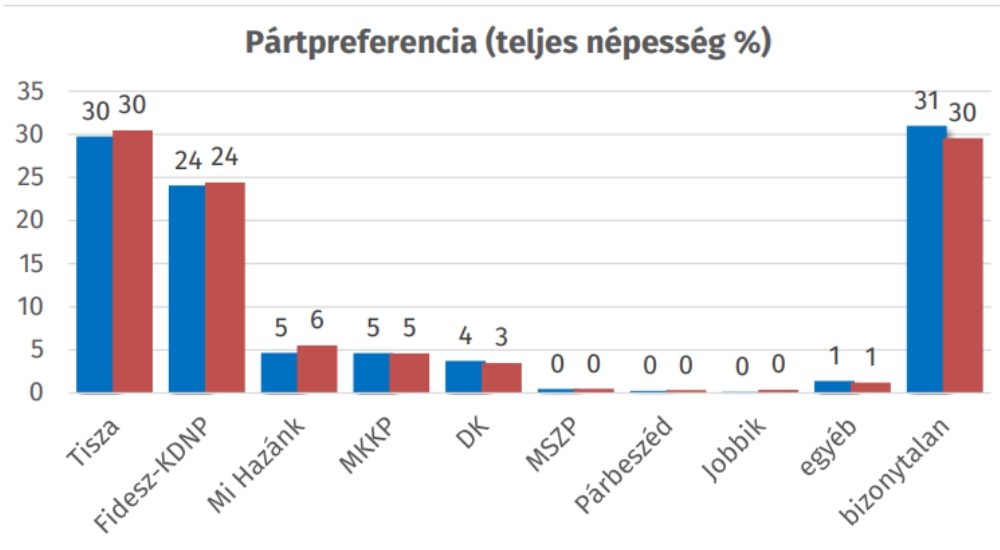
But the main question is whether all of this will work for the upcoming elections. Currently, the independent public opinion polls show that the Tisza party has a slight upper hand with the voters, but right now, so much is going on in the political sphere that these numbers can easily change, and only the Fidesz-supported institutions have the financial budget to conduct weekly research. And of course, this would not be the first example of polls to differ from the actual election results. Can Fidesz turn more people against a change with their fear-politics, and what percentage of the voters will the populist and no policy politics of the Tisza capture? These questions are yet to be determined.
References:
https://24.hu/belfold/2022/11/11/polgari-korok-tortenete-fidesz-orban-viktor-hende-csaba-pesti-imre/
https://republikon.hu/elemzesek,-kutatasok/251126_kvk-november-(1).aspx