





In a few days, Hungary will hold its parliamentary elections, one that many refer to as “the most important election” of the last two decades. It is true that a lot is at stake this April, and as opinion polls have shown consistently, this election will be a close one. The two front-runner parties, the long-time governing Fidesz-KDNP, and the newcomer Tisza Party, will surely have a great presence in Parliament, but aside from the far-right Our Homeland party, other opposition groups have either withdrawn or hope to pass the 5% entry threshold.
Growing support for the opposition points to a considerable chance for Tisza, suggesting that, for the first time in 16 years, there is a real possibility that the Fidesz-KDNP coalition will not be able to secure the votes needed for unhindered governance, or even a majority.
The saying that each vote counts stands truer than ever. The win is not set in stone, and Tisza – as other opposition parties before – faces numerous systematic disadvantages. One of the dark horses in question is the electoral system itself. As critics and experts have pointed out, the current system strongly favors the status quo, meaning that even if the two leading parties receive an equal share of the votes, Fidesz-KDNP could still secure more mandates in the end.
It is important to note that all electoral systems distort votes in some measure and usually support the current systems of power, but tampering with the electoral structure is not a new Fidesz tactic. From redrawing electoral boundaries and changing party-list requirements to extending voting rights to Hungarians living abroad, numerous changes have been made to the system, many of which helped secure a political upper hand before elections. The main difference in the current landscape is that Fidesz’s dominance is no longer a given; while previously these changes only solidified their win, this time around, it could settle who comes out the winner and the loser.
The Strategic Weight of Individual Mandates
This problem can be examined from various sides, but the one that weighs the most in the outcome of this election is the case of Single-Member Constituencies. Interestingly, they have not always been such a crucial focus of the electoral system, especially before 2011, when the voting conditions in Hungary looked vastly different.
The task of reshaping the electoral system was undertaken by the returning Fidesz government in 2011. Leveraging its two-thirds parliamentary majority, the party was able to pass any constitutional change without the need for cross-party cooperation, so much so that no other actor was involved in the reform’s creation. At the same time, the refinement of the voting system had long been considered overdue, largely due to the complexity and disproportionality of the previous set-up. One central outcome of these changes was the reversal of the relative importance of party-list mandates and Single-Member Districts (SMDs). Following the reduction of the National Assembly members from 386 to 199, the weight of a constituency mandate grew significantly as each Member of Parliament now represents a larger portion of the population. As a result, today a clear majority of 106 seats are decided in single-member constituencies, leaving only 93 to be filled by party lists and minority representatives.
Figure 1: The pie charts show the composition of mandates in the National Assembly before and after the 2011 electoral system change
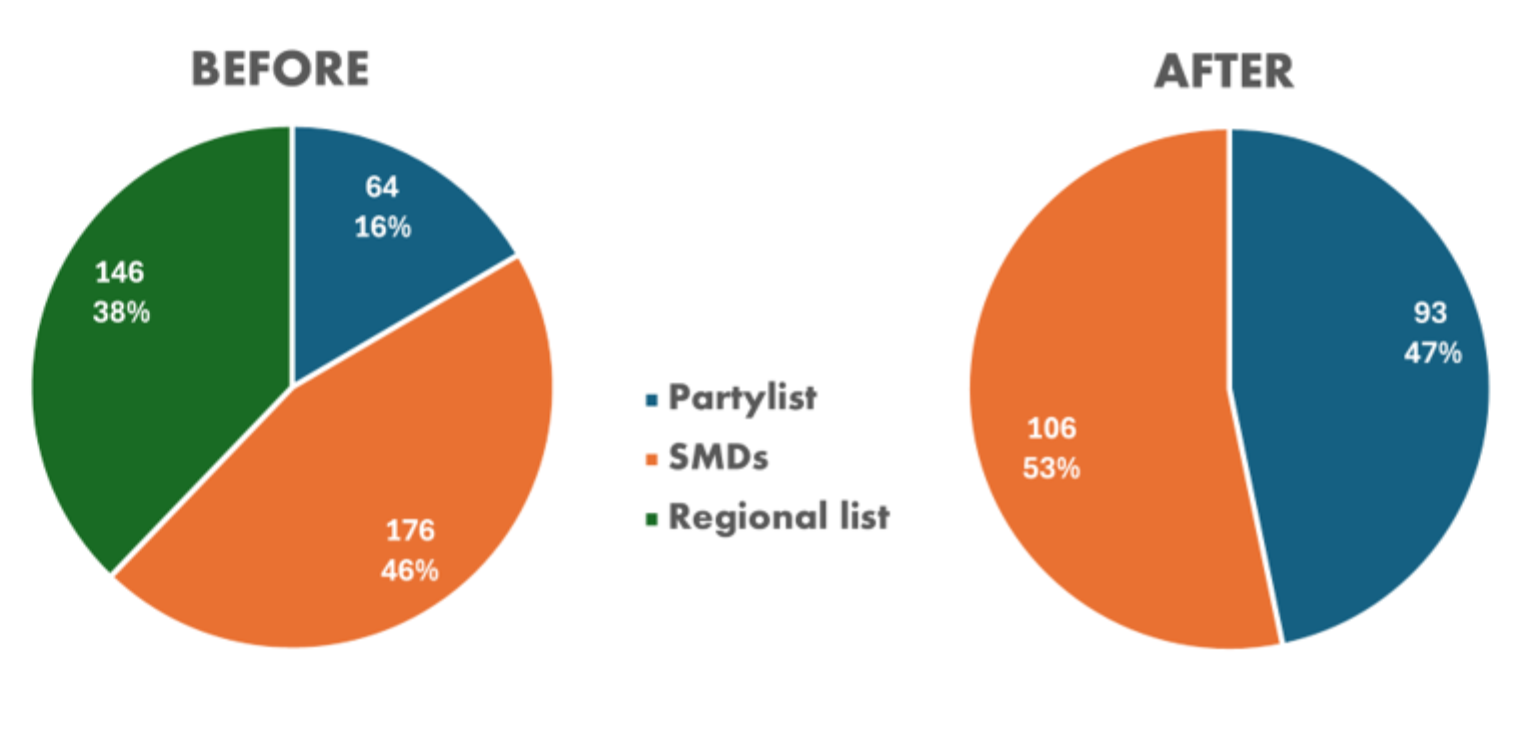
In the Hungarian parliamentary elections, each citizen usually possesses two votes: one for an individual representative and one for the national party list. However, the votes cast for the individual constituencies carry more influence in the grand scheme of the election; surplus votes from the winning candidate (the difference between the winner’s and the second-place candidate’s votes, minus one) and votes cast for the losing candidates (provided their party has reached the entry threshold) are transferred to the party lists. Thus, both the winner’s margin and the performance of losing candidates are of critical importance. Ultimately, the path to a parliamentary majority is paved through these local districts; without dominance in the single-member constituencies, a national victory is mathematically out of reach.
The Last Round of Changes
The most recent electoral reform was proposed and passed in December of 2024, only one and a half years before the upcoming April election. Many have raised their voices about its supposed gerrymandering essence, especially as the changes mainly impact the opposition-strong areas of the province and Budapest, and alterations show the use of the “crack and pack” technique in favor of the government.
The justification for the changes comes from an actually existing problem: the voting constituencies have been disproportionate since 1990, and changing demographics due to urbanization and rural decline have called for a more proportionate representation for a long time. This is hard to achieve, as in many cases, there is no ideal constituency number, only less disproportionality.
The “golden rule” for the creation of constituencies was proposed and enacted as part of the package of bills in 2011, which reshaped the characteristics of the whole electoral system. It states that the voting population of constituencies cannot differ by more than 20% from the national average to ensure that voting districts approximately represent the same number of people. According to the official database, there are more than 8 million eligible voters, but only 7.5 million possess the requirements to be able to vote for the SMD list.
According to this rule, the upper and lower limits are around 85,000 and 56,000 voters. While this 20% rule explains and justifies reducing Budapest’s voting districts and increasing the ones of Pest county by two, it simultaneously highlights an inconsistency. Why have depopulating counties – where votes now carry disproportionate weight – not faced similar restructuring?
A Complete Makeover of the Capital
Budapest is regarded as the ultimate opposition stronghold. In the 2022 parliamentary elections, non-government candidates won 19 individual seats, and 17 of those victories occurred within the capital alone. Only two opposition wins were secured in the rest of the country. No surprise that the opposition strongly counts on the mandates that they can score in the capital. With that said, even in Budapest, Fidesz candidates reached a high number of votes, scoring more than 40% in almost all districts, and losing only by a few thousand votes. With changes made to the boundaries of the voting districts, this number could be increased.
Under the 2024 bill, the political arena of Budapest has shrunk; the original 18 constituencies have been consolidated into just 16. To make this work, new boundaries had to be drawn in all cases. Whilst the old boundaries mostly followed the original district lines, some abrupt changes have been introduced. These new borders seem to utilize the “crack and pack” technique: non-favorable voters are “packed” into a few concentrated districts, while other opposition strongholds are “cracked” and distributed across multiple areas to spread out influence.
For instance, “cracking” can be examined in the concentration of opposition support within the 6th and 7th districts, which will now be split across three separate constituencies. The latter “pack” technique can be seen in the northern part of Budapest, where the former 11th SMD had a bigger measure of Tisza supporters, and now parts of it will belong to the former 12th SMD, which is an area with a smaller number of Tisza supporters. By cutting, adding, and rearranging these constituencies, more Fidesz favorable SMDs are created. According to public opinion polls, Tisza is still likely to win most/ or all Budapest constituencies but the performance of the candidates is still of utmost importance. The newly drawn boundaries might produce a higher number of Fidesz voter shares and smaller Tisza wins in a few constituencies, which will count towards the party lists.
The Countryside Decides
While the alterations in Budapest gathered the most attention, this election will not be won in the capital. Whether Tisza will be able to gain a majority, or the most optimistic prediction of two-thirds mandates, will heavily depend on the countryside. This is not an easy terrain for the opposition; since 2010, in each election the electoral map has become even more covered in the orange color of Fidesz.
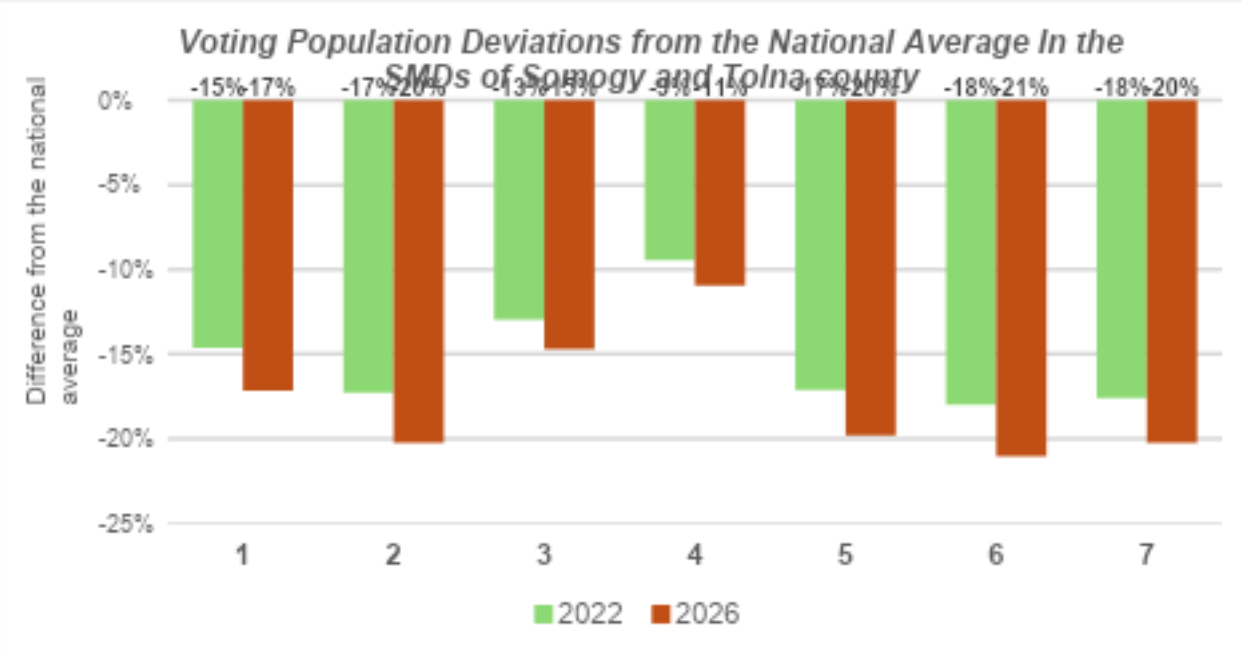
The changes – and the lack of changes – made in certain areas can hint at what the government believes to be its stronghold and show the challenges the opposition faces. This can be seen in the three electoral districts of Tolna, a county located in the southern part of Hungary, where support for Fidesz in 2022 was particularly high. Here, the number of voters barely reaches the minimum level, with an average of 56,000 voters per district, making their vote weight significantly greater than a vote in the capital. This disproportionality clearly makes alterations necessary in the region, and although not addressing the problem now may benefit Fidesz in the election, the solution is also not straightforward.
While the reduction of the number of constituencies from three to two could mean one less Fidesz mandate in the Parliament, it would also make the new constituencies with an average of 84,000 voters per district the most populous in the country. Tolna’s shrinking electorate – which has decreased by 6,000 voters since the last parliamentary election – might eventually mitigate this imbalance, yet the current situation highlights the limitations of strictly adhering to county boundaries. It is not uncommon for parliamentary constituencies to cross administrative or county lines when necessary for better population distribution, as can be seen in the UK or even in the segmentation of Budapest. Implementing this alternative model in Tolna and the surrounding counties could be the best solution in the long run for parity representation.
Altogether, 36 constituency borders have been redrawn across the country. As in Tolna, in the neighboring Somogy county the number of constituencies would need to be adjusted to meet the national average. Another notable example, resembling the above-mentioned “crack and pack” technique, is Csongrád-Csanád county: its provincial city of Szeged and its surroundings is one of the few areas where the opposition previously won a constituency outside of Budapest. This April, Szeged will now be condensed into a single district, and its agglomeration has been added to the other three voting districts.
Figure 2: The calculations were based on the official database of the National Election Office (2026). The numbers are indicative only
What We Do Not Know Yet
While many calculations on the territorial support of Tisza have been based on the results of the European Parliament election in 2024 – the first ballot where the party officially ran – the political landscape has not remained static since then. Public opinion has shifted, the pool of political actors has shrunk, and the nation is under a very intense political campaign leading up to the elections, some parts strengthening the opposition, others solidifying the government. Because of this, translating earlier electoral results directly onto the upcoming parliamentary election can only offer a partial picture of what may unfold.
What is certain, however, is that the institutional framework within which the election takes place will play a decisive role in shaping the outcome. Electoral systems are never neutral mechanisms; not surprisingly, it often becomes a tool for securing power. In a political environment where the margin between the leading parties is narrow, even relatively small structural advantages can translate into significant differences in parliamentary representation.
For this reason, examining the structure of the electoral system is not just a technical issue. It reveals how political competition is organized and highlights how rules and boundaries influence democratic outcomes long before a single vote is cast. Whether the upcoming election ultimately reinforces the current balance of power or awards a new political configuration, understanding the asymmetries of the electoral system can help design a more just and equal electoral reform – one that will be needed in the future.
Sources:
https://gerrymander.princeton.edu/info/
https://www.valaszonline.hu/2022/01/18/valasztasi-foldrajz-keruletek-lakossag-aranytalansag-elemzes/
https://telex.hu/valasztasi-foldrajz/2024/11/19/uj-orszaggyulesi-valasztokerulet-terkep
https://politicalcapital.hu/hireink.php?article_read=1&article_id=3469
https://vtr.valasztas.hu/ogy2022/valasztasi-informaciok/valasztopolgarok-szama
https://vtr.valasztas.hu/ogy2026/informaciok/valasztopolgarok-szama?tab=orszagosan