



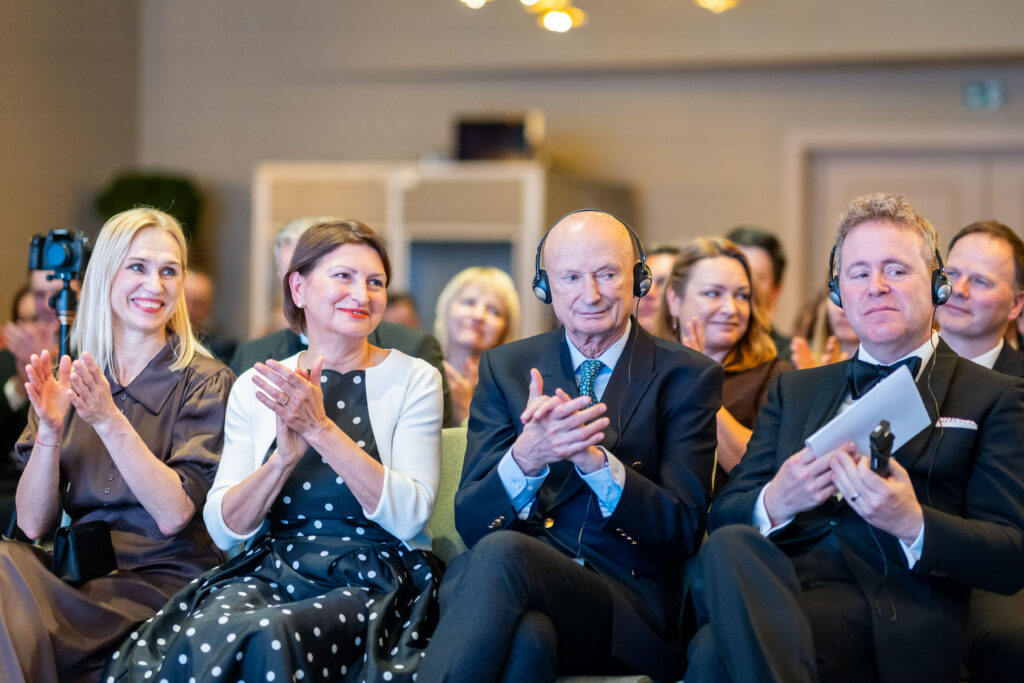
“When I was a child, the monarch of Liechtenstein told me: our duty is to protect people from power. If you have power, your first task is to limit the powers of the government, not to expand them.” Prince Michael of Liechtenstein said these words during a short visit to Lithuania.
The guest, who was invited as a guest speaker to the 35th anniversary of the Lithuanian Free Market Institute, came as a surprise to many: a mission of liberty, limited government, and responsibility, and here is a representative of a monarchy. And the Prince’s family’s position sounded almost paradoxical – the ruler’s duty, passed down from generation to generation, is to protect the people from the government and limit the power of the state.
The prince’s words struck a chord with European society, which is increasingly feeling this issue everywhere but rarely talks about it. Lithuania is not an exception, where the recent civil protests have publicly appeared to be a struggle over specific laws, personalities, or decisions of those in power. However, at their core lies a simple demand: that the government should not abuse the powers granted to it.
This is a longing for limited government, even if the words “limited government” do not appear on the posters. People no longer want to be treated like a herd that is “told what to do from above” and “explained to after the fact”. They want decisions to be made together with them and not to be obviously short-sighted. They want the government to adhere not only to the rule of the law, but also to its spirit.
The idea of limited government is not our “invention”. It is the backbone of Western civilization and political tradition, dating back to the Magna Carta: government must be limited by law, not chopping off people’s heads and taking away their property whenever it feels like it. This idea is consistently developed in classical political thought: Charles de Montesquieu and James Madison emphasized that government must be organized in such a way that it limits itself, rather than expanding its powers without restraint. Our country’s Constitution adopts this tradition, clearly stating: “The powers of government are limited by the Constitution. Government institutions serve the people,” and sovereignty belongs to the people. The country’s fundamental law enshrines the separation of powers, human rights and freedoms, and the principles of self-government.
However, it is easy to lose sight of the spirit of the Constitution in everyday life, as liberty and responsibility are increasingly separated: liberty is understood as an unlimited right to demand and consume, and responsibility as a burden that should be borne by “others” – business, the tax-funded budget, or the European Union. Modern states are sinking ever deeper into an insidious pact: give more power to the government, and we will protect you from life’s crises, risks, and mistakes.
Such “security” comes at a price: government powers are always expanded at the expense of human liberties. The principle of limited government comes not as a nice theory, but as a safeguard: a reminder that the state is a servant of its citizens, not the manager of their destinies.
In the coming years, the idea of limited government will inevitably become a key issue in European as well as Lithuanian politics. A government that promises everything to everyone – free of charge and without limits – is no longer appealing but rather raises suspicion. A government that promises people what it cannot and should not give to them leaves them with no responsibility. And without responsibility, as we know, there is no liberty.
And here, it is not only the limits set by law that are important, but also the attitude of those in power: a spirit of humbleness, service, and respect.
Expecting the criticism from the left, I need to disclaim: limited government is not “weak government” and is certainly not a recipe for chaos. It does not leave those who cannot take care of themselves to the mercy of fate. It is a fundamental principle that the state has clear, transparently defined functions, while everything else is left to the people, communities, and businesses. It means the rule of law, long-term rules, respect for property, a predictable environment, and the fact that citizens are not seen as petitioners or wards, but as sovereigns. For a small state, this is a condition for survival.
Limited government is also inseparable from subsidiarity: decisions should be made as close to the people as possible. The more local government, communities, and professional associations can decide, the less room there is for central government. However, we have inherited a peculiar form of “reverse subsidiarity” from the Soviet imperialist era, where local governments and communities were “handed down from above”, rather than the other way around, where people delegate “upwards” what they are unable to deal with themselves.
The opposite of limited government and governance is bureaucracy. Bureaucrats are not necessarily “bad people”. They are often polite, rule-abiding professionals and civil servants. However, the system in which they work has a strong inertia to expand. It constantly generates new procedures, report forms, and requirements. The government likes to say that this is for consumer protection, crime prevention, transparency, and stability. The only problem is that gradually everyone becomes slaves to incomprehensible and inexplicable norms. People and capital who disagree with this choose other jurisdictions, such as Liechtenstein.
So Liechtenstein’s lesson is crucial for modern states, and especially for small countries. As Prince Michael said, a small country needs two things: gold and gunpowder. Gold is not ore from the mountains, but people who are creative, patriotic, enterprising, and able to achieve a level of prosperity comparable to that of Western countries. It is an open economy, with respect for property and stable rules that do not change every four years.
Our gunpowder is not just in army warehouses and the defense budget. The people are determined to defend the state and their ability to ensure the country’s security through their ingenuity and cooperation. To prevent our gold and gunpowder from being scattered, the principle of limited government is essential.
It means not only the limits set by the Constitution and the law, but also the spirit of those in power: not to revel in the power they have been given, to maintain a humble and gentle attitude of service, not to throw words around – since at the top of Olympus they have different powers. In other words, to limit oneself in every way, to strive for moderation and restraint – as long as we are free people and not a powerless crowd that worships tyrants.
Continue exploring:
No, Money Is Not Public Good. Full Stop.
Tomio Okamura Wants to Destroy Czech Sovereignty and Economy