





Across Europe, cities are trying to reduce their dependence on cars. Paris has removed traffic lanes along the Seine. Barcelona has redesigned entire neighborhoods around pedestrian “superblocks.” Even traditionally car-oriented capitals, such as Madrid and Brussels, are rethinking urban mobility in favor of public transport, cycling, and walking. Budapest appears to be moving in the opposite direction. Congestion has become a routine part of daily life in the Hungarian capital, particularly on the roads connecting the city to its suburbs.
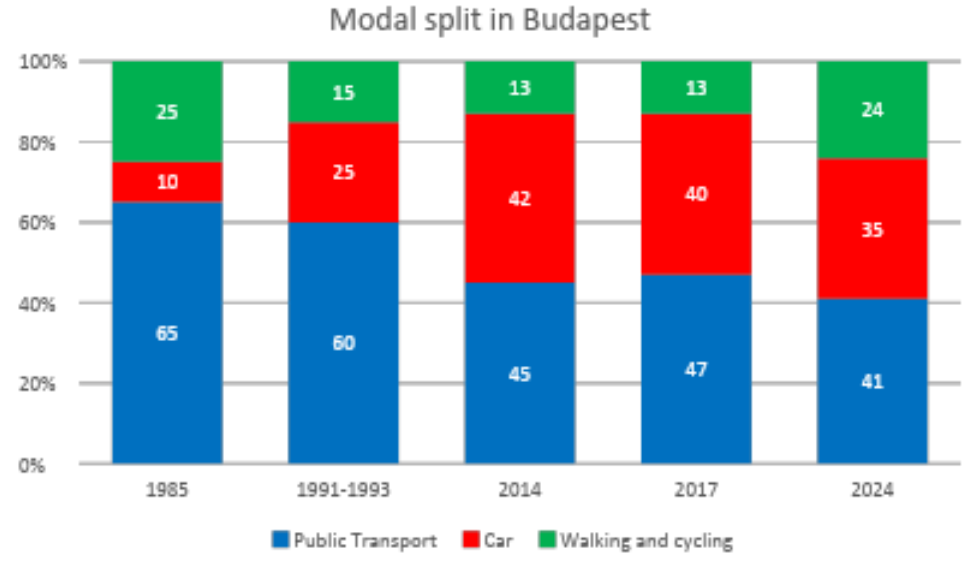
Yet, Budapest remains one of the most transit-oriented large cities in Europe, meaning that much of its urban structure and mobility patterns are organized around public transport, with dense development and daily activities concentrated along major transit corridors. Its metro lines, trams, buses, and suburban railways carry millions of passengers every day, and public transport still accounts for roughly half of all trips within the city. The paradox is clear: a city with an exceptionally strong public transport system is nevertheless heavily dependent on cars.
The usual explanation is policy failure. Rising traffic is attributed to weak political commitment to public transport, insufficient investment, or a lack of restrictions on cars. But Budapest’s experience suggests a deeper story. The city’s growing car use cannot be explained simply by transport policy choices made in the past decade. Instead, it reflects institutional structures created across several historical periods.
Centralized planning during socialism shaped the physical structure of the city. The democratic transition of 1988-1990 triggered suburbanization and rapid motorization. The governance system that emerged after the transition has made it difficult to coordinate transport and land-use planning at the metropolitan level. What appears to be a transport problem is in fact the result of institutional design.
The Socialist Foundations of Budapest’s Transport System
To understand why Budapest became such a transit-oriented city in the first place, it is necessary to look at the late socialist period. During the 1960s and 1970s the Hungarian state pursued an ambitious program of transport modernization designed to support a growing industrial capital. The centerpiece of this strategy was the expansion of the metro system. Budapest’s second metro line opened in 1970, followed by the third in 1976, creating the backbone of the modern network.
These projects dramatically increased the capacity and speed of urban travel and reinforced the central role of public transport in everyday mobility. At the same time road infrastructure expanded. Major junctions and overpasses were constructed to move traffic through the city’s busiest nodes. Expressways cut through the fabric of the city in the name of efficiency. Projects such as the Baross tér overpass in 1969 and the Nyugati tér flyover in 1981 reflected the planning logic of the era: maximizing traffic throughput at key intersections.
These infrastructure decisions were made within a highly centralized planning system. National ministries and technical planning institutes controlled major investments, while local governments had little influence and public participation was minimal. Transport planning was closely linked to the priorities of the socialist economy. Budapest functioned as the administrative and industrial center of the country, drawing large numbers of workers from across the metropolitan region. Infrastructure was, therefore, designed to move large volumes of passengers efficiently into the city.
The result was one of the most transit-oriented urban mobility systems in Europe. Around 1980 roughly 80 percent of motorized trips in Budapest were made by public transport, an exceptionally high share by international standards. Private car ownership remained limited because vehicle supply was tightly controlled and waiting lists were long. In effect, the institutional structure of the socialist economy produced a city where collective transport dominated everyday mobility.
Figure 1. Modal split in Budapest, selected years.
Suburbanization After 1990
The decisive transformation began after 1990. Housing markets were liberalized and private construction expanded rapidly. For the first time in decades households could freely choose where to live. Many families moved from Budapest to surrounding towns where housing was cheaper and large family homes were available. Population statistics illustrate the shift clearly. Budapest’s population fell from around two million in 1990 to roughly 1.7–1.8 million today, while the metropolitan region continued to grow and now contains around 1 million in the immediate vicinity and more than 2.5 million residents in total, spread across dozens of municipalities. In other words, the metropolitan area expanded even as the city itself shrank.
This demographic shift fundamentally reshaped travel patterns. Budapest remained Hungary’s dominant economic center, concentrating government institutions, universities, hospitals, and most high-value service-sector jobs. Workers increasingly lived outside the capital but continued to commute into it. Public transport still carries millions of passengers. Before the COVID-19 pandemic the system handled close to four million trips per day, and even today daily ridership remains around three million. Yet, suburban expansion produced a much more dispersed metropolitan geography. New residential developments often appeared far from rail lines, while employment spread to industrial parks and logistics zones outside traditional transit corridors. These trips are difficult to serve with transport systems designed around radial travel toward the city center. As a result, the car became an increasingly attractive option.
Motorization accelerated rapidly during the same period. During socialism private cars had been scarce, but after the transition imports of used vehicles from Western Europe dramatically increased availability. Passenger car numbers in Budapest rose from roughly half a million in the early 1990s to more than 700,000 today. The interaction between suburbanization and motorization created a self-reinforcing dynamic. Living outside the city made car ownership more attractive, while owning a car made suburban living feasible.
At the same time, the noise and air pollution caused by excess traffic had a negative impact on the quality of life inside the city. Budapest gradually became a metropolitan region where the urban core remained strongly transit-oriented but the surrounding landscape relied increasingly on automobiles. Car ownership also carried significant social meaning in the post-socialist context, functioning not only as a mode of transport but also as a symbol of personal freedom and socio-economic status, often acquired beyond immediate mobility needs.
Fragmented Metropolitan Governance
Suburbanization alone, however, does not explain why the metropolitan transport system struggled to adapt. The deeper problem lies in Hungary’s institutional structure. The municipal system created during the democratic transition deliberately decentralized political authority. Nearly every settlement became an autonomous municipality with its own elected government. After decades of centralized socialist rule, strong local self-government was seen as a cornerstone of democracy. Yet, the system produced an extremely fragmented, thus administrative landscape. Hungary now has more than three thousand municipalities, many of them very small, each with authority over local development decisions.
Budapest itself reflects this fragmentation. The capital is divided into twenty-three districts, each with its own mayor and council and substantial control over local planning decisions. The city council is not necessarily above the districts, so decision making often becomes difficult. Beyond the city lie more than eighty municipalities that form part of the metropolitan economy. Hundreds of thousands of residents commute daily to Budapest; yet, these settlements remain institutionally separate from the city government. The metropolitan region functions as a single labor market but is governed by dozens of separate political authorities.
This institutional mismatch has clear consequences. A suburban municipality may approve large housing developments because they bring new residents and tax revenue, but many of those residents will commute to Budapest, adding pressure to regional transport networks outside the municipality’s jurisdiction. The roads that these commuters might use, are primarily used by suburbanites; yet, they are maintained by the city. Land-use decisions and transport consequences are therefore often separated institutionally.
Centralization and the Limits of Local Transport Policy
In recent years another institutional shift has complicated the situation further. Since the early 2010s the Hungarian state led by the right-wing populist FIDESZ party has increasingly centralized decision-making. Several public services previously managed by municipalities have been transferred to state administration, and local governments have lost significant financial autonomy. Transport policy illustrates the tension. Budapest’s own mobility strategy emphasizes improved suburban rail integration and stronger public transport networks.
Yet, many of the decisions that determine whether those goals can be achieved are taken at the national level. Infrastructure investment has heavily prioritized motorway construction, expanding the expressway network that connects regional towns to the capital and making long-distance commuting easier.
Rail investment has been more uneven. Hungary still has an extensive railway network, much of which requires modernization. Institutional decisions have also removed parts of the metropolitan transport system from local control. The suburban HÉV commuter railway network was transferred from the city’s transport company to the state railway operator MÁV in 2016. At the same time Budapest is required to transfer substantial revenues to the central government through the so-called “solidarity contribution,” a national fiscal transfer imposed on wealthier municipalities and widely regarded as a political tool that disproportionately burdens opposition-led local governments, with limited transparency regarding the use of the collected revenues.
The city’s financial situation is not helped by the fact that the types of taxes Budapest can collect has decreased substantially since the regime change. This depletes the resources available for transport investment, or even basic infrastructure maintenance. The result is a system in which the city bears the consequences of mobility decisions but does not control many of the policies that shape them.
Institutions Shape Mobility
Budapest’s growing traffic is therefore not simply a story about transport policy. It is the product of institutional change. Centralized planning during socialism produced a transit-oriented city. The democratic transition then triggered suburban expansion and rapid motorization. Fragmented metropolitan governance limited coordinated planning, while later political centralization moved key decisions to the national level. Together these institutional forces reshaped how the metropolitan region functions.
Budapest still relies heavily on public transport, far more than most cities of comparable size. But the broader institutional framework increasingly favors car-based mobility. Urban transport systems do not evolve in isolation. They reflect how cities are governed. Budapest shows how institutional structures can gradually push even a transit-rich city toward greater dependence on automobiles.
Written by Ármin Farkas – an intern at the Republikon Institute, attending the Philosophy, Politics, and Economics BA program at Budapest Corvinus University