





In 2020, Budapest was the only region in the European Union where citizens felt more attached to Europe as a whole than to their own region or country[1]. This is a common phenomenon across much of what is now post-communist Europe. In the past decade, EU member states with a communist past have shown rates of attachment to the Union that have been up to 15% higher than in those of countries without such a background.
One might expect this stronger European identity to translate into greater support for European Federalism in these areas. However, data from the past ten years show the opposite. While the gap is closing fast, and EU-wide levels are still growing, support for more decision-making at the EU level has grown more slowly in these countries, remaining consistently 2 to 4% below that of non-post-communist member states.
Why does this contrast between identity and choice of governance exist? Is it merely because of cultural differences, or does the answer lie in a deeper historical and societal experience of authority in Eastern European nations, where European belonging coexists with a persistent sensitivity towards centralized political powers? Moreover, why is this chasm disappearing? And what can federalists learn from the views of Eastern Europeans?
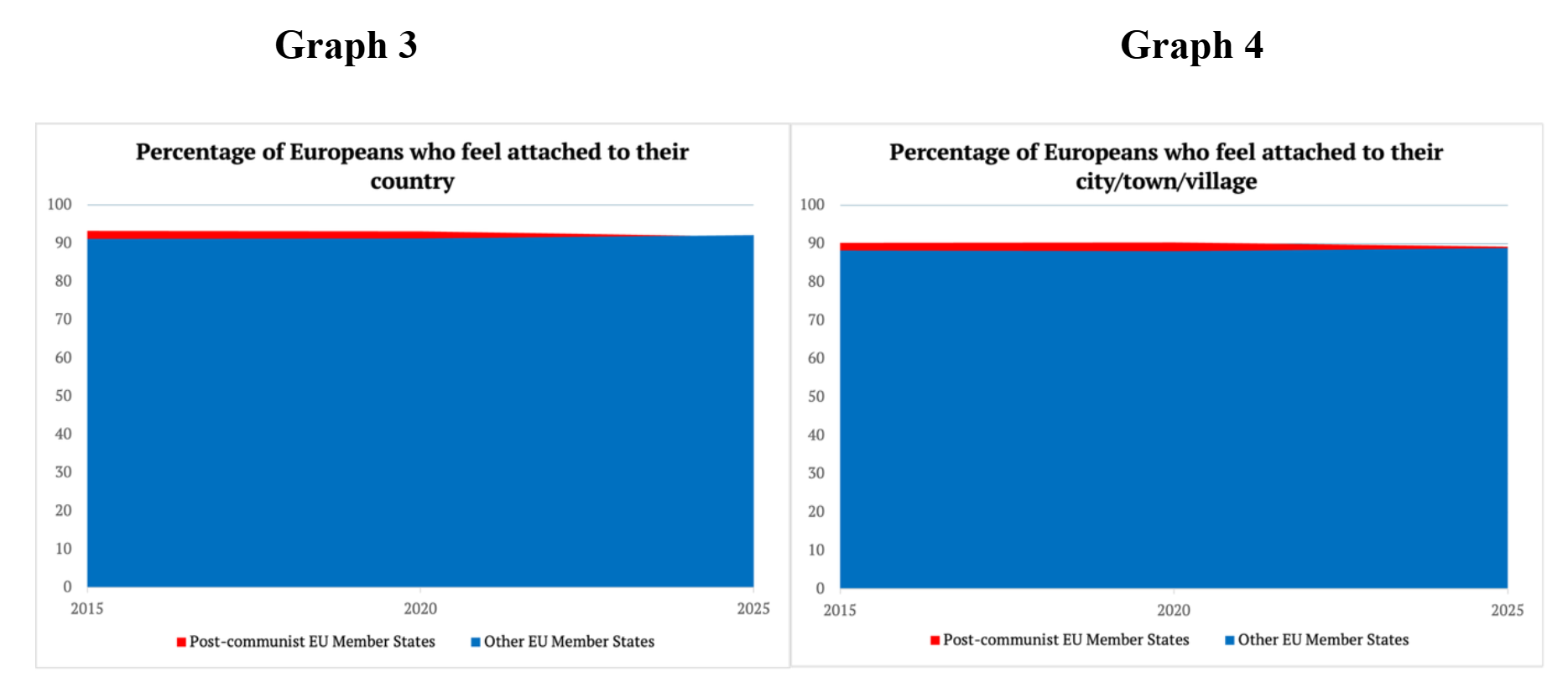
Eurobarometer has been measuring the levels of attachment of European citizens to their own settlements, their countries, the EU, and Europe as a continent. The gap between Eastern and Western Europe has been clear. Eastern Europeans feel more attached both to the EU and to Europe. One might suspect this to simply reflect higher overall levels of patriotism. However, the difference in levels of attachment to individual regions and nations has been consistently within 2% between the two blocs, with the gap dropping to 0% in the autumn of 2025. (See: Graphs 1-4)
We get a clearer image when attachment to Europe as a concept is separated from the attachment to the European Union as an institution. Attachment to the continent, meaning its culture and broader civilizational community, has been higher in post-communist states throughout the decade; a 3-point lead in 2015, peaking at 5 points in 2020, and narrowing to just 1 point in 2025, all while overall EU-Wide levels continue to grow. (See: Graph 1)
Attachment rates to the EU as an institution tell a story of an even larger difference. In 2015, post-communist Member States showed a 15-point lead in EU attachment (58% to 43%). By 2020, this had narrowed to 9 points, and by autumn of 2025, to just 4 points (63% versus 59%). Despite our initial beliefs, it is not post-communist citizens who have become less attached to the EU. Instead, Western Europeans have caught up, with support levels increasing at a faster rate. (See: Graph 2)
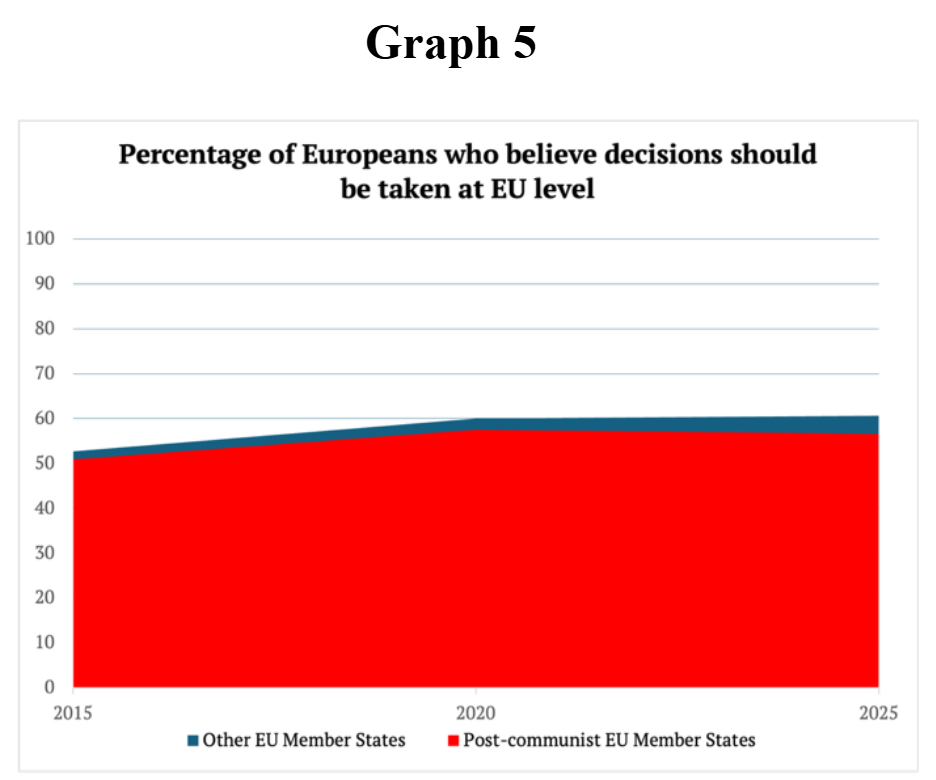
The puzzle is completed by a third dataset: support for more decision-making to happen at the EU level. Here, post-communist states consistently trail slightly behind. The gap was 2 percentage points in both 2015 and 2020, and widened to 4 points by 2025, even as overall EU-wide support for centralized EU governance grew, rising from roughly 53% to 61% in non-post-communist states, while post-communist support grew more slowly and plateaued at around 57% (See: Graph 5)
Taken together, the data paint a coherent, though counterintuitive picture; citizens of post-communist Member States feel more European, are more attached to the EU as a symbol, and yet are more cautious in handing power over to it.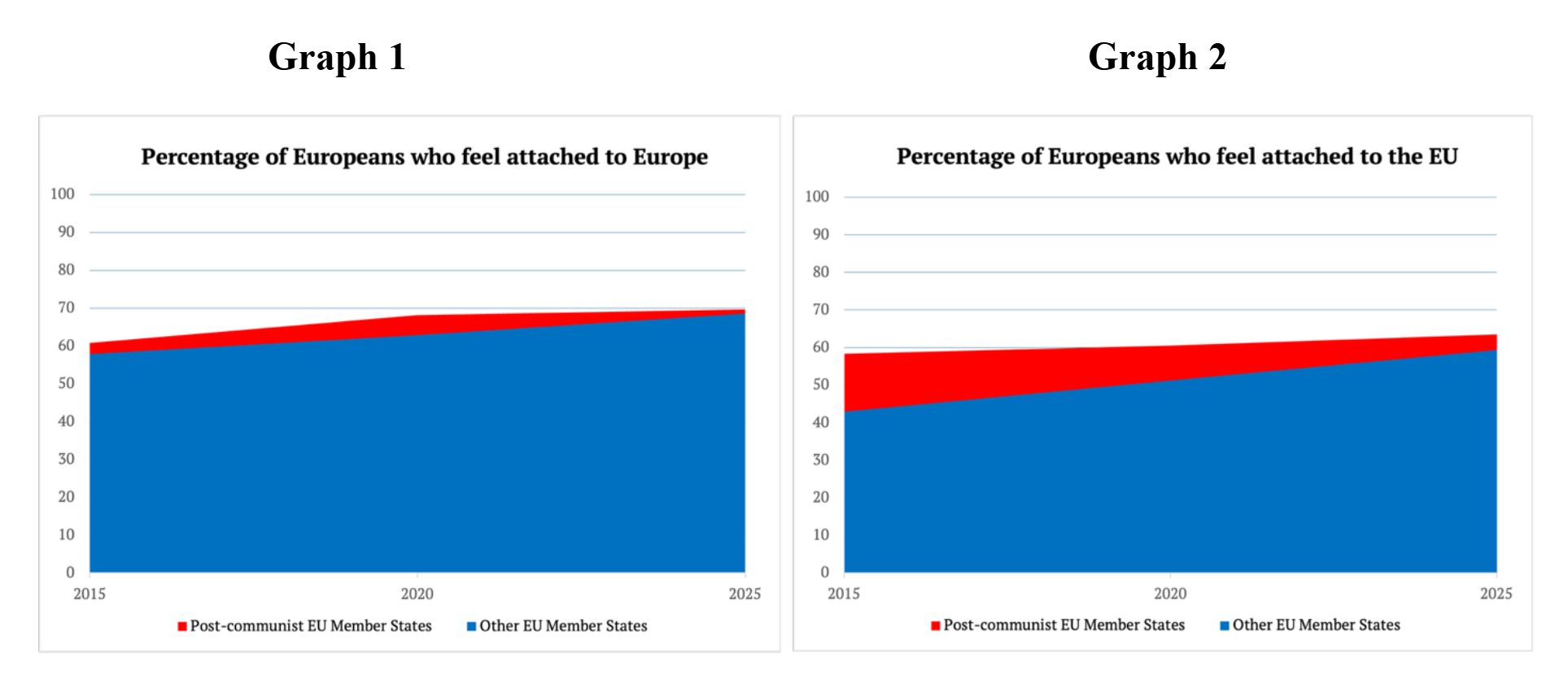
Sources: European Commission (2025, December) Standard Eurobarometer 104 – Autumn 2025. europa.eu. https://europa.eu/eurobarometer/surveys/detail/3378
European Commission (2020, October) Standard Eurobarometer 93 – Summer 2020. europa.eu. https://europa.eu/eurobarometer/surveys/detail/2262
European Commission (2015, December) Standard Eurobarometer 84 – Autumn 2015. europa.eu. https://europa.eu/eurobarometer/surveys/detail/2098
Europe as Liberation
To understand why European identity runs deeper in the post-communist East, one must understand what “Europe” meant to societies that lived under the Iron Curtain. It was not merely a geographic area, but rather the name of liberation.
The clearest illustration presents it as a picnic. In 1989, at the brink of the collapse of the Soviet Union, a peace demonstration was held at the long-sealed border crossing near Sopron, Hungary. The idea of opening the border at a ceremony and testing the Soviet Union’s limits came from Ferenc Mészáros of the Hungarian Democratic Forum and Otto von Habsburg, the president of the International Paneuropean Union, who famously opened a symbolic empty chair in the European Parliament dedicated to the states behind the Iron Curtain, presenting their absence.
With the support of the then Hungarian Prime Minister, an invitation to the picnic was issued to demonstrate the opening of the borders and the reunification of Europe. The news of the symbolic opening of the border spread like wildfire among many citizens of the German Democratic Republic, who were waiting in Hungary for a chance to flee to the West. In a historic decision, the local commander of the border post at the time forbade the use of weapons, granting a way for the test that showed how far one could go in opening borders. A good two weeks after the picnic, it became clear that the border would be opened completely. For various actors, this very event, dubbed the Pan-European Picnic, was considered the event that knocked the first stone out of the Berlin Wall[2].
What the picnic captures is that “Europe” in the East was not an abstraction. It was rather a direction; literally West, towards freedom. Significant sections of the population in these former Eastern Bloc countries still see the EU as a symbol of belonging to Europe and the realization of the political aspirations of the Cold War. When Eurobarometer surveys record that Eastern Europeans feel more attached to Europe and the EU, part of it is this historical sediment being measured.
This also explains a crucial asymmetry in how the East and West relate emotionally to European integration. The decades following the end of the Second World War are remembered in the West as a time of postwar recovery, modernization, and growing prosperity, not least due to the creation of the common market in 1957. The CEE countries do not share this memory, since during the same period, they were bereft of their sovereignty, ruled by authoritarian regimes, and struggling with an economy of shortages.
For Western Europeans, European integration is fundamentally a peace project, a structure built to prevent repetitions of the world wars. For Eastern Europeans, it is a liberation project, the institutional completion of 1989. When citizens in Warsaw or Budapest declare themselves European, they are making a statement that carries a different historical weight than when the same word is used in Paris or Amsterdam.
The Sovereignty Reflex
If European identity is so strong in the post-communist East, why does support for EU-level decision-making consistently lag behind? The answer lies not in hostility towards Europe, but in a historically ingrained wariness of what happens when political power is exercised from above and from afar.
The semi-recent memory of anti-communist resistance has allowed for a populist, “anti-imperialist” Euroskeptic narrative to emerge and resonate in Central Europe, emphasizing national sovereignty and resistance against powerful neighbors and supranational authorities. For generations, the experience of external authority meant Moscow: edicts that arrived without democratic input, economic systems imposed without consent, political choices made in a capital that was not their own. The structural feel of a supranational body overriding national democratic decisions is, for these societies, culturally familiar and familiarly uncomfortable. This instinct does not need to be ideologically formulated to be politically powerful.
Since historical experience has shown how vulnerable sovereignty can be in CEE, the traditionalist, nation-centered approach to the past became firmly rooted in the region and never lost its appeal among the majority of the population. Crucially, this does not mean that nationalism and pro-European sentiment are in tension here. In Central and Eastern Europe, unlike in Western Germany, nationalism and liberalism are likely to be seen as mutually supporting rather than clashing ideas, because it was national self-determination, the right to choose one’s own path, that the anti-communist revolutions were fought for. In the worldview of citizens, supporting Europe and defending national sovereignty are not opposites, unlike their leaders might portray it for political profit.
A second, structural mechanism reinforces this. The EU accession process carried a specific dynamic that left its own residue. Ivan Krastev and Stephen Holmes have argued that for countries emerging from communism, the post-1989 imperative to “be like the West” generated discontent, rooted in rebellion at the humiliations that accompany a project requiring acknowledgment of a foreign culture as superior to one’s own[3].
A Different Federalism
The contradiction in the data is real, but it is worth examining whether it is actually a paradox. The assumption behind treating it as one is that “federalism” and “EU-level decision-making” are synonymous. They are not, and the post-communist East may be pointing that distinction out more clearly than it is given credit for.
A classical tradition of federalist thought has always been concerned primarily with distributing sovereignty, not concentrating it. Althusius established a theory of federalism where power is shared among autonomous, smaller and larger political communities, building a federal political system out of political associations grounded in the free initiative of citizens. In his model, power and rights belong to the constituent bodies of the federation, not to the constituted body. This is federalism defined from the bottom up. These associations are also ethical imperatives, each retaining autonomy while delegating specific competencies upward through voluntary treaties, ensuring that sovereignty resides in the collective rather than a distant apex[4].
This tradition did not disappear when the EU was built. It was formalized in the principle of subsidiarity, embedded in the Maastricht Treaty and all EU treaties since. The principle holds that decisions should be made at the lowest level of government capable of handling them effectively, with higher levels intervening only where lower ones cannot act adequately. In a genuine federal structure operating on this principle, one recognizes a federation by the vertical separation of powers, leading to shared sovereignty between member states and a federal body.
This is the very structure that is closest represented practically by the Swiss Federation. Thus, it is increasingly intuitive that many scholars of European Federalism call for a Swiss model of federation.
What post-communist citizens have been consistently signaling in Eurobarometer surveys is not opposition to a European federation. It is skepticism about a specific trajectory of integration, one that moves power upward without the corresponding downward accountability that a genuinely federal structure would require. That is a legitimate intra-federalist position. The Althusian tradition did not produce a vision of a powerful center with subsidiarity as a concession to the periphery. It produced a vision of a center whose authority is derived from and constrained by its constituent communities.
Federalists would do well to take this seriously on its own terms rather than treating it as a softer version of euroscepticism to be eventually overcome. The post-communist East is not saying “no federation.” It is asking: in which direction is power flowing? That question is as old as federalist thought itself, and the data suggests it is the right one to keep asking.
It must be said plainly: nothing in these surveys tells us that Eastern Europeans support federalism of any kind, Althusian or otherwise. The data shows what they feel and what they are cautious about. What it does not show is what they want built instead. The argument that their caution reflects a specifically federalist intuition, one concerned with the direction of power rather than its existence, is a reading of the data, not a conclusion from it. It may be a plausible one, grounded in the historical experience outlined above, but it remains speculative.
What the data does establish is that emotional belonging and political consent are not the same thing, and that the EU has been more successful at generating the former than the latter, particularly in the East. That distinction may not survive much longer as a measurable phenomenon. As the generation with direct memory of communism recedes, so does the instinct it produced, and the surveys suggest this is already happening. The window to take this particular form of caution seriously, on its own historical terms, before it becomes a generational footnote, is narrowing. Eastern European hesitation has earned the right to be treated as a considered position rather than a problem to be waited out. Whether federalists choose to engage with it before it disappears is, at this point, up to them.
[1] Charron, N., Lapuente, V., Bauhr, M., & Annoni, P. (2022) Change and Continuity in Quality of Government: Investigaciones Regionales – Journal of Regional Research, 53, 5–23. https://doi.org/10.38191/iirr-jorr.22.008
[2] Wikipedia contributors. (2026, February 14) Pan-European picnic. Wikipedia. https://en.wikipedia.org/wiki/Pan-European_Picnic
[3] Kallmer, B. (2025, December 23) Explaining Eastern Europe: Imitation and its discontents | Journal of Democracy. Journal of Democracy. https://www.journalofdemocracy.org/articles/explaining-eastern-europe-imitation-and-its-discontents-2/
[4] Althusius and the Federal Commonwealth | Online Library of Liberty. (n.d.). https://oll.libertyfund.org/pages/althusius-and-the-federal-commonwealth
Written by Simon Csató – Intern at the Republikon Institute