




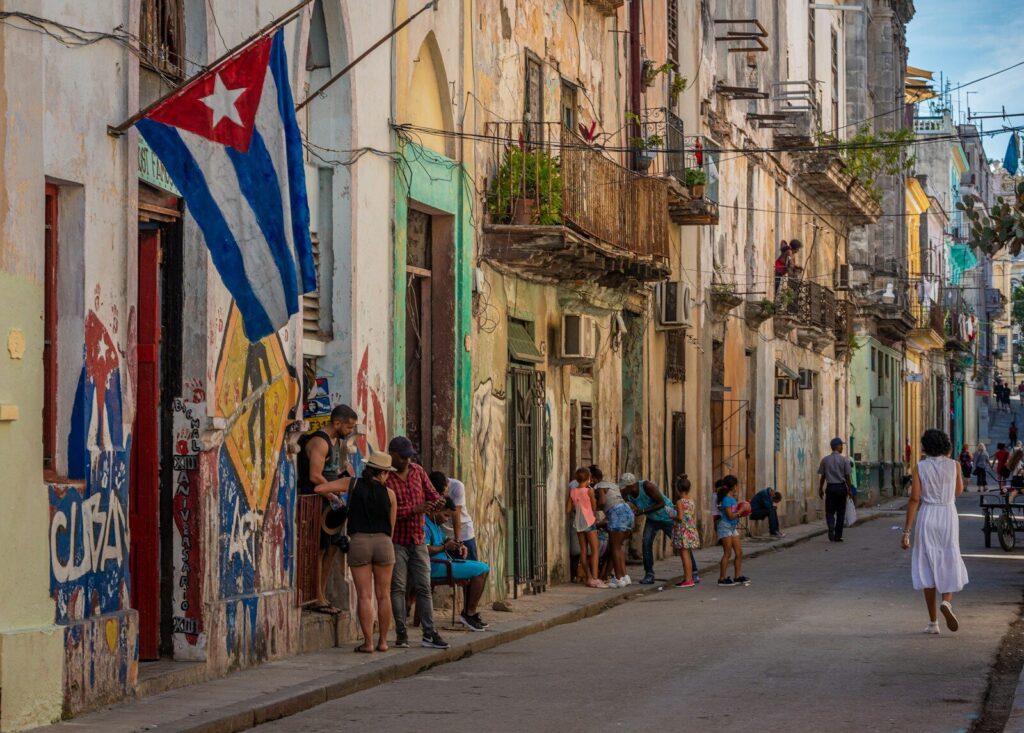
By the end of May, the banners of May Day are usually gone. But in Cuba, the holiday lingers as a political smell: flags come down, but rubbish remains.
For most people across the world, May Day is simply a spring holiday — a day off, a chance to plant roses, clean the greenhouse or visit family. Few, while doing so, think of International Workers’ Day, born out of nineteenth-century labor struggles and later seized by communist regimes as one of their grandest rituals.
What began as a demand for dignity at work was transformed under communism into a theatre of loyalty. The worker was glorified in speeches, posters and parades — and gradually stripped of dignity in real life. Labor was praised, but its meaning was hollowed out.
In the Soviet Union, May Day became a compulsory pageant. Working people marched in neat columns past a tribune, from which party chiefs waved down at them. A week before these celebrations, Lenin’s birthday was marked by so-called “people’s subbotniks” — mandatory communist clean-up days dressed up as voluntary labor. Everyone worked without pay, fulfilling the plan and exceeding the plan, sweeping streets and clearing forests. At lunchtime, food and drink were shared in comradely fashion, and communist morality quietly surrendered to human nature.
And despite decades of argument, Lenin’s body still lies in its mausoleum — as though the system cannot quite bring itself to admit its final defeat.
Sadly, some countries have become entire mausoleums of communism. Cuba is one of them: almost the last Soviet republic, a broken-off piece of the old empire that has still not publicly renounced communism. On May 1, as every year, the ritual resumed. Schoolchildren and workers marched with flags and slogans praising labor, solidarity and equality — while ordinary Cubans stood in queues, endured blackouts and waited for rubbish to be cleared from the streets.
The message was familiar: the people, the revolution, the worker, the future. Behind the words lay a grim reality: rubbish piling up in city centres, the stench of decay, and people who could no longer bear it. Asked by journalists what they wanted, Cubans answered almost in one voice: food, electricity, and someone to clear away the rotting waste.
But who is that “someone”? In a society where “everything belongs to everyone,” the question gradually loses its addressee. When everyone is supposedly the owner of everything, no one is truly responsible: no one picks up the broom, organizes tractors from nearby farms, or calls the neighbors together for a clean-up. Communism begins by abolishing private ownership and ends by abolishing the person who feels responsible enough to act. Its rubbish heaps grow day after day — vast, anonymous and morally ownerless. Everyone sees them. No one owns them.
When the municipal rubbish truck fails to arrive for too long, reports say that people simply set fire to the piles of waste accumulating in city centres. That alone is a sign of ecological disaster. Yet even without the flames, pollution, spreading disease, rodents and stray dogs show how catastrophic the situation has become. Black vultures circle ever more densely above the cities, helping people do what the “perfect system” no longer can: clear the streets of the waste left to rot there.
Some explain Cuba’s current misery by pointing to fuel shortages, U.S. sanctions and restrictions affecting oil supplies. These factors matter, but they do not explain the deeper pathology. The U.S. embargo on Cuba, in one form or another, has existed for more than six decades. Until 1959, when Fidel Castro’s barbudos — the bearded revolutionaries — came to power, Cuba was one of Latin America’s relatively wealthier countries. Since then, it has gradually descended into deep poverty. While it maintained close ties with the USSR and functioned almost as an unofficial Soviet republic, it somehow kept going — perhaps even a little better than some republics inside the Soviet Union itself. But when the USSR collapsed and subsidized trade links were severed, what had long been hidden became obvious: the system does not create value.
The catastrophe cannot be explained by the embargo alone; Cuba’s deeper tragedy is the system itself — one that promises dignity to the worker while making ordinary work meaningless, underpaid and morally absurd. That is why today, according to media reports, Cubans lack even the most basic foods: rice, chicken and other everyday products, available only through ration cards after long hours in queues. Fidel Castro once promised that milk would be free in Cuba. Today, only children and the elderly receive coupons to buy a limited amount of powdered milk. In the country where Ernest Hemingway wrote The Old Man and the Sea, there is now a shortage even of salt and fish.
It is true that the authorities have been forced to tolerate more private initiative, so food does exist in the parallel market. But it remains unaffordable for workers in state enterprises, because those enterprises fail to create the value needed to pay wages that can buy more than slogans. This is the paradox of communist labor: it glorifies the worker while making his work unable to feed him.
An old, almost comic story about a Soviet nail factory comes to mind. When the production plan was measured in tonnes, the factory produced giant, kilogram-heavy nails that no one needed. When the plan was changed to units, it switched to tiny, useless nails. The worst part is that this is not really a joke. It is the logic of the system.
The question is how a country such as Cuba can return to normal life when thousands of people who have shown the courage to resist the system are put in prison. The diaspora could help the struggle for freedom, and in Cuba’s case it is especially large: in the United States alone, the Cuban-origin population has reached millions, and hundreds of Cuban diaspora organizations are active. But change requires more than numbers. It requires unity — just as Lithuania’s Sąjūdis movement brought together people of very different views and enabled the country to win back independence from the Soviet empire.
We can help countries still suffocating under rubbish and ideology — first of all through encouragement and example. That means not squandering the freedom we have regained, and remaining a beacon for those who still live under communism.
For anyone still nostalgic for the Soviet era, Cuba offers a useful pilgrimage: a mausoleum of communism where people stand in endless queues, poverty keeps guard, and rotting waste lies around like a sacred relic.