




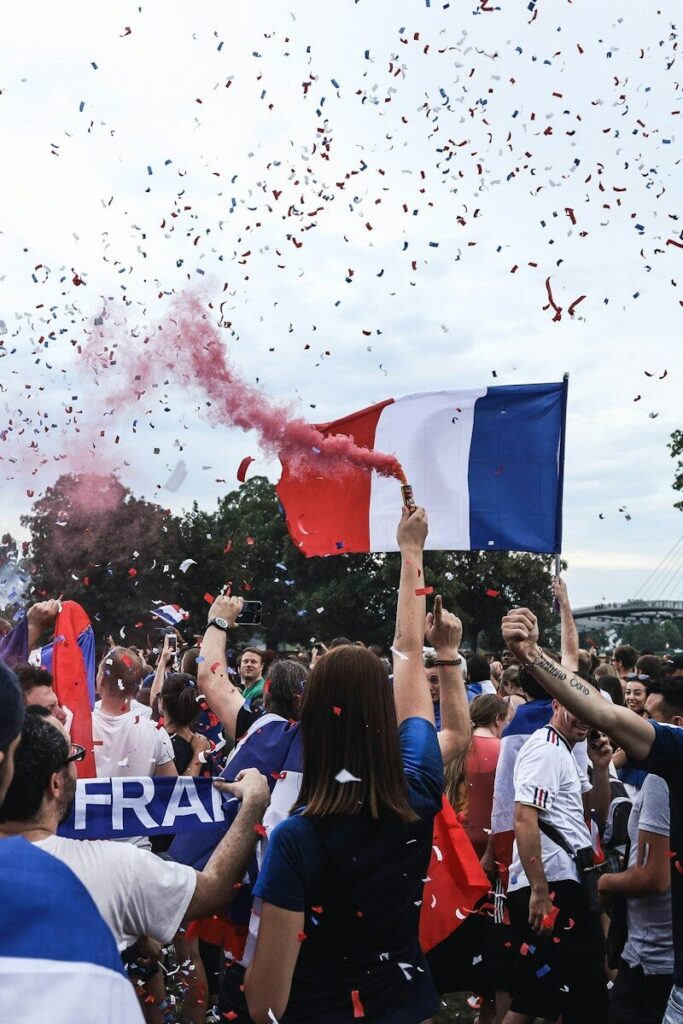
France has been in turmoil (again) since mid-September: peaceful student blockades turned into street fights unusually quickly, and alongside mainstream media, social media plays an invaluable role in this. The student movements that began in the autumn of 2026 are not merely the practice of traditional French strike and protest culture, but a digitally – and often spontaneously – organized, largely media-conscious rebellion of Gen Z. All of this is happening in a spiral where the anger of dissatisfied protesters is only further fueled by frequent police overreach. As a student studying in Paris, I will try to offer a new perspective on the daily demonstrations, the riot police presence, and the boiling French population.
Behind the demonstrations lies a multifaceted social discontent: students originally took to the streets due to educational reforms, deteriorating conditions in higher education, the cost-of-living and housing crises, and an uncertain outlook on the future. The spark, however, quickly turned into a nationwide movement: high school and university students were joined almost immediately by the largest trade unions (CGT, FO), public sector workers, teachers, firefighters, as well as more radical leftist and anti-fascist groups. The protests thus expanded from a student issue into an all-encompassing resistance against the government’s strict budget cuts, the slashing of social benefits, and President Emmanuel Macron’s uncompromising political leadership.
The initial school blockades – for which students used dumpsters, discarded mattresses, cardboard boxes, and handmade banners – were replaced by a spiral of violence fueled by police overreach and retaliatory responses. The armed riot police were generally characterized by aggressive baton use, dragging and isolating protesters, and later deploying tear gas and water cannons.
The protesters’ reaction was simple: police violence did not deter them, but rather radicalized them as well, with smoke grenades, fireworks, and vandalism (e.g., setting fire to dumpsters and public rental bikes) appearing among their methods. These understandably triggered a vicious cycle: the disproportionate nature of the police response often immediately generated renewed aggression within the crowd, therefore creating ongoing street confrontations.
The blockade of high schools (lycées) soon spread to disrupting university buildings as well. In Paris and several major French cities, education was effectively paralyzed for about two weeks. In many places, the leadership announced on a day-to-day basis in the evenings through the school email system whether the campus would be suitable for in-person classes the following day. One culmination of this institutional uncertainty and escalation was the October 5 incident at the Nation campus of Sorbonne Nouvelle, which clearly illustrates the limits of university autonomy and the disproportionate nature of state intervention.
A general assembly held around midday quickly culminated in a vote to occupy the building, while dozens of outside arrivals managed to enter the premises. By early afternoon, the situation had spiraled completely out of control: citing safety hazards, the administration turned to the police at the end; however, instead of defusing tensions, the law enforcement intervention sparked panic. In the enclosed space, riot police deployed the notorious kettling tactic (nasse): in the university lobby, hundreds of innocent students and staff members were trapped between the police lines.
Due to the brutal intervention and chaotic conditions, the university president himself submitted his resignation that very day; however, after a few days of uncertainty, Daniel Mouchard-Zay remained in his post. Finally, in an email sent on October 19, it was announced that following the events of October 5, the entire presidential team would end its mandate on December 11.
The end of the regular blockades and protests was therefore far from sight – quite the contrary. A demonstration larger than anything before was announced for October 17 – a second French revolution, if you will. The hype and preparation for the “big day” was unprecedented on social media: content creators used memes and various elements of pop culture as a mobilizing force. Threats involving the guillotine were popular, as were “outfit checks” (showing what kind of masks and goggles they would wear to the streets), while various figures from the multiverse came to life: Captain America, Darth Vader etc. The simpler videos and the comment sections all signaled that they were preparing for a demonstration of a scale and volume that would rightfully evoke the era of the French Revolution.
The day marking the “end of the world” and the “beginning of a new era” could then be followed hour by hour on screens. The gathering had already begun at midnight – as hinted at in the videos of the preceding days – and throughout the morning, music and the crowd chanting in rhythm still took center stage. By the afternoon, however, the situation escalated almost everywhere: tear gas, cordons of riot police, smoke bombs, and fireworks.
Social media was flooded with POV footage of young people being wrestled to the ground, hand-to-hand clashes, and ultimately looting and anarchic conditions. Traditional mainstream media often favored the latter type of footage, showing merely the vandalism and thereby stigmatizing the crowd of hundreds of thousands. On social media platforms, in contrast, the protesters’ true attitude became more seemed: anger was intertwined with solidarity, as well as digital creativity.
The wave of protests in France is part of a so-called Gen Z protest movement actively taking shape during these years: this common denominator could also be observed during the Hungarian student movements of 2021-22 – students took to the streets to protest for education and their future, confronting the indifference of political power. However, looking at the events in Hungary through objective lens, they were far less characterized by violence: while there, tear gas was an instrument of genuine police overreach during the disassembly of the cordons in front of the Carmelite Monastery, and its deployment essentially shook the entire country, in France it has become an almost standard “fixture” of demonstrations.
We can say, therefore, that there is a significant difference between the two countries (or Western and Eastern Europe) both in political and in protest culture. While in Hungary the mobilizations largely remained in peaceful, symbolic forms (human chains, bridge blockades), in France radical, direct street confrontation and immediate resistance form an integral part of the protest culture; the last truly violent protest and civil-law enforcement clash happened in 2006 in Hungary, and the retrospective is still unclear: one part of the population chiefly remember it as police brutality, but the other mostly remember it as the destructive streak of a violent mob.
The wave of protests in France is far from over: further blockades and strikes have been announced nationwide for several autumn weekends and in the coming weeks. Emmanuel Macron’s speech on October 18 added fuel to fire: rather than calming tempers, it further stoked tension among students and trade unions due to a lack of willingness to compromise. In response, the mobilization continued October 19, including the shutdown of the Louvre, and a curfew went into effect in the evening.
The outcome remains entirely unpredictable. In France, social tension has reached a point where students do not back down from batons, and the government refuses to yield. As long as there is no meaningful exchange between the government and the youngest generation, only smoke and tear gas, a further deepening of the conflict is to be expected – and we are still very much at the beginning of this drama playing out against a revolutionary backdrop.