


The Polish Council of Ministers is deliberating a bill drafted by the Ministry of Health (UD147), which would introduce numerous restrictions on the sale, advertising, and promotion of alcohol. The bill would ban alcohol sales at petrol stations as well as in healthcare and health spa facilities (sanatoriums), introduce a total ban on alcohol advertising and limit its promotions, impose restrictions on online selling, and ban the sale of alcohol in containers smaller then 300 ml if the packaging is other than metal or glass. At least some of the proposed measures appear unjustified, given, among other, the decline in alcohol consumption among Poles. Banning alcohol sale at petrol stations will not deliver the positive social effects claimed by proponents.
Alcohol abuse and risky drinking have negative consequences for drinkers and their loved ones, and also pose risks to public health. Reducing the harmful effects of drinking is therefore an important objective for public policies. However, it appears that a substantial part of the solutions proposed in the ministerial draft (UD147) will not effectively address alcohol-related problems, while potentially creating other negative effects.
Positive Trends in Polish Society
In the bill’s justification, the Ministry of Health cites data from the National Centre for the Prevention of Addictions (KCPU) on alcohol consumption in Poland – 8.93 litres of pure alcohol per resident in 2023. The authors of the draft also claim that alcohol consumption has remained at a similar level in Poland for many years. Meanwhile, recorded consumption in 2023 was the lowest since 2006. Data for 2024 suggest a further decrease to 8.77 litres, and the downward trend has been visible for several years. Since 2021, recorded consumption has declined by almost one litre of pure alcohol per resident.
Figure 1: Recorded alcohol consumption in Poland (litres of pure alcohol per resident), 2000-2024
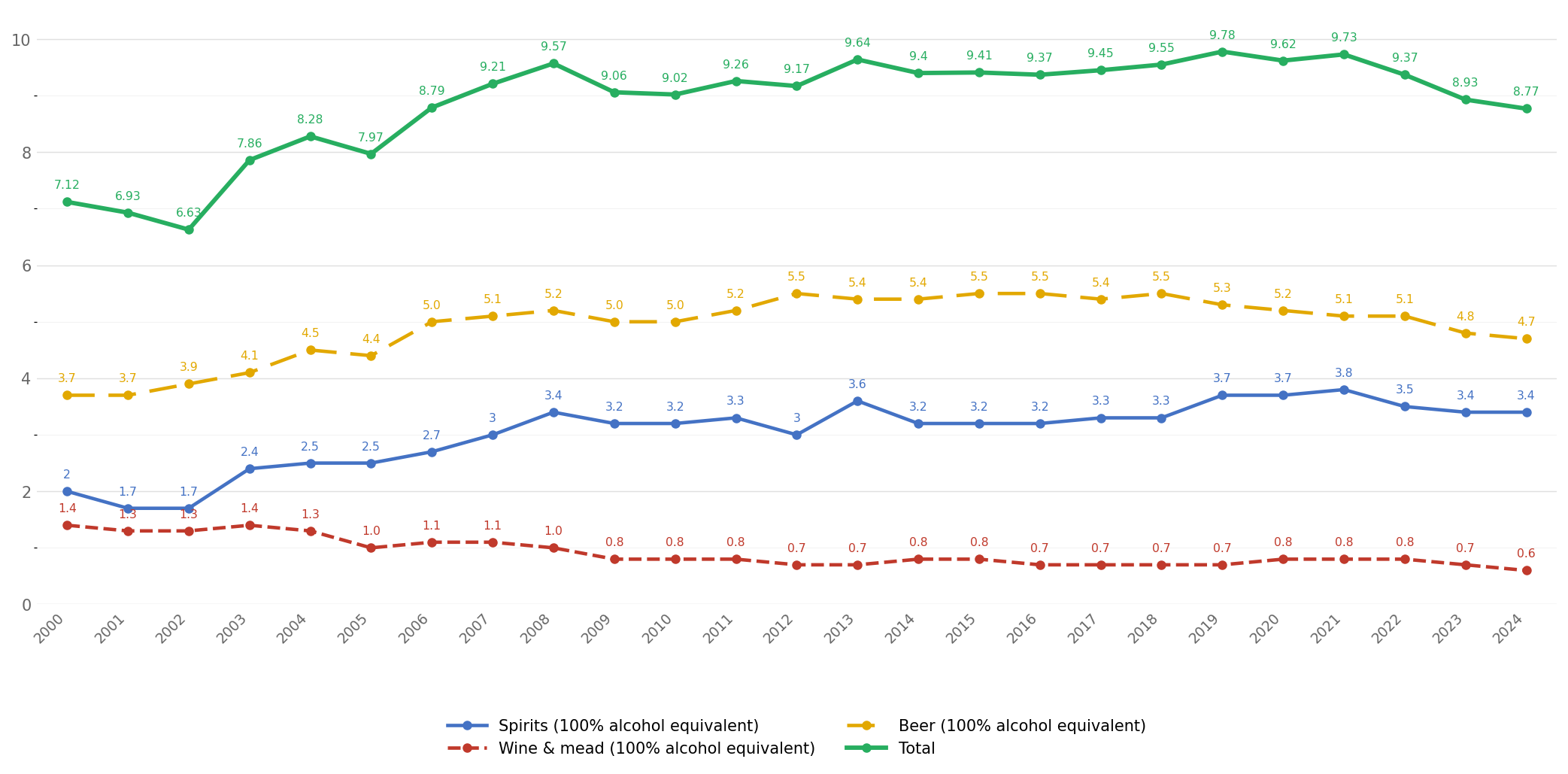 Source: KCPU/GUS
It is possible that the decline in recorded consumption over recent years is even more pronounced relative to the first and second decades of the 21st century than the KCPU data suggest. These data are based on a fixed assumption that beer contains 5.5% pure alcohol and wine 12%. In reality, the alcohol content in beer has been falling, as confirmed by industry reports2 (a drop from 5.6% to 5.3% in 2018-2021 alone), so this figure should be updated.
The market share of strong beers has also declined significantly: such products accounted for more than 20% of beer sales volume in Poland in 2004-20083; before the pandemic it was already below 8%4; and in recent years the strong-beer segment has been the fastest-shrinking category on the market5. The most popular beer brands have also reduced their alcohol content – at the beginning of the century they most often contained over 6% alcohol, whereas today they are slightly above 5%6. It is therefore reasonable to say that the average beer had more than 5.5% alcohol two decades ago, and less than that today.
It can also be assumed that unrecorded alcohol consumption in Poland is much lower than, for example, at the beginning of the 21st century. One indication is the sudden increase in spirits consumption after the excise duty cut from 1.7 litres of pure alcohol in 2002 to 2.4 litres in 20037 (while the Border Guard confiscated alcohol in 2003 of a five-times lower value than a year earlier8; smuggling and unrecorded imports primarily concern spirits9). In 2002, the grey market in alcohol was estimated at 30%10, whereas in recent years it may have been at most in the low double digits (or even below 10%)11.
The Contribution of “Zero” (Non-Alcoholic) Beers
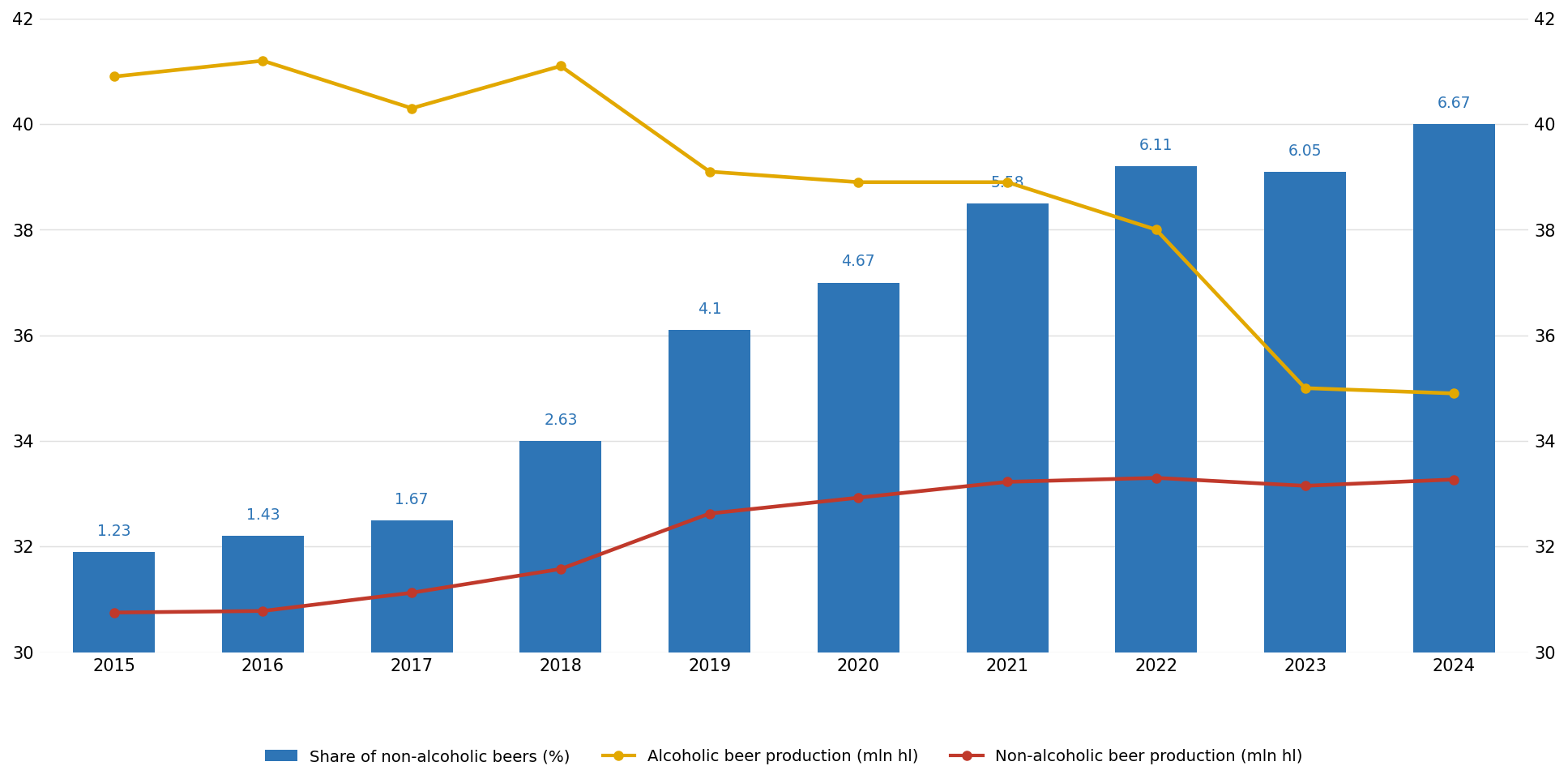
All data indicates that trends in alcohol consumption in Poland are highly positive, and Poles are drinking less on their own initiative. This is largely reflected in falling beer consumption. At the same time, the market for non-alcoholic beers has been developing rapidly for several years, and such products increasingly replace alcoholic beer.
The draft bill, however, would also ban all advertising of non-alcoholic beers if they can be associated with the same or a similar brand or logo of alcoholic beers. It seems that the growing public awareness and the rising popularity of “zeroes” are, to some extent, also a result of promoting this segment – even though the best-known beer brands are widely recognised without advertising – and the expanding market of non-alcoholic beers offers numerous new products. Moreover, the most frequent consumers of “zeroes” are young adults12 (which suggests that overall alcohol consumption may decline substantially in the coming years).
Figure 2: Beer production in Poland: alcoholic beer (million hl, left axis), non-alcoholic beer (million hl, right axis), and share of non-alcoholic beers in total beer production (%, right axis)
Source: FOR’s own calculations based on Statistics Poland (GUS) data
Fewer Drunk Drivers on the Roads
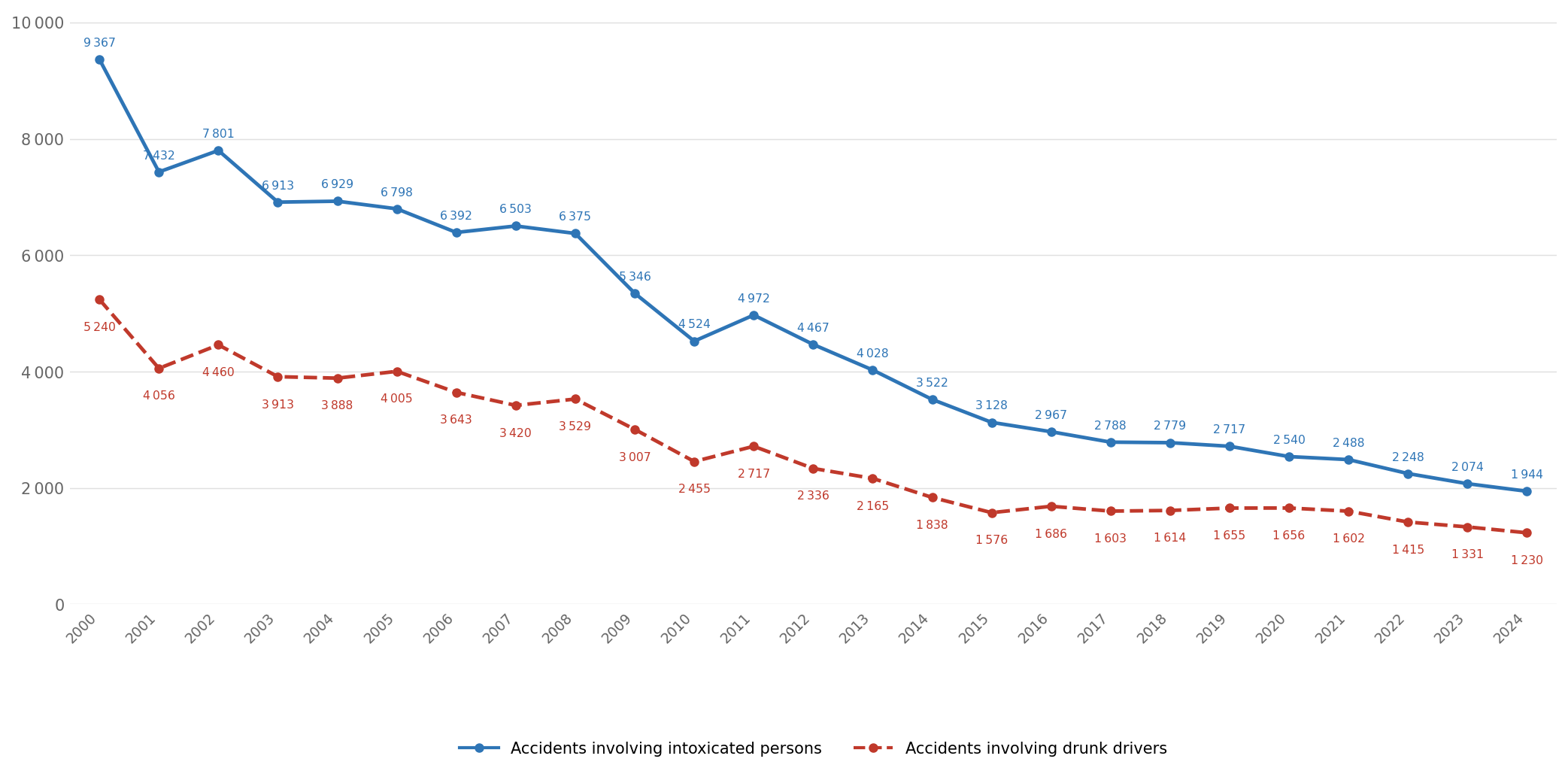
These positive trends are also reflected in road safety. In justifying the proposed ban on alcohol sales at petrol stations, the Ministry of Health points to the problem of intoxicated drivers and accidents caused by them. It overlooks the fact that both the number of accidents involving intoxicated persons and the share of such accidents in total road accidents have been systematically falling in Poland.
At the beginning of the 21st century, there were 7-9 thousand accidents per year involving intoxicated persons, representing 14-16% of all road accidents in Poland. Today, it is fewer than 2 thousand accidents and below 10% of all accidents. Accidents involving intoxicated drivers accounted for 8-9% of all road accidents in 2000-2006, and today they are below 6%.
Figure 3: Road accidents involving intoxicated persons and accidents involving intoxicated drivers, 2000-2024
Source: Polish Police
There is no evidence that intoxicated drivers purchase alcohol mainly at petrol stations. Alcoholic beverages can also be bought in grocery stores and other retailers, which offer lower prices and are therefore in general more attractive to customers.
In its regulatory impact assessment, the Ministry itself notes that petrol stations account for only about 2% of alcohol sold in Poland. Consequently, a targeted ban for this specific type of outlet will not, by itself, materially reduce the availability of alcohol in Poland. There are about 8.5 thousand petrol stations nationwide, and 5.5 thousand of them have licences to sell alcohol13. The total number of alcohol sales outlets is just under 120 thousand14 – so petrol stations selling alcohol account for about 4.5%. Alcohol is therefore purchased there less often than in an average sales outlet.
The number of alcohol sales outlets has also been decreasing systematically. In 2008 there were over 200 thousand alcohol points of sale in Poland14, while last year there were fewer than 120 thousand15. It is worth noting, however, that banning alcohol sales at petrol stations will not reduce the number of alcohol outlets if municipalities do not reduce the number of licences issued. Those outlets will simply emerge elsewhere.
The Centre for Regulatory Impact Assessment at the University of Warsaw points out in its opinion that a targeted ban on alcohol sales specifically at petrol stations may be unconstitutional and incompatible with the principles of proportionality, the social market economy, equality before the law and the prohibition of discrimination16, and that the government has not demonstrated the proportionality and effectiveness of the proposed ban in achieving its stated goals.
The Ban Would Raise Prices at Petrol Stations
Although petrol stations are not the most common place to purchase alcohol, alcohol sales constitute an important part of their profits. Stations earn not only from selling fuel, a significant part of their income comes from selling other products and services (such as coffee, snacks, beverages, or car washing and cleaning).
Even though non-fuel products and services constitute a relatively small share of stations’ revenues (for example, for the MOL group in Poland last year it was about 11%, including about 7.5% from the shop, where alcohol was among the leading categories), the much higher margins make them an important and relatively stable driver of profits. According to MOL reports, in 2023 the shop segment operated at a margin of about 37% (the foodservice segment had margins even above 60%), generating over PLN 269 million in gross margin on PLN 725 million in revenues. The shop segment accounted for 42% of total gross margin on sales17.
Fuel margins fluctuate substantially over time. According to estimates, the station margin in 2022 may have been 12 grosz per litre for petrol and 6 grosz per litre for diesel; last year, it was respectively 30 grosz and 25 grosz per litre18.
Different sources estimate alcohol’s share of non-fuel sales at petrol stations at anywhere from 12%19 to as much as 48%20. The data therefore differ widely and the estimates are uncertain. Taking into account the overall revenue structure of petrol stations, approximate margins, and approximate shares of alcohol in non-fuel sales, one can assess that the ratio of profits from alcohol sales alone to profits from fuel sales at an average station last year could have ranged from about 10% to even over 50%. Non-fuel sales, including alcohol, clearly constitute a substantial part of the petrol stations’ profits. This is also because alcohol and snacks can to some extent be complementary goods: those who will not come to a station to buy alcohol due to a ban also won’t buy crisps or a hot-dog.
Size of alcohol’s share is in a station’s profits depends heavily on the station’s location – likely higher in small towns or near popular places for drinking alcohol (e.g. the Vistula boulevards in Warsaw), and lower at stations on motorways, where snacks or non-alcoholic beverages play a bigger role. Thus, for some stations the ban will be only a minor inconvenience, but for others it may be significant and undermine the economic viability of the business. Losing revenue from alcohol sales may translate into higher prices – whether for coffee and hot dogs or potentially for fuel itself.
A ban on alcohol sales at petrol stations will not materially affect alcohol availability in Poland and appears unjustified in light of the trends observed in society, while it may lead to higher prices for all consumers.
In Other Countries, a Full Ban at Petrol Stations Is Rare
Although in its regulatory impact assessment the ministry cites examples of a dozen EU and EFTA countries that introduced restrictions on alcohol sales at petrol stations, based on what the ministry itself reports, a total ban at petrol stations exists only in Norway, Lithuania, and the Netherlands. The first two are widely known for very restrictive alcohol policies.
Other countries either ban sales at stations only during certain hours (Portugal, France, and Belgium – the latter only at stations on motorways), or limit the amount of alcohol that can be purchased at stations (Germany) or its alcohol content (Spain – beverages up to 20% alcohol). In Slovenia, Latvia, Estonia, Finland, and Sweden, petrol stations are subject to exactly the same requirements as ordinary shops. In the first three, this refers to nationwide night-time restrictions (which therefore also apply to petrol stations). In Sweden, it refers to restrictions on alcohol strength (beverages above 3.5% alcohol can be purchased only in state-run stores). In Finland, both restrictions apply: maximum alcohol content and specific hours of sale – both also apply to ordinary shops.
It is worth noting that in many municipalities (especially large cities) in Poland, night-time prohibitions on alcohol sales are already in place. The ministry’s observation that “in most Spanish regions a driver or passenger will not buy alcohol between 22:00 and 06:00” is therefore misleading, as the same often applies in Poland due to local night-time restrictions – which also cover petrol stations. In this respect, Poland does not differ from Slovenia, Estonia, or Latvia, except that in Poland the ban on nighttime alcohol sales is regulated at the local level, whereas in those countries—whose populations are several to several dozen times smaller than Poland’s—it is regulated at the central level.
Thus, the suggestion that far-reaching restrictions and bans that specifically target petrol stations are common in Europe is not true.
Ban on Alcohol Advertising and Promotion
The draft bill bans advertising and promotion of all alcoholic beverages, including beer. Poland already has a restrictive legal framework for alcohol advertising and promotion compared to the rest of Europe. According to the 2025 edition of the Nanny State Index, Polish regulations rank fourth in the EU in this area – after Lithuania, Latvia, and France, ex aequo with Finland21.
The ministry raises the alarm that more than 50% of alcohol in Poland is consumed in the form of beer. Yet this is consistent with the objectives of the Act on Upbringing in Sobriety and Counteracting Alcoholism22, which provides for shifting the structure of consumed alcoholic beverages towards those with lower alcohol content. This goal has in fact been achieved – Poland moved from 55-65% share of spirits and 20-30% share of beer in the 1980s and early 1990s to the current state, where beer accounts for over half of alcohol consumed, while spirits account for well below 40%.
A ban on advertising is likely to entrench the position of the largest beer producers23. On the one hand, their advertising expenses would disappear, on the other, the ban would prevent potential competitors from building brand recognition, creating substantial barriers to entry. Bans strengthen the position of the largest players, as confirmed by research24. In practice, this means that the regulation would benefit primarily the biggest beer producers.
Through advertising, breweries do not promote beer as such, but rather compete to win over consumers from their competitors within the beer industry or to encourage consumers of stronger spirits to choose beer. There are studies showing that advertising of one type of alcohol primarily affects the structure of consumption – consumption of beer increases, while consumption of other beverages (e.g. vodka) decreases, without major changes in total alcohol consumption25. Similarly, when bans on advertising the weakest types of alcohol are lifted, their consumption rises while consumption of spirits declines26. A ban on beer advertising could therefore potentially increase consumption of stronger spirits at the expense of beer, which would be contrary to the objectives set out in the Act on Upbringing in Sobriety and Counteracting Alcoholism, other state policies, and public health.
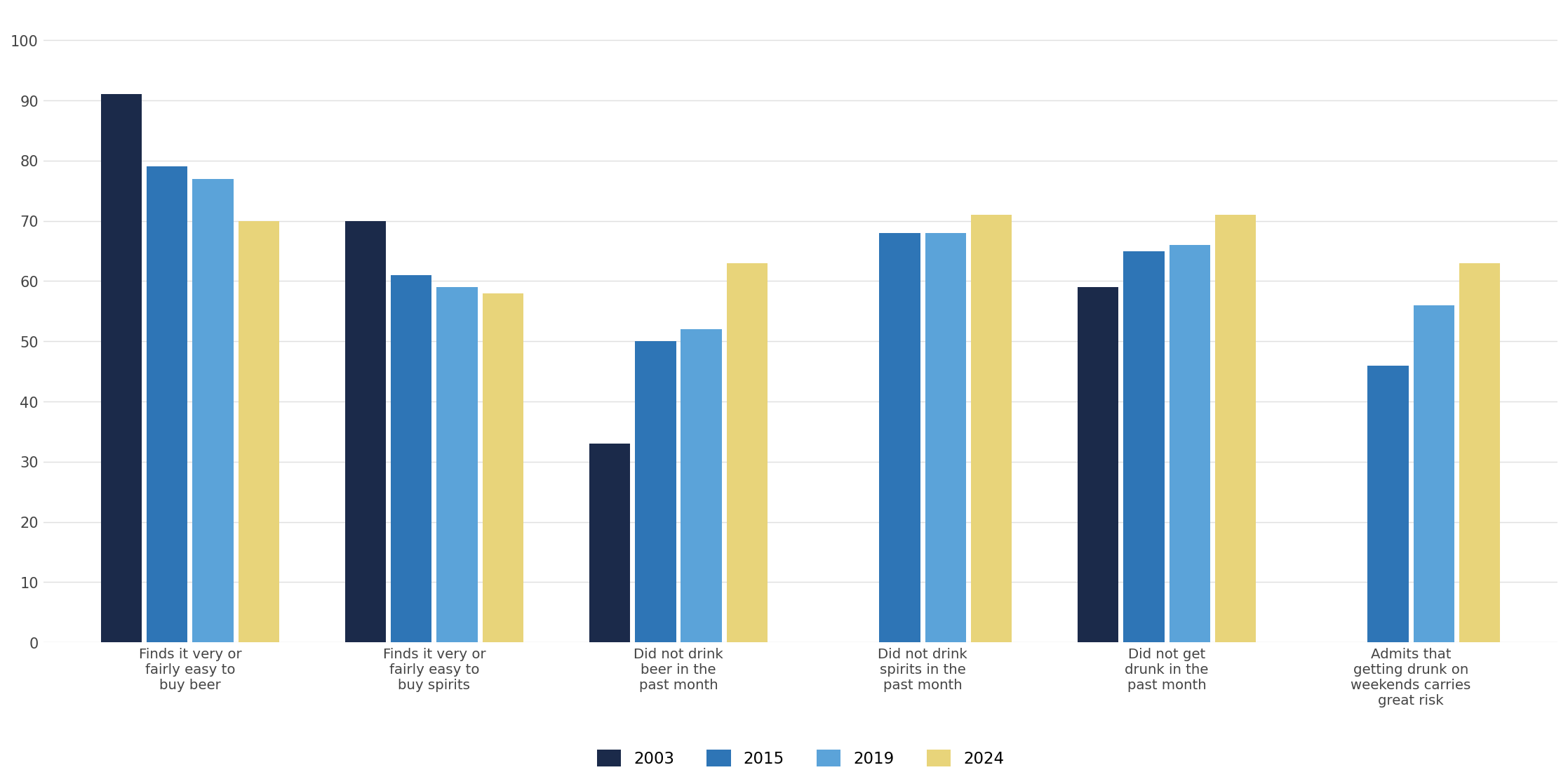
The ministry refers to the impact of advertising on youth. According to the latest edition of the ESPAD study27, among Polish 15-16-year-olds almost 63% reported not drinking beer even once in the past 30 days, and 71% reported not drinking spirits even once. These are the highest results in the history of the study. In 2003, the year when legal beer advertising was reinstated in Poland, less than one third of respondents had not drunk beer over the preceding month. Since 2018, total beer consumption in Poland has also been falling despite legal advertising. Alcohol in beer consumption per resident is only slightly higher than in 2003 when calculated using the KCPU methodology, and after accounting for changes in beer alcohol content – slightly lower. With this correction, it is also 25% lower than in 2012.
In the latest edition of ESPAD study, only under 29% of surveyed teenagers reported having been intoxicated28 in the past month, compared to 45% in 1999. Between 2015 and 2024, the share of teenagers who believe that getting drunk every weekend carries high risk rose from 46% to 63%. At the same time, the share of respondents saying it would be easy to buy beer has been falling (though much more slowly), and in the case of spirits it has fallen only marginally.
Figure 4: ESPAD study results among Polish 15- and 16-year-olds in 2003 and 2015-2024 (percentage of respondents who…)
Source: data.espad.org
Taking into account the growing awareness of alcohol’s harmfulness among young people, the “NoLo” trend, the fact that young adults most often consume non-alcoholic beers, and the systematic decline in alcohol consumption, it does not appear that alcohol advertising is particularly effective in driving youth drinking.
Moreover, as mentioned above, the bill would also ban advertising of non-alcoholic beer if it is linked to the same or a similar brand as alcoholic beer – even though one can assume that “zeroes” have played a substantial role in reducing alcohol consumption in Poland.
The bill would also ban all price promotions and discounts on alcohol. Here too, there is no evidence that such promotions increase total alcohol consumption, rather than influencing the choice of a particular brand, type of alcohol, or retail chain. Especially, given that promotions such as “12+12” – reducing the unit price when purchasing a very large number of beers – became popular in discount chains only in recent years, while beer consumption per resident has been falling markedly in the same period.
Online Sales
The draft bill also regulates online alcohol sales. This is somewhat beneficial, as the legal status of online alcohol sales in Poland has so far been unclear29. Clarifying this issue therefore seems necessary. It is also good that the government withdrew its idea of a total ban on online alcohol sales30. Such restriction would not improve the society’s situation, but it would hit small local wineries and breweries, depriving them of the possibility to reach customers at a broader scale. In practice, online orders are more likely to serve planned consumption of interesting and less readily available alcoholic products, rather than impulse purchases or buying miniature drinks.
The draft provides that online sales will be possible only with collection at an alcohol sales outlet operated by the seller or another entrepreneur. This creates the potential for products purchased online to be collected, for example, at a nearby shop (similarly to how courier parcels are collected today), if such shop concluded relevant agreements with the seller. Nevertheless, this solution will create difficulties for local breweries and wineries that will not be able to build a distribution network.
Although online alcohol sales – including, to some extent, delivery to one’s home – are allowed in almost every EU country31, Poland has so far lacked unambiguous rules for this sales channel. Given today’s capabilities, including technological ones, the challenge of verifying the buyer’s age does not seem challenging. Instead of mandatory collection in a sales outlet, the government could consider effective methods of age verification. The requirement that a shipment must be collected by the buyer (rather than any other adult) also seems unjustified and may cause unnecessary difficulties for citizens. Still, the legal clarification and abandoning the idea of a total ban can be assessed positively.
However, both the restrictions on online alcohol sales and those relating to packaging and the volume of alcohol products (discussed below) constitute technical regulations within the meaning of Directive 2015/1535. This means that the draft should be notified to the European Commission under the procedure provided in that directive. If adopted without notification, the provisions would not be applicable after they enter into force.
What Else Does the Draft Ban?
The draft also bans the sale of alcohol in containers smaller then 300 ml in packaging other than metal or glass. This regulation can obviously be associated with the so-called “alkotube” scandal of 2024. Everything suggests that this is a measure motivated mainly by PR considerations. It does not appear to be particularly burdensome, as the vast majority of alcoholic beverages in this volume are already sold in packaging that would remain legal.
It’s good that the draft introduces a volume limit for the beverages to which the regulation applies. A total ban would also hit, for example, wines and other beverages sold in multi-litre carton packaging – products that are not typically subject to the same criticisms as “alkotubes”.
The draft also bans retail sales of alcohol in a form other than liquid (e.g. gels, powders, pastes). Such products are not particularly popular, and the provision does not seem especially controversial given the threats that alcohol in non-standard forms may pose.
The draft also introduces an obligation for sellers to verify the buyer’s age (by requesting an ID card or other document) in case of doubts32. Until now, sellers were only authorised to do so. While the objective seems appropriate, this is not a revolutionary change, even today, selling alcohol to minors can result in sanctions such as fine or the loss of an alcohol sales license, moreover a seller may – and should, if they wish to avoid committing an offence – ask for proof of identity when there are doubts about the customer’s age. The change should not be expected to significantly alter well-established practices, but there are also no grounds to assume harmful consequences.
The draft also contains changes that would mean that in small retail outlets, only beverages above 4.5% alcohol would be permitted, and beer sales would be prohibited – as noted, for example, by the Union of Entrepreneurs and Employers33. This appears to be a mistake inconsistent with the drafter’s intentions, the draft requires a correction.
Summary
Given the decline in alcohol consumption in Poland (likely declining more strongly than the recorded-consumption estimates suggest) and the improvement in road safety – reflected in the falling number of accidents, including an even faster decline in accidents involving intoxicated persons and intoxicated drivers – introducing a ban on alcohol sales at petrol stations lacks a rational justification.
There is also no basis for banning advertising of non-alcoholic beers when they are linked to the brand of an alcoholic beer, given the positive role of “zeroes” in reducing alcohol consumption. A ban on beer advertising itself may also contradict the objective of shifting consumption towards beverages with lower alcohol content.
Alcohol sales are an important component of profitability for a substantial share of petrol stations. The ban would therefore lead to higher prices of other products (possibly including fuel) and could force some stations to close. Such restriction will not significantly affect alcohol availability in Poland, because petrol stations account for a small share of alcohol sales; and without reducing the number of licences for alcohol sales, outlets will simply appear elsewhere.
While reducing the negative consequences of drinking is a valuable goal, it should be assumed that a significant part of the proposed solutions have little impact on alcohol consumption. The academic literature also points to ineffectiveness in achieving the objective – and, for some regulations, to effects that may even be contrary to the legislator’s intentions.
The latest trends in Polish society regarding alcohol consumption are not alarming in any way, they are even very optimistic. There is therefore no need to reach for restrictive measures – especially those that would contribute only marginally to the objective, while negatively affecting citizens as consumers (not only of alcohol) and businesses.
Written by Gabriel Hawryluk – FOR Economic Analyst