

EXECUTIVE SUMMARY
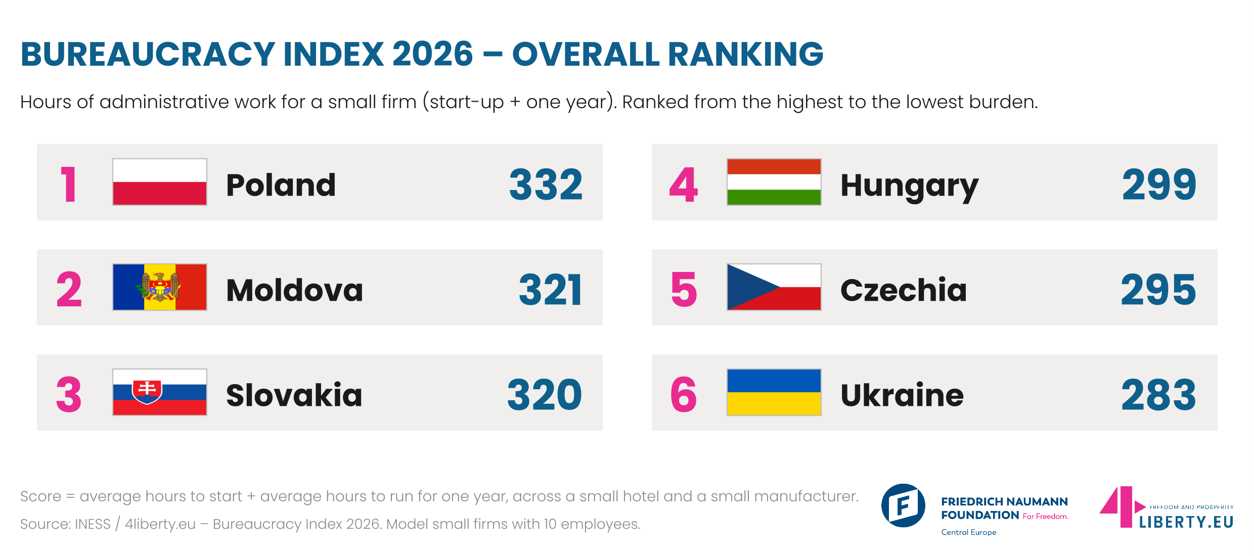
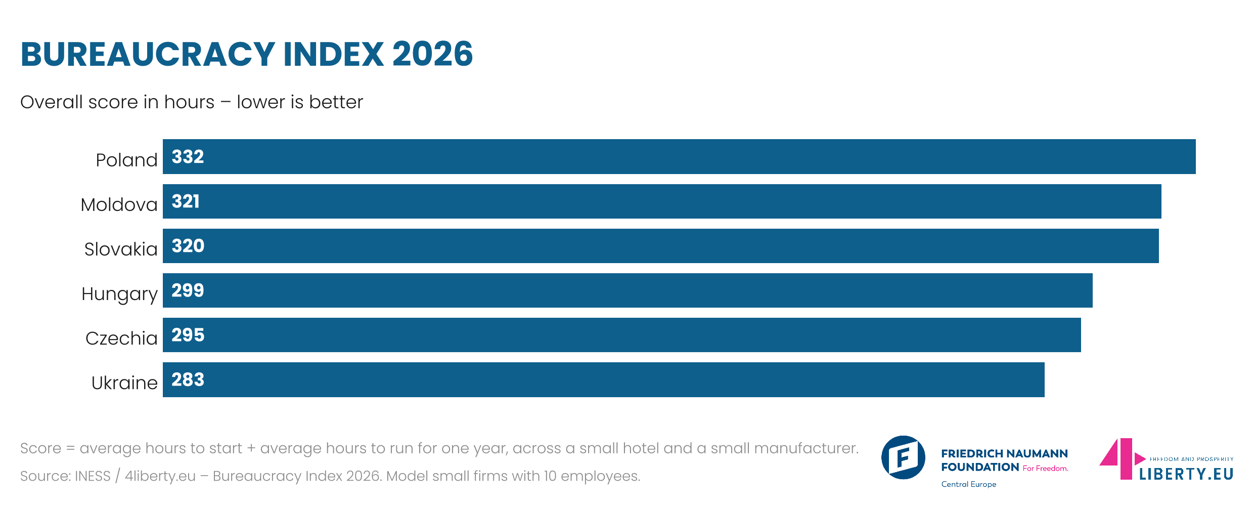
- Ukraine has the lightest bureaucratic burden (283 hours), followed by Czechia (295) and Hungary (299). Poland carries the heaviest burden (332), followed by Moldova (321) and Slovakia (320).
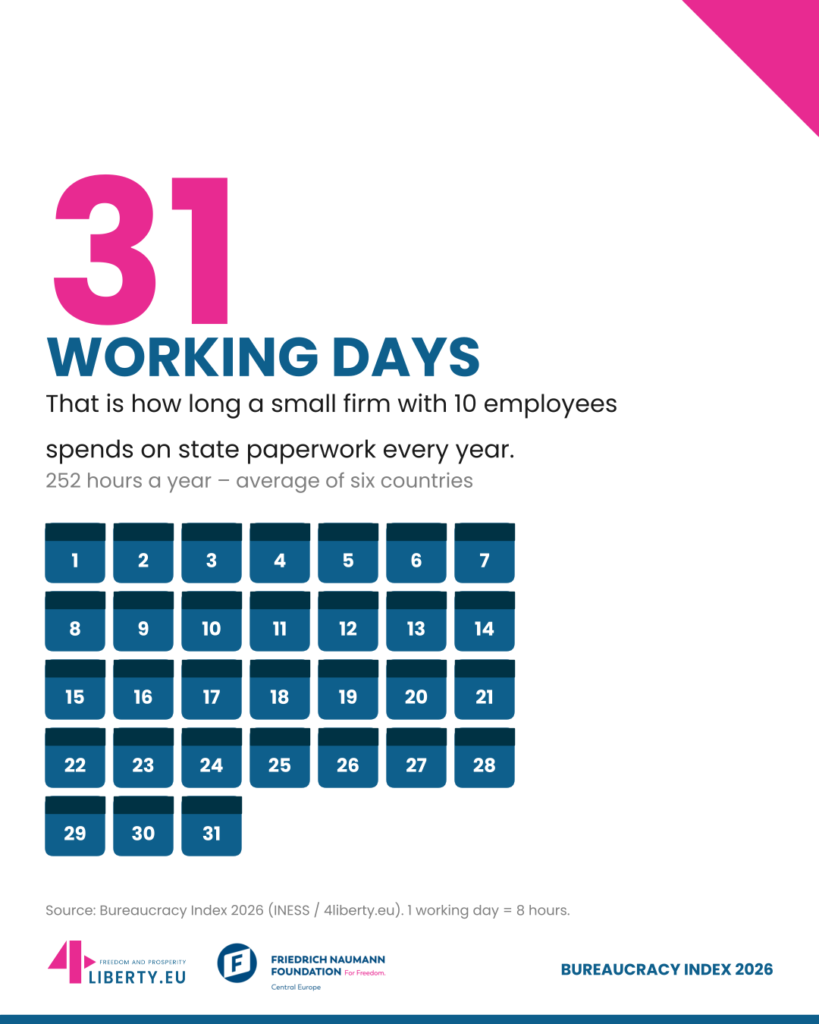
- A small firm with 10 employees spends on average 57 hours setting up and 252 hours a year running its business – about 31 working days of paperwork every year.
- Employment administration – payroll reports, sick-leave and working-time records – is the largest source of bureaucracy in most countries; in Czechia and Poland it is taxes and waste reporting.
- Only 49 hours separate the best and the worst country, while the composition of the burden differs widely – from heavy start-up duties in Ukraine and Moldova to heavy running costs in Poland.
- Most countries already have formal anti-red-tape tools, but new obligations – many driven by EU legislation – arrive faster than old ones disappear.
INTRODUCTION
The Bureaucracy Index was launched in 2016 by the Institute of Economic and Social Studies (INESS) to fill this gap. It lists and quantifies the administrative duties that the state imposes on small and medium-sized enterprises (SMEs) and expresses them in a single, intuitive unit: hours of work. Piloted in Slovakia, the project now compares bureaucratic costs internationally. To raise awareness, International Bureaucracy Day is marked every year on 29 September.
The 2026 edition was prepared in collaboration with partners from the 4liberty.eu network and covers six countries: Czechia, Hungary, Moldova, Poland, Slovakia and Ukraine. Moldova joins the index for the first time. The project was supported by the Friedrich Naumann Foundation For Freedom Central Europe.
OVERALL RANKINGS
The overall score is the average time required to start and run both a small hotel and an industrial SME. Poland ranks highest for bureaucratic burden: the fastest start in the index is outweighed by the heaviest running costs. Moldova and Slovakia follow, only one hour apart. Ukraine has the lowest overall bureaucracy in the 2026 Index – despite the ongoing war, it combines a heavy start-up phase with the lightest day-to-day administration.
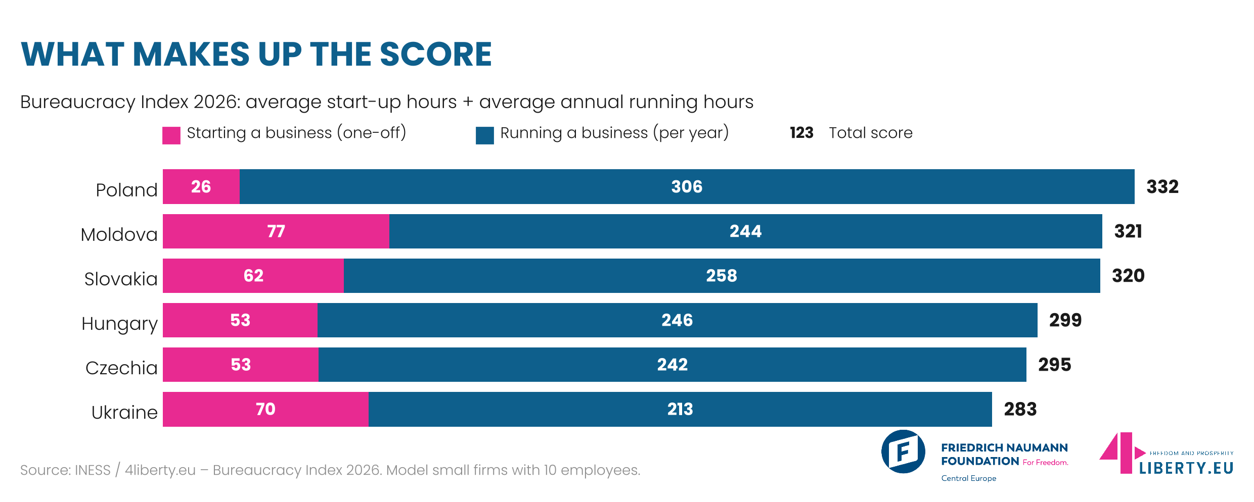
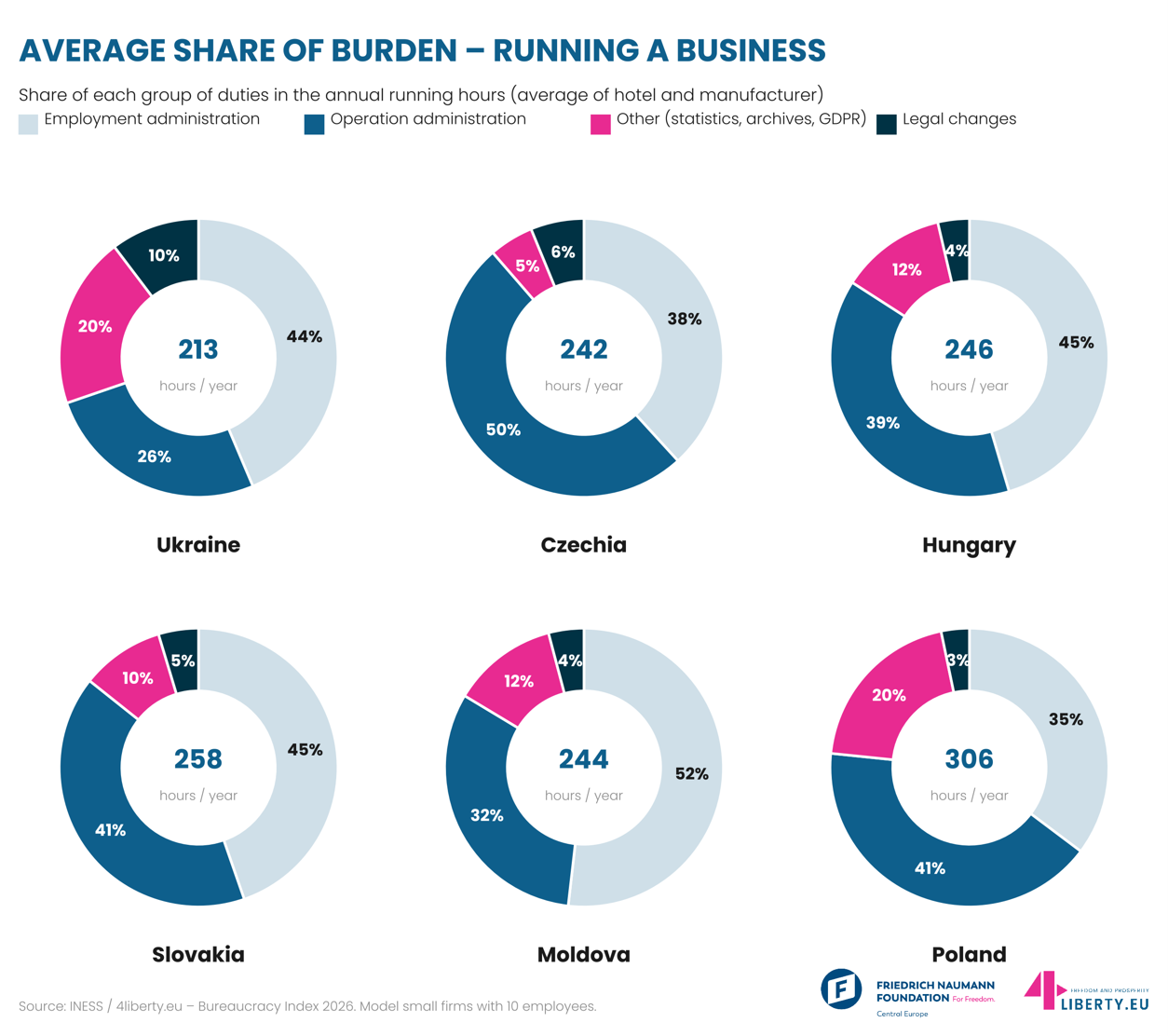
The composition of the score shows different models: Moldova and Ukraine have the most demanding start (77 and 70 hours on average), and Ukraine then has the lightest recurring administration, while in Poland the quickest start (26 hours) is offset by the heaviest running costs (306 hours a year).
Several existing competitiveness rankings assess factors like law enforcement, infrastructure and tax law from a business perspective. However, they rarely translate into something tangible: how much of an entrepreneur’s working time the state actually consumes.
METHODOLOGY AND KEY FINDINGS
The Bureaucracy Index uses a straightforward approach. Together with practitioners, national partners identify every administrative task the state requires from two model micro businesses with 10 employees: a manufacturing company (a producer of metal gates) and a small hotel with a restaurant. Tasks are grouped into “starting a business” and “running a business”, and each is assigned the time needed to complete it – including travel, payment, submission and searching for service providers – multiplied by how often it recurs. Fees and other direct costs are not included; the index measures time only. In Poland, the estimates combine expert assessment with responses from a business survey.
STARTING A BUSINESS
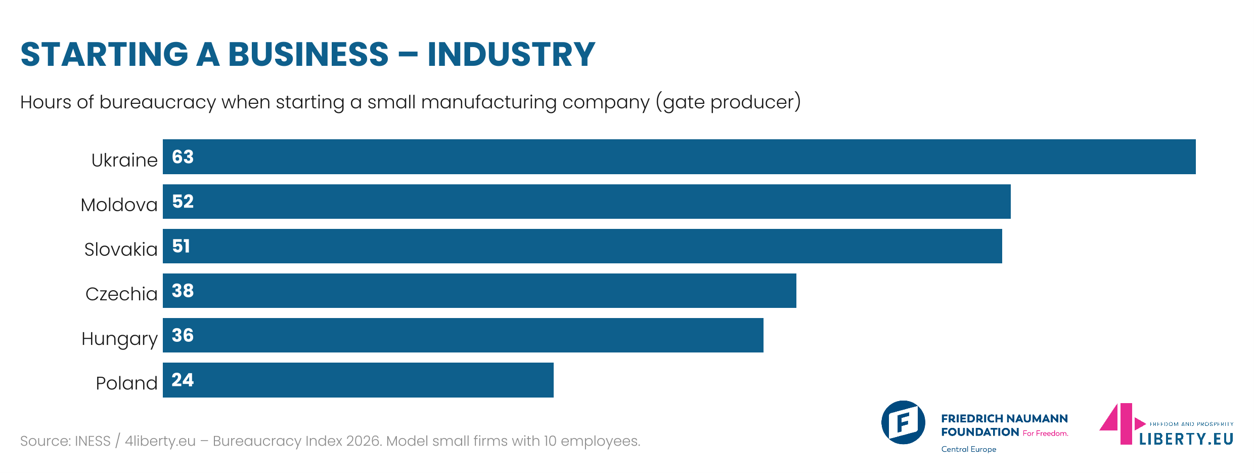
Ukraine has the highest bureaucratic burden for starting an industrial SME, at 63 hours – driven largely by fire-safety, labour-safety and military-registration duties that must be in place before the first employee starts. Moldova (52) and Slovakia (51) follow. Poland is the fastest place to set up a company, at 24 hours, thanks to largely automatic online registration.
Starting a small hotel is more demanding everywhere, mainly because of hygiene and food-safety rules. Moldova tops this ranking with 103 hours, with the preparation of a food-safety (HACCP) plan alone estimated at 41 hours. Poland is the outlier at the other end, with 29 hours.
RUNNING A BUSINESS
The “running a business” category measures the annual hours of administrative work for an established SME. Poland tops the ranking for running an industrial SME with 301 hours (38 working days), followed by Moldova (282), with Czechia and Slovakia both at 256. Ukraine has the lowest burden at 196 hours.
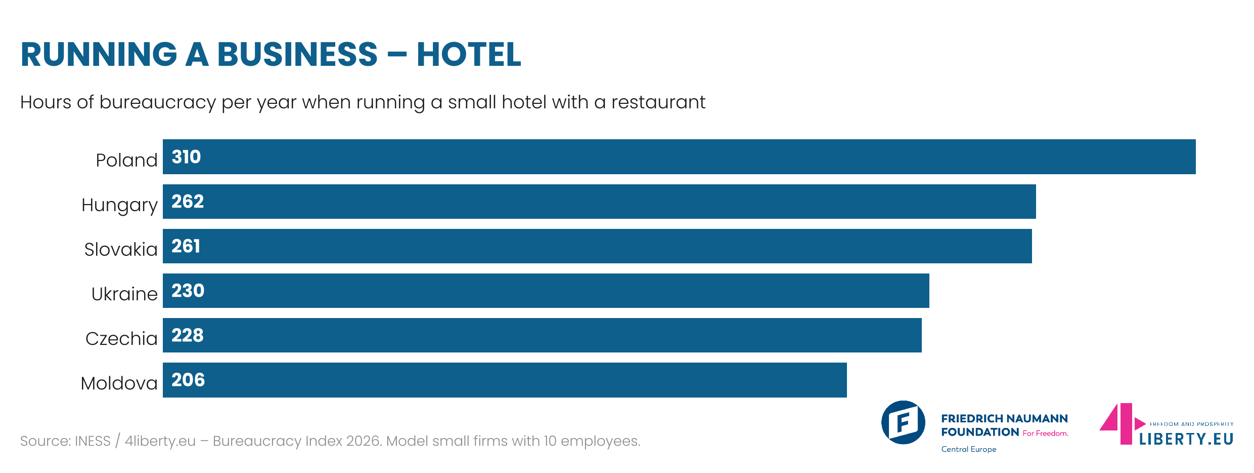
For a hotel, Poland (310 hours), Hungary (263) and Slovakia (261) lead the ranking. Running a hotel is not universally more bureaucratic than running a factory: in Moldova and Czechia the manufacturer carries the heavier load, mainly because of waste records, customs and occupational-risk reporting.
In most countries the bulk of the running costs comes from employment administration – payroll reports, sick-leave records, working-time evidence – which accounts for more than half of the burden in Moldova and around 44–45% in Hungary, Slovakia and Ukraine. In Czechia and Poland, operational tasks such as taxes and waste reporting are the main driver. Poland and Ukraine stand out with a large “other” category, mostly statistical reporting and archiving.
LEGAL CHANGES
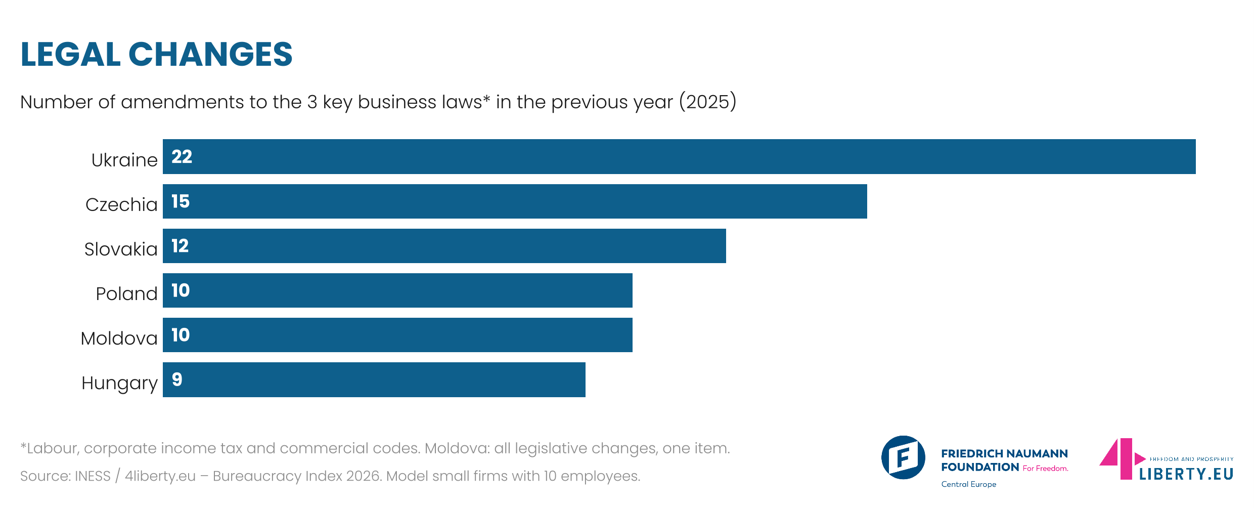
A notable subcategory of the running costs is the time needed to follow and implement changes to the three main business laws – the corporate income tax code, the labour code and the commercial code. Ukraine recorded the most amendments (22 in 2025), followed by Czechia (15) and Slovakia (12).
VOICES FROM THE COUNTRIES
- Most absurd requirements. In Poland, a hotel needs a separate permit for each type of alcohol it sells – beer, wine and spirits – instead of a single one. In Moldova, a company needs prior police authorisation to put its own logo on its own delivery van. In Hungary, an ordinary two-step ladder counts as work equipment, so the employer must keep a written register of its inspections. Czech hotels must report foreign guests, keep alcohol-sales records and submit guest statistics to several institutions, and a small firm may have to register for a broadcasting fee that turns out to be zero.
- Good practice worth copying. Poland lets firms register a company fully online and file financial statements, social-security and tax payments remotely. Moldova’s automated tacit approval issues an official, QR-coded permit whenever an authority misses its deadline. Ukraine’s Diia platform offers more than 150 online services, and during martial law many permits were replaced by a simple declaration. Czechia’s data boxes make most communication with the state fully digital, and its planned Single Monthly Employer Report should merge many payroll filings into one.
- Formal tools, weak results. Slovakia applies a one-in, two-out rule and has a dedicated anti-bureaucracy department, yet impact assessments are often a formality and abolished duties are outweighed by new ones – most recently the e-invoicing obligation due on 1 January 2027. Hungary’s new government has scrapped the mandatory chamber fee for micro-enterprises, but meaningful deregulation is yet to come.
- Zombie rules. Moldovan partners describe requirements that are abolished in practice but remain in law – such as certificates for river vessels that no authority issues any more – leaving firms formally non-compliant and open to selective enforcement. In Moldova, firms are also still asked to prove facts the state already holds in its own databases.
- Where bureaucracy ranks among business concerns. In Poland, partners point to slow proceedings – registering a company in the court register can take months – and to harsh criminal and administrative penalties, such as fines of up to one million zloty for a missing registration number on waste documents. In Ukraine, the war, labour shortages and security risks dominate – an unfavourable regulatory climate ranks seventh among obstacles to growth. In Moldova, red tape comes fourth or fifth, behind inflation, economic instability and labour shortages. In Czechia, 72% of firms named complex administrative procedures as a barrier in a recent survey. In Slovakia, the topic stays mostly among experts, as voters rarely meet obligations such as the pay transparency directive.
- Small steps forward. In Poland, a joint deregulation project of business and government has led the government to accept 354 proposals from entrepreneurs since 2025, though the overall burden for the model firms has not yet changed. Hungary’s new government plans to reintroduce the simplified KATA tax scheme for the self-employed. Ukraine’s State Regulatory Service and the EU-funded Business Ombudsman Council help firms in disputes with tax and customs authorities. Czechia runs an expert group with business representatives to identify unnecessary requirements.
In their own words
“Moldova has moved from bureaucracy by paperwork to bureaucracy by uncertainty. … A digitised absurdity is still an absurdity, delivered faster. Abolish first, then digitise what survives.”
IDIS Viitorul, Moldova
“The key problem of Polish bureaucracy is not the shape of the regulations themselves, but the toxic mix of exceptionally oppressive criminal law, abuse of pre-trial detention, and legal uncertainty, particularly in tax law.”
FOR, Poland
“It is an example of how an unnecessary European regulation is further complicated by a member state through its own implementation – and then even that implementation is not handled well technically.”
INESS, Slovakia – on the e-invoicing obligation starting 1 January 2027 (translated)
“None of these duties is individually overwhelming, but together they illustrate the problem well: a small company can spend a surprising amount of time repeatedly reporting fairly absurd information to several different public institutions.”
Institut liberálních studií, Czechia
“No, not yet any that is doing anything more than smoke and mirrors.”
Free Market Foundation, Hungary – asked whether any institution fights red tape
“Bureaucracy remains relevant but is currently overshadowed by more urgent challenges. Nevertheless, further deregulation and more predictable legislation are important for reducing business costs, encouraging investment and supporting Ukraine’s economic recovery and European integration.”
IER, Ukraine
CONCLUSION
The Bureaucracy Index serves as a practical tool for sparking discussion about excessive red tape and its impact on competitiveness. By identifying the most demanding areas, it points to concrete opportunities to reduce the administrative load on businesses.
Bureaucracy is an economic deadweight: it reduces profitability, discourages investment and distorts entrepreneurs’ choices, pushing them towards strategies designed to minimise contact with the state rather than to grow. The European Union itself acknowledged excessive bureaucracy as a major obstacle to growth and innovation in the Letta and Draghi reports, particularly in light of competition from the United States and China.
This year’s results also show that formal tools are not enough. Several countries in the index already use regulatory impact assessments, one-in-out rules or tacit approval, yet entrepreneurs see little relief when new obligations – many of them originating in EU legislation – keep arriving faster than old ones are removed. Reducing red tape must be a continuous process, measured by the hours firms actually save rather than by the number of laws amended.
PARTICIPATING MEMBERS
- INESS (Slovakia)
- Institut liberálních studií (Czechia)
- FOR – Civil Development Forum (Poland)
- Free Market Foundation (Hungary)
- IER – Institute for Economic Research and Policy Consulting (Ukraine)
- IDIS Viitorul (Moldova)
The Bureaucracy Index 2026 was made possible through the support of the Friedrich Naumann Foundation for Freedom.
APPENDIX: DETAILED RESULTS 2026
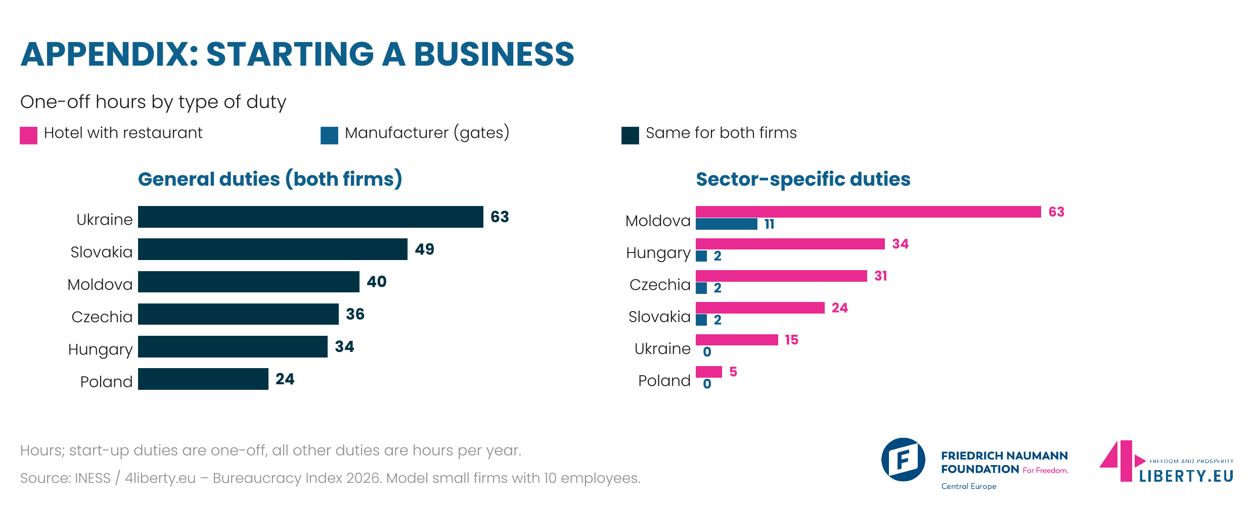
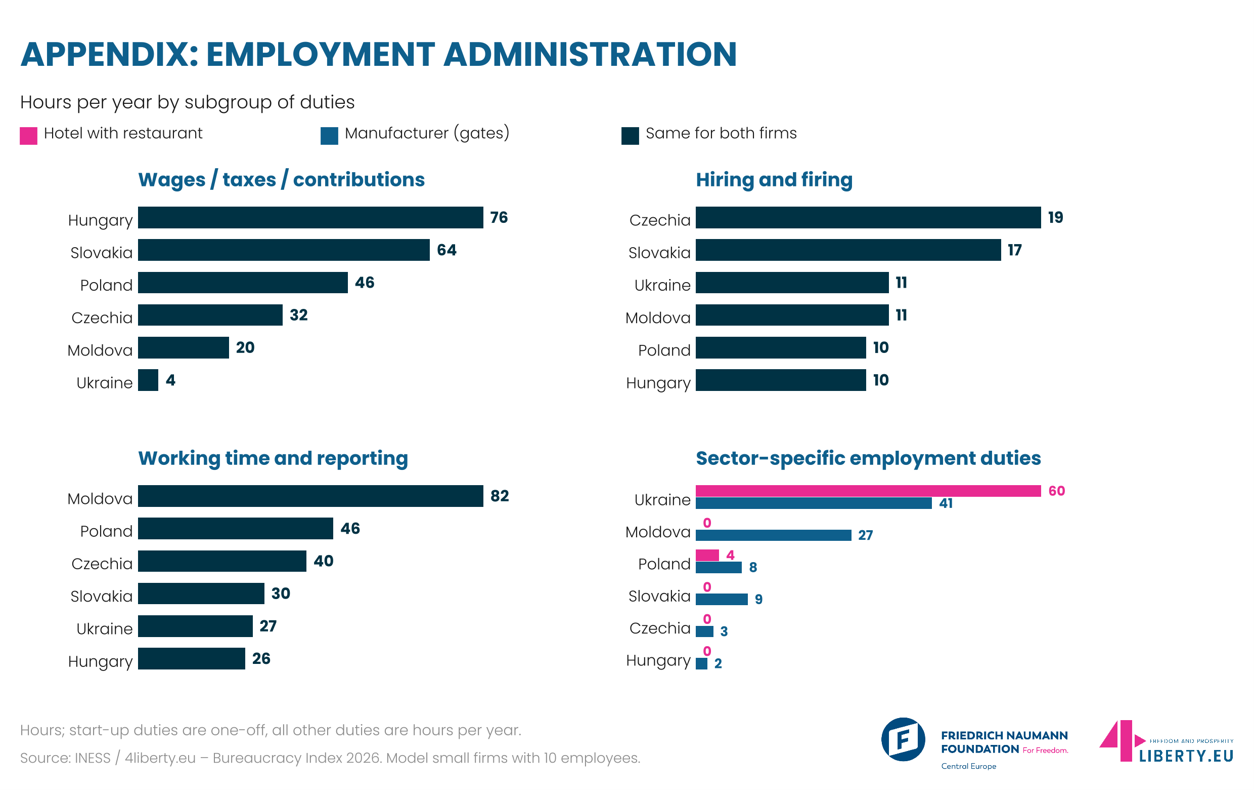
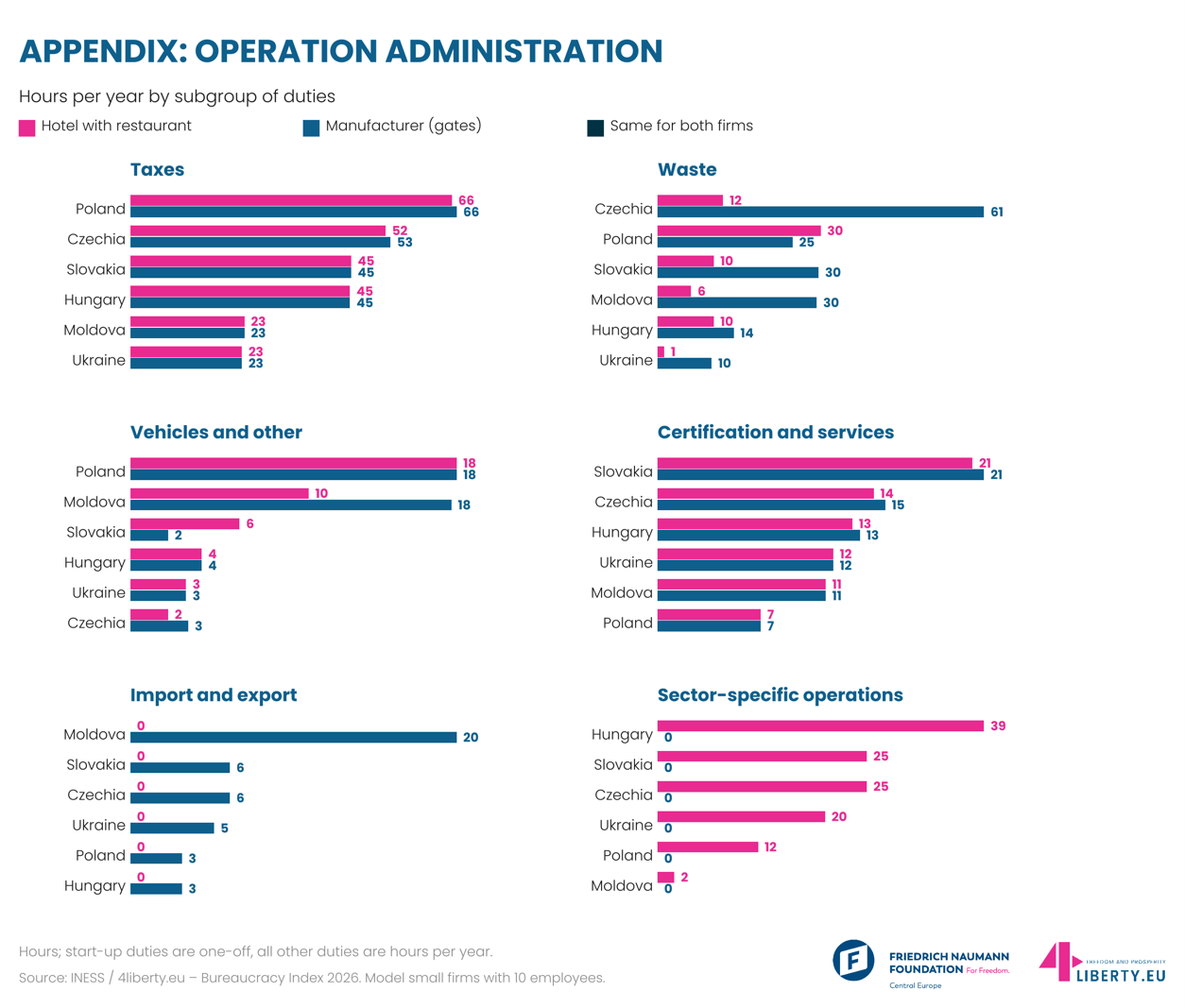
The charts below break the results down by subgroup of duties. Pink bars show the small hotel with a restaurant, blue bars the small manufacturer; where a duty applies equally to both firms, a single dark bar is shown. Countries are sorted from the highest to the lowest burden within each subgroup. National duty lists were mapped to common subgroups.
A1 STARTING A BUSINESS
General start-up duties range from 24 hours in Poland to 63 hours in Ukraine, where appointing persons responsible for fire safety, labour safety and military registration each takes about a full day. Sector-specific duties fall mainly on hotels: Moldova (63 hours, of which 41 for the food-safety HACCP plan), Hungary (35) and Czechia (31). Manufacturers face at most 11 hours of sector-specific start-up duties.
A2 EMPLOYMENT ADMINISTRATION
- Wages / taxes / contributions. Hungary (76 hours) and Slovakia (64) lead, driven by separate monthly reports to the social insurer, the health insurer and the tax office – about 15 hours a year each in Slovakia. Ukraine needs only 4.5 hours thanks to a single joint report that the tax service shares with the pension fund.
- Hiring and firing. Between 10 and 19 hours per year; entry medical examinations and initial health-and-safety training are the largest items. Czechia (19) and Slovakia (17) are at the top.
- Working time and reporting. Moldova (82 hours) stands out because of sick-leave records and the annual leave plan, followed by Poland (46) with monthly settlement declarations and absence records.
- Sector-specific employment duties. Ukraine requires regular health checks of all employees – 60 hours a year for the hotel and 30 for the manufacturer – plus safety training. In Moldova, occupational-risk reporting adds 27 hours for the manufacturer.
A3 OPERATION ADMINISTRATION
- Poland has the heaviest tax administration (66 hours), including VAT returns (25.5 hours) and monthly property-tax payments (15). Czechia follows with 52 hours, Slovakia and Hungary with 45, while Moldova and Ukraine need about 23 hours.
- A burden mainly for manufacturers: in Czechia, monthly waste evidence sheets alone take 48 hours a year (61 in total). Slovakia and Moldova require about 30 hours from the manufacturer; in Poland, waste fees and reports affect both firms.
- Vehicles and other. Poland (18 hours) requires continuous mileage records; Moldova’s manufacturer spends 18 hours on vehicle registration, deregistration and insurance.
- Certification and services. Slovakia leads with 21 hours, including 5 hours of preparation for the launch of e-invoicing.
- Import and export. Moldova’s manufacturer spends 20.5 hours on export and import checks, declarations and CBAM reporting; elsewhere it is 3–6 hours.
- Sector-specific operations. Hotels report foreign guests and keep alcohol-sales records: Hungary 39 hours (27 for reporting foreigners), Slovakia and Czechia 25, Ukraine 20 (excise and tourist-tax returns).
A4 OTHER DUTIES AND LEGAL CHANGES
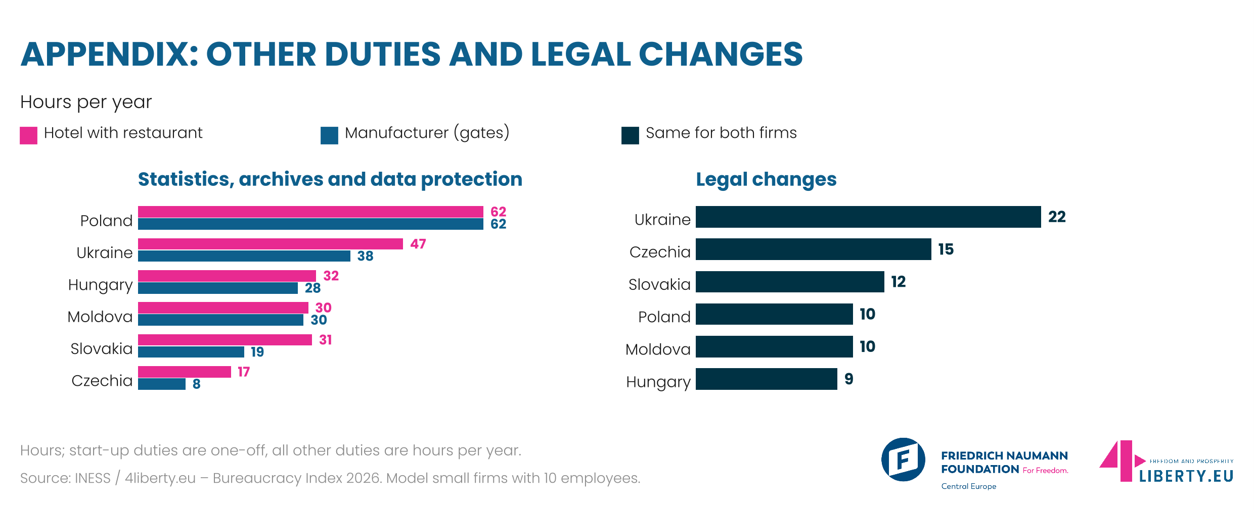
Statistical reporting, archiving and data protection take the most time in Poland (62 hours), mainly because of ongoing archive upkeep (48 hours), and in Ukraine (47 hours for the hotel, 38 for the manufacturer), where several statistical reports are monthly. Czechia needs the least (8–17 hours). Keeping up with amendments to the three key business laws costs between 9 hours (Hungary) and 22 hours (Ukraine) a year.