





The day after election night, Hungary woke up to outstretched arms, ready to embrace its return to Europe. April 12, 2026, stands as a pivotal moment in the history of Hungarian democracy. The victory of Péter Magyar and the Tisza Party marked the end of Viktor Orbán and Fidesz’s 16-year reign, ushering in a new chapter in the country’s modern timeline.
Facts and Figures: The Tisza Flood
To fully grasp the significance of the Tisza Party’s victory, it is essential to understand the mechanics of the Hungarian electoral system. In Hungary, members of parliament are elected using a mixed electoral approach, involving two ballots cast by voters. Out of the 199 members of the National Assembly (essentially the Parliament), 106 are elected in single-member districts based on a relative majority principle, while the remaining 93 seats are filled from a national list through proportional representation.
The entry threshold for party lists is set at 5%, while joint lists can face requirements of 10% or 15%. A noteworthy aspect of this system is the fractional vote recount, which enhances the list outcome by incorporating votes from losing candidates in single-member districts and utilizing the “surplus” votes from winning candidates. This mechanism effectively bolsters the position of the winner, contributing significantly to the formation of a stable parliamentary majority, and in some instances, even a two-thirds majority.
Péter Magyar’s triumph is particularly remarkable as he secured this two-thirds majority in a system that has been designed by the former incumbents to marginalize opposition parties. His victory serves as a powerful symbol of unity among Hungarians, reflecting their collective defiance against oppression — a recurring theme throughout the nation’s history.
With 98.93% of the votes counted (excluding absentee ballots), the results are as follows: the Tisza Party is projected to secure 138 seats, having garnered over 3 million votes. At the same time, the Fidesz-KDNP coalition is expected to receive 55 seats, their number of votes amounting to about 2 million and 250 thousand votes. Mi Hazánk is the only smaller party managing to surpass the 5% entry threshold, projected to gain 6 seats in the Hungarian Parliament.
This outcome grants the Tisza Party a commanding two-thirds supermajority, empowering Péter Magyar to initiate significant constitutional changes and reshape the institutional framework established over the past 16 years. The near-total collapse of traditional opposition parties is underscored by the fact that only the far-right Mi Hazánk persists as a minor parliamentary presence outside the two dominant blocs.
It is noteworthy here that two other smaller parties, the Democratic Coalition (DK) and the Hungarian Two-Tailed Dog Party (MKKP), were also in the running for governance. Klára Dobrev, the leader of DK, has resigned from her position after garnering minimal support and failing to reach the entry threshold. This resignation is significant, especially given that Dobrev is the former partner of Ferenc Gyurcsány, who served as Hungarian Prime Minister from 2004 to 2009, his government directly preceding the 16-year Orbán regime. In terms of the former incumbents, the Fidesz-KDNP coalition now faces a new reality, becoming a diminished opposition that holds its lowest number of seats since the 1990s.
Figure 1: Projected seats in the Hungarian Parliament starting in May 2026
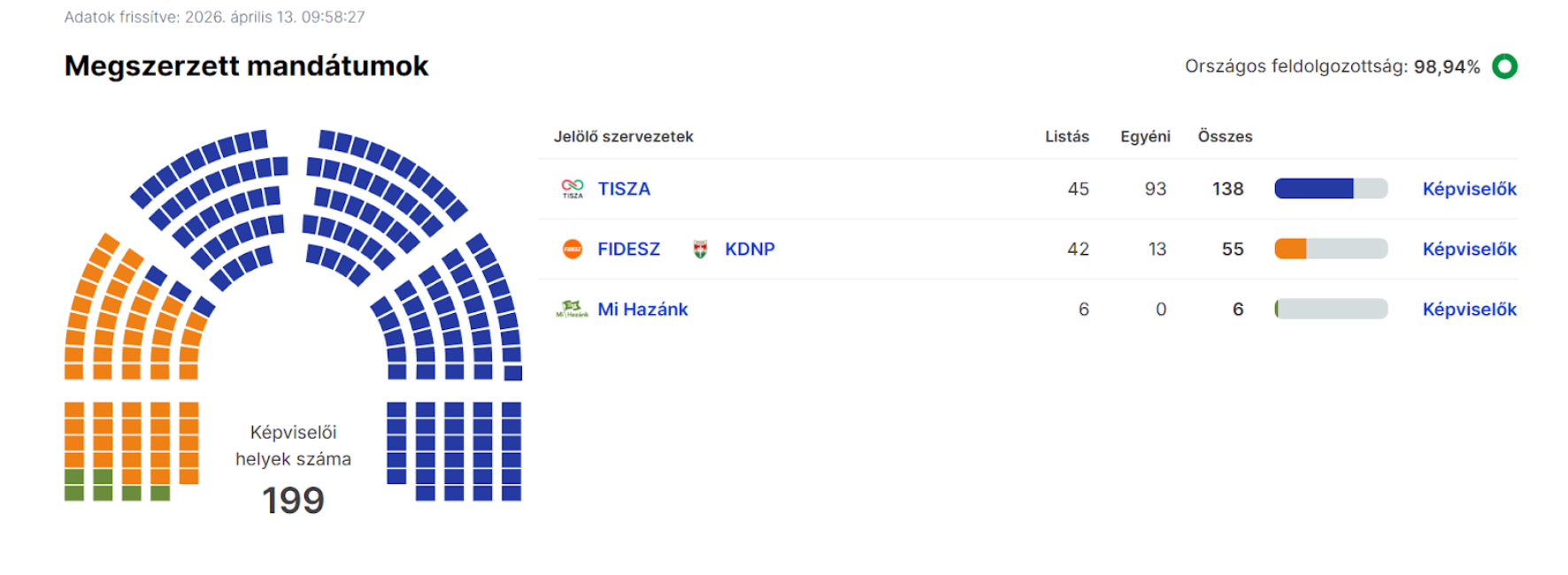
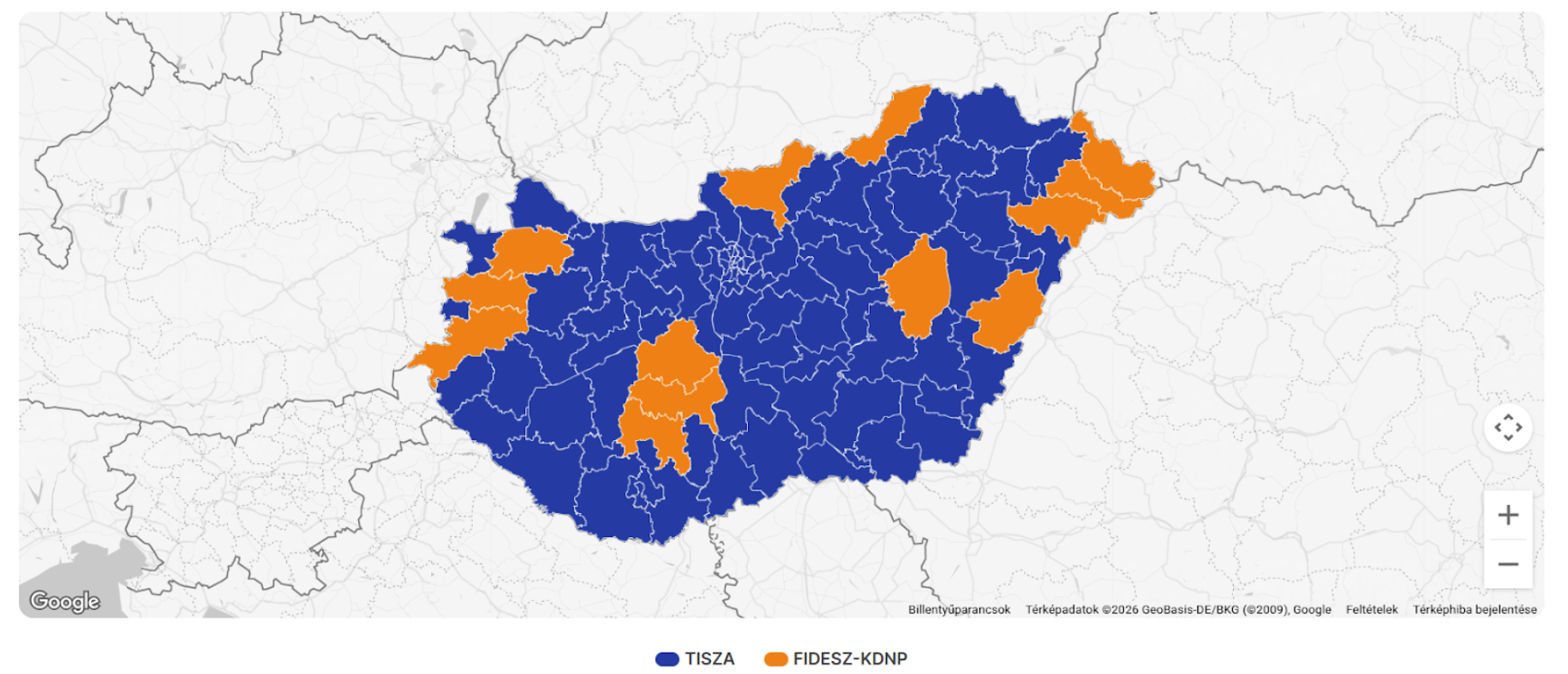
Figure 2: Results of the single-member districts
Political Post-Mortem: Expert Perspectives on the Results
According to an article from Telex, by Balázs Cseke, the smooth formation of the new Tisza-led government is likely. In this article, Nóra Novoszádek, the head of the Rule of Law Program at the Hungarian Helsinki Committee, shares her insights on the nomination process for Hungary’s prime minister. She emphasizes that while the president of the republic is legally permitted to nominate anyone without a criminal record who is eligible for the position, political pragmatism and the need for stability play a crucial role in the decision-making process as to who will be asked to form the government.
Following the Tisza Party’s resounding two-thirds victory, it seems almost certain that Hungary’s president, Tamás Sulyok, will ask Péter Magyar to assume the role, a scenario hinted at by the President’s congratulatory remarks. Historically, since 1990, the National Assembly has consistently approved the head of state’s nominee. Gábor Török, a political analyst, was also interviewed, and his ideas further reinforce this perspective, noting that the President must make the decision in strict accordance with the Hungarian Constitution, taking into account the final election results, and is obliged to make this decision public.
Expanding on the prospects of the newly formed government, Politico offers insights into the economic outlook. They suggest that the Tisza Party’s two-thirds majority creates the most favorable scenario for both the market and the EU. Interestingly, before Sunday’s vote, this outcome was considered one of the least likely. The article highlights that while the EU is likely to support the new Hungarian government, it will probably proceed with greater caution in unfreezing funds, taking lessons from the situation in Poland and expecting guarantees from Hungary.
The election result could also signify a crucial turning point for the Hungarian economy. The victory of Tisza presents a valuable opportunity for credible fiscal consolidation, something that was notably lacking under the Fidesz government. Analysts predict that the budget deficit could potentially be reduced from the current 5.5% to between 3.5% and 4% if EU funds help ease financing pressures.
To maintain market confidence, it would be essential for the new government to swiftly rebuild its relationship with the EU and establish a clear and transparent fiscal framework. The status of the currency, the forint, is also noted. A qualified majority in Hungary suggests that the market will have another reason to extend the forint’s appreciation.
The Passing of the Torch
The Tisza Party’s victory became clear when Magyar announced that Viktor Orbán had personally congratulated him via phone call on becoming the next prime minister, even though the vote count had not yet reached 80 percent. Shortly thereafter, the former prime minister delivered a speech acknowledging his defeat and recognizing Tisza’s win, which lasted about five minutes. In his address, Orbán expressed his disappointment with the election results but also recognized the evident nature of Tisza’s win. He emphasized that his party would not give up and would focus on reinforcing its presence and supporting its communities during its time in opposition.
Barely before midnight, in his speech, Péter Magyar celebrated an unprecedented victory, highlighting that his 3 million votes represent the largest support base in Hungary’s democratic history. After expressing gratitude to his family and colleagues, Magyar proclaimed the fundamental collapse of the Orbán administration, citing a clear public rejection of the “illiberal model” and the systemic misuse of state resources. He framed the election outcome not just as an opposition victory but as a triumph for the Hungarian people as a definitive return to European values.
Emphasizing a paradigm shift in governance, Magyar asserted that the state must prioritize serving its citizens, particularly through quality healthcare and education, rather than the other way around. He envisioned a “civil Hungary” where no citizen is subjugated to foreign interests or marginalized for their beliefs. Magyar’s rhetoric moved toward a broader definition of equality, suggesting that the new administration would move past the exclusionary social policies of the previous decade in favor of a more pluralistic society. He promised to foster a democratic future that welcomes back those who had been forced into emigration by the previous regime.
Looking ahead, Magyar acknowledged the challenges of dismantling 16 years of systemic damage. However, he assured a restoration of democratic institutions, the rule of law, and Hungary’s standing within the EU and NATO. His diplomatic roadmap emphasizes this reorientation, with his first official visit planned to Poland to strengthen bilateral ties, followed by trips to Vienna and Brussels. In his final remarks, Magyar invoked historical imagery and called for accountability for past corruption, reaching out to Fidesz voters and embracing all generations, pledging to be a prime minister for the entire nation.
The Turning of the Tides
The historic shift on April 12, 2026, symbolizes more than just a change in leadership; it signifies a fundamental recalibration of the Hungarian state. With the Tisza Party securing a supermajority in a system previously designed to favor incumbents, they have received a clear mandate to dismantle the “illiberal” framework that has governed the country for the last 16 years and to reinstate robust democratic principles.
The road ahead promises to be challenging; however, the record-breaking voter turnout indicates a population eager to face the complexities of a pluralistic society. As the “Tisza flood” recedes, a transformed political landscape should emerge where the government is once again expected to serve its citizens. With a prime minister-elect dedicated to inclusivity and the vision of a “Civil Hungary,” the nation stands on the brink of a new era.
For the first time in a generation, Hungary’s future is shaped not by isolation or systemic overreach, but by a decisive return to the European fold and a renewed commitment to accountability. The currents have shifted; now, the work of rebuilding can truly begin.