





- Well-designed environmental policy can strengthen the competitiveness of the construction sector, while policy based on excessively detailed procedures and formal indicators can weaken it. At the same time, cost pressures associated with energy and materials force firms to become more efficient, and energy and material efficiency are important sources of competitive advantage.
- The current model of “green construction” in Poland relies heavily on certificates and design-stage indicators, which do not guarantee real emissions reductions or greater energy efficiency.
- Design and investment decisions are often disconnected from the subsequent benefits and costs of operating a building. This problem is compounded by the gap between design and actual construction performance (the performance gap), and by parallel assessment frameworks arising from legislation, financing conditions, market standards and certification. These encourage optimization for documentation rather than real outcomes.
- Effective climate policy in construction should reward measurable performance over the entire life cycle of a building, at the lowest possible compliance cost. This requires shifting the emphasis from increasingly detailed efficiency requirements to technology-neutral minimum standards, disclosure of actual performance, and simpler procedures wherever those procedures do not improve safety or quality.
Debate about environmental objectives in the construction sector usually comes down to a familiar conclusion: either climate goals or the sector’s competitiveness. Public and industry discussions often assume that growing environmental requirements mean higher costs, less freedom in design and lower returns on investment. As a result, environmental objectives are sometimes treated as an additional requirement to be met only to the minimum extent necessary for a building to obtain a certificate, rather than as part of a rational design and investment strategy.
The same debate plays out in everyday investment and design decisions. In investors’ cost spreadsheets, every “green” item has to compete with other expenditure. In architectural practices, formal environmental requirements often conflict with the need for durable, simple and adaptable buildings. The prevailing model creates a situation in which meeting certification criteria is easier and safer than genuinely optimizing a building’s energy use, materials and emissions over its entire life cycle.
At the same time, the position of the end user remains unclear. An environmental certificate becomes a label attached to a development, but its practical significance can be difficult to interpret: it does not always translate into lower operating costs, a more durable construction or greater comfort for its occupants. As a result, a development’s environmental impact is often understood in terms of meeting formal criteria rather than improving its energy, material or emissions efficiency.
This produces a compromise that satisfies the regulatory system and the certification market, but does not necessarily deliver real emissions reductions or greater competitiveness in construction. This analysis takes as its starting point precisely that discrepancy between declared environmental objectives and the mechanisms used to pursue them in design and investment processes.
Energy Efficiency and Low Life-Cycle Emissions as a Rational Objective and a Driver of Innovation
The Environmental Impact of the AEC Sector
The AEC (architecture–engineering–construction) sector affects the environment on a scale that makes environmental objectives a basic attempt to limit social costs. It encompasses the whole investment and construction chain: design, including architectural and engineering practices; construction, including main contractors and subcontractors; and the related production and supply of building materials. In a broader sense, it also includes the management of buildings during their operation. According to UNEP/GlobalABC reports, in 2022 the sector accounted for approximately 37% of global energy- and process-related CO₂ emissions, while operational emissions from constructions reached almost 10 Gt of CO₂.[1]
The AEC sector’s environmental impact has three overlapping dimensions. The first is operational: a building’s energy demand, or its efficiency in terms of how much energy is needed to provide comfort and functionality through heating, cooling, ventilation and lighting. This is a flow spread over decades of use, which translates directly into operating costs. It is also the main lever for influencing environmental impact during operation: lower demand means less energy and heat production, and therefore lower emissions and less pressure on infrastructure, regardless of whether the building is heated by gas, a heat pump or district heating. The difference lies only in the emissions factor of the energy supplied to the building.
The second dimension concerns materials and construction. A carbon footprint is generated at the outset by materials and the construction process: cement, steel, glass, insulation, transport and construction work. This is known as embodied carbon. Even in modern, energy-efficient buildings, it can account for more than half of whole-life emissions (Lützkendorf and Balouktsi 2022).
The third dimension concerns resources and waste. The AEC sector is one of the largest “consumers” of raw materials, from aggregates to metals, and generates significant waste streams. Infrastructure studies indicate that infrastructure-related material consumption may account for approximately 60% of global material use, with non-metallic minerals used in construction making up the largest component (Global Infrastructure Hub 2023). The consequences are economic as well as climatic: fluctuating raw material prices, supply-chain risks, and disposal and recycling costs.
All three dimensions come down to costs and risks over time, associated with energy, emissions and waste. Managing them is, in effect, a test of economic rationality. Pursuing lower emissions and improved energy efficiency in the AEC sector makes social and economic sense because the sector is large and its products are long-lived: poor technological and material choices accumulate costs for decades.
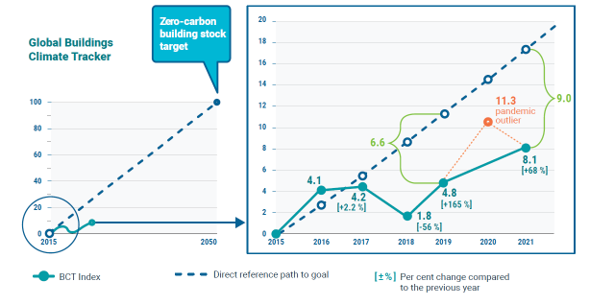
Figure 1: Global Constructions Climate Tracker: Is the global construction sector on track for a zero-carbon construction stock in 2050?[2]
 Source: United Nations Environment Programme 2022, p. xvii, Figure 2.
Energy Efficiency and Low Emissions as Interdependent Dimensions of a Building’s Life Cycle
Public debate often treats energy efficiency and low emissions as equivalent, or even identical, objectives. In the AEC sector, however, they are two distinct, though related, dimensions. The relationship between them has important implications for the actual environmental and economic outcomes of construction investment. Understanding this relationship is essential to the rational design of climate policies and market mechanisms in construction.
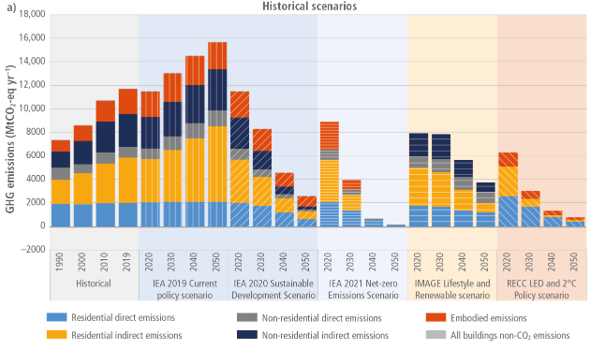
Figure 2: Global greenhouse gas emissions from buildings: Historical trends and reduction scenarios, 1990–2050[3]
 Source: Cabeza et al. 2022, p. 963, Figure 9.3.
Energy efficiency refers to the amount of energy needed to provide a particular function in a building: heating, cooling, ventilation, lighting or domestic hot water. Low emissions, by contrast, concern the reduction of greenhouse gas emissions. They therefore depend both on energy demand and on the emissions intensity of the energy carriers used, as well as on the carbon footprint of materials and processes throughout the supply chain. Research shows that improving energy efficiency very often reduces emissions, but this relationship is not linear (Ke et al. 2024; Ürge-Vorsatz et al. 2020).
A whole-building life-cycle approach (LCA) is therefore particularly important (Cabeza et al. 2022). Focusing exclusively on energy efficiency during operation shifts the emissions problem to other life-cycle stages instead of actually resolving it. Conversely, focusing exclusively on lower-emission energy carriers or materials without reducing demand at the same time increases costs and pressure on the system through higher energy consumption, greater capacity requirements and more infrastructure, rather than delivering genuine whole-life optimization. The right approach is therefore to reward solutions that simultaneously reduce energy demand, use lower-emission energy and reduce the carbon footprint of materials and construction. This should apply whether the outcome is achieved through “passive” measures such as geometry, insulation, airtightness and shading, better workmanship and quality control, or changes in energy sources.
Market Incentives in the AEC Sector and the Problem of Split Incentives
In theory, the objective is simple: improve energy efficiency and reduce emissions intensity, because this approach also makes economic sense over the long term. One might therefore expect the market to reward such solutions on its own. However, a distinctive feature of the AEC sector is the separation of incentives, known as split incentives (Gillingham, Harding and Rapson 2012; International Energy Agency 2007). Operating costs are largely borne by the end user, while the most important design and material decisions are taken earlier by the investor or developer. The latter naturally optimizes construction costs and, in a large proportion of cases, will not pay future electricity and operating bills.
As a result, “greenness” is often assessed primarily at the design and documentation stage, through indicators, procedures and certificates rather than measurable performance in use. In many cases, this translates into a building that is expensive to maintain. Here, the appropriate response, consistent with market principles, is to improve the transparency and availability of building information: disclose expected and actual costs of use, benchmark buildings, and strengthen accountability for declared performance. These measures are discussed in greater detail in the next section.
What Does “Green Construction” Currently Mean?
Today, “green construction” most commonly refers to compliance with a specified set of regulatory, procedural and certification requirements, including energy standards, design obligations and voluntary environmental assessment systems.
This model reflects an attempt to translate complex climate objectives into enforceable operational criteria that can be applied during design, construction and the handover of a building for use. At the same time, the literature increasingly suggests that ease of procedural verification does not always translate into real environmental benefits, especially over a building’s long operating life (Newsham, Mancini and Birt 2009).
The Regulatory Framework: What Formally Defines a Development’s Environmental Impact Today?
At EU level, the main points of reference are:
- The Energy Performance of Buildings Directive (EPBD), which establishes the framework for moving from the existing approach of nearly zero-energy buildings (nZEB) to the standard of zero-emission buildings (ZEB).[4]
- The EU Taxonomy Regulation, which defines which investments can be considered “sustainable” for financing purposes.[5]
- The EU Emissions Trading System (EU ETS), a cap-and-trade system: emissions in the sectors it covers are limited (the cap), and emission allowances can be bought and sold (trade), creating a market price for CO₂.
- EU ETS I covers electricity and heat generation, energy-intensive industry and parts of the transport sector, including aviation within the European Economic Area and maritime transport.[6] For the AEC sector, this has an indirect effect through energy and heat prices, and hence building operating costs, as well as through emissions costs in those parts of the supply chain where material and energy production falls within EU ETS I.
- EU ETS II, which is due to become fully operational in 2028, covers buildings, road transport and additional sectors.[7] This means that the cost of CO₂ will be “embedded” in the prices of energy used during operation, creating a cost incentive to reduce consumption and switch energy carriers, provided that markets and regulation do not weaken that incentive through other instruments.
It should be stressed that, in 2028–2030, emissions from buildings and transport will be covered simultaneously by EU ETS II and by national reduction targets under the Effort Sharing Regulation (ESR).[8] This implies inconsistent emissions pricing and a risk of double regulation (Stagnaro and Zieliński 2025).
In Poland, the formal criteria governing a development’s environmental impact arise primarily from:
- Technical conditions, particularly the EP (primary energy) indicator, the U-value (thermal transmittance of building elements) and requirements for technical systems.
- Obligations relating to energy performance certificates and other energy documentation.[9]
- The gradual tightening of standards for new constructions and renovations, driven by the direction of EU policy, including the EPBD, and implemented through national legislation.
Alongside binding law, a second set of definitions of a development’s “greenness” also operates: certification schemes such as BREEAM and LEED. These are not mandatory, but in many market segments they shape the expectations of investors, tenants and financing institutions in practice. Certificates rely on sets of criteria and metrics intended to organise and compare the environmental quality of developments. However, they often become marketing tools and a language for communicating “greenness”, regardless of whether they translate into actual performance in use.
Inconsistent Incentives in the AEC Sector
As discussed above, environmental objectives are pursued through a set of instruments that create several parallel frameworks:
- Emissions pricing (EU ETS).
- Minimum standards and disclosure obligations (EPBD, technical conditions and certificates).
- Financing criteria (EU Taxonomy).
- Market standards (certificates).
The coexistence of these frameworks need not itself be a problem, since some address real market failures. The problem arises when these instruments begin to regulate the same outcome through different channels, potentially duplicating costs and encouraging optimization for compliance rather than performance.
Two Regimes for the Same Emissions: EU ETS II and the ESR in 2028–2030
The clearest example of overlapping instruments concerns EU ETS II and national ESR targets in 2028–2030. The same emissions from buildings and transport will then be subject both to an EU carbon price under EU ETS II and to a national obligation to meet an emissions budget under the ESR.[10],[11] As a result, countries may introduce additional national measures to comply with the ESR, even though ETS II already “prices” emissions. The result need not be a greater overall reduction, since the total emissions cap remains unchanged. Instead, reductions are required through an additional channel and become more expensive.
EU ETS II and Energy Efficiency Requirements for Buildings
In an ideal model, the EU ETS works like a Pigouvian tax: it sets a price for emissions and leaves the choice of technology to the market. When the cap is binding, additional sectoral policies, such as binding energy-consumption reduction targets or other mandates that accelerate reductions, do not reduce total emissions within the EU ETS but shift them to other industries.
The introduction of emissions trading becomes relevant to buildings because, from 2028, EU ETS II is intended to introduce a CO₂ price into fuels used for heating, among other purposes. This raises a question: if ETS II will increase the emissions cost of fuels anyway, why introduce separate, binding energy efficiency targets? If the cost of emissions is added to the price of fuel, the market receives a clear signal: a building that consumes a great deal of energy will be more expensive to run. The owner can then calculate whether it is more worthwhile to improve insulation, buy better windows, change the heat source or accept higher bills. In a well-functioning market, energy efficiency does not require a separate mandate; it becomes one means of rationally reducing costs.
This applies especially where the party making the investment decision subsequently bears the cost of using the building. When building for their own use, owners have a direct incentive to compare lower construction costs with future energy bills. In the development sector, too, transparent information about expected and actual operating costs should allow buyers or tenants to make an informed comparison not only of purchase prices or rents, but also of future costs of use. A building that is cheaper to buy may prove more expensive over the long term if it generates higher energy bills or requires earlier renovation.
Public policy should therefore shift its emphasis from increasingly detailed energy efficiency requirements towards credible emissions pricing and disclosure of information about the actual costs of using buildings. Energy efficiency then remains important as the outcome of straightforward economic calculation.
The Performance Gap: The Building as Designed and the Building in Use
In construction, efficiency is sometimes measured on paper but paid for through bills. The difference between declared or modelled energy consumption and actual consumption is described in the literature as the performance gap. It is an important source of discrepancies between claimed and actual efficiency (de Wilde 2014).
The phenomenon is well documented. Research reviews show that differences between modelled and actual consumption are widespread. Their causes include modelling assumptions, workmanship, the commissioning of building systems and, above all, user behavior and building management. Classic post-occupancy studies found that actual energy intensity could be higher than expected; these findings later became one of the foundations of the debate about the performance gap (Bordass et al. 2001).
The performance gap can operate in both directions. Alongside the typical situation in which a building consumes more energy in use than in the model or design, the literature also describes cases where measured consumption is lower than forecast. Such a “positive” difference does not always indicate a perfect design. It may reflect conservative modelling assumptions, for example concerning loads, operating hours or weather, but it may also result from a genuinely different pattern of use: lower occupancy, shorter equipment operating hours, or different temperature and ventilation settings. Researchers also stress that the gap varies over time and depends on the conditions of observation, including the measurement period, organizational changes and weather. A single annual result does not therefore always capture the way design assumptions and operational performance diverge.
The cases below, documented by researchers, illustrate how large the differences between design and reality can be, in terms of both higher and lower energy demand. The associated cost differences resulting from underestimating or overestimating building performance have been calculated.
The case studies show that deviations between designed and actual energy performance can be substantial. Actual consumption in some buildings is much higher than assumed, for example +140% at IfM Cambridge, while in others it is much lower, for example −43.1% in the monitored office building in China.
In cost terms, at typical final-energy prices and exchange rates, the annual OPEX difference resulting from the gap can range from a few thousand zlotys, when the gap is small or the building is small, to several hundred thousand zlotys a year, when the gap is large and concerns a medium-sized or large non-residential building.
The most commonly identified causes fall into three groups:
- Incorrect or inappropriate model inputs and assumptions, such as internal gains, thermal capacity and airtightness.
- Actual conditions of use omitted from the forecast, such as comfort temperatures, schedules and intensity of use.
- The complexity and tuning of technical systems, including actual efficiencies, controls and seasonality.
- Examples of gaps between actual and designed energy consumption in buildings and their financial consequences[12]
| Parameter | Institute for Manufacturing | Center for Interactive Research on Sustainability | Energy-efficient social housing | 18-storey office building |
| Building; total floor area | Offices and laboratories; 4,380 m² | 5,434 m² | 40 flats; 3,024 m² | 23,471 m² |
| Country; year opened | United Kingdom; 2009 | Canada; 2010 | Canada; 2015 | China; 2017 |
| Certification | BREEAM Excellent; Cambridge Work Plan; EPBD | LEED Platinum | LEED Platinum | LEED Platinum; Chinese Three-Star Green Building |
| Energy consumption measurement period | January 2010–July 2014 | April 2012–March 2013 | January–December 2016 | November 2017–October 2018 |
| Designed energy consumption (kWh/m²/year) | 75.0 | 80.0 | 74.3 | 42.0 |
| Actual energy consumption (kWh/m²/year) | 180.0 | 126.0 | 129.1 | 23.9 |
| Difference (%) | +140.0% | +57.5% | +73.8% | −43.1% |
| ΔOPEX (PLN/year; PLN/m²/year) | +285,000; +65.07 | +92,713; +17.06 | +37,136; +12.28 | −220,692; −9.40 |
Source: Author’s calculations based on Pritchard and Kelly 2017; Salehi et al. 2015; Rouleau, Gosselin and Blanchet 2018; Wang et al. 2019.
The scale of these deviations is consistent with that reported in the literature. In a review covering 62 non-residential buildings, actual consumption was on average 34% higher than predicted, with a standard deviation of 55% (van Dronkelaar et al. 2016). The gap is neither marginal nor confined to one direction. Alongside buildings consuming considerably more energy than expected, the review also identified the opposite cases: measured consumption in a British office building in Cornwall was 30% below the design forecast, in an office building in Sheffield it was 17% lower, and across four monitored office buildings in Australia it was 14% lower on average.
This shows that “greenness” based exclusively on design-stage indicators does not always reflect operational performance. This matters for the effectiveness of proposed policies and existing market mechanisms.
A Certificate Instead of Performance: A Marketing Tool That Does Not Guarantee Results
The best-known examples of certification in construction are environmental certification schemes such as LEED, BREEAM and similar systems. Obtaining a certificate itself imposes a cost on the investor, including design preparation, documentation and administration of the process. The literature includes both cases in which the direct cost of applying for LEED certification was estimated at below 2% of the project value (Mapp, Nobe and Dunbar 2011), and cases indicating an additional “greening” cost of 7–9% of construction costs. At the same time, property-market research indicates that green certification can be reflected in prices: an analysis of office transactions in Finland, France and Germany found an average price premium of 19% relative to uncertified buildings (Porumb, Maier and Anghel 2020).
Certification does not necessarily guarantee the desired outcome either. For example, a study of 100 LEED-certified buildings showed that, although some used less energy on average than conventional buildings, 28–35% used more. Actual efficiency was only weakly correlated with certification level and the number of points obtained at the design stage (Newsham, Mancini and Birt 2009). Another widely discussed critique compared energy use in LEED office buildings with a reference sample and found that the data did not unambiguously support an aggregate advantage for LEED (Scofield 2009). A more recent analysis of retrofits to US federal buildings that received LEED certification goes further: although energy savings were an explicitly stated objective of the federal efficiency programme, the LEED-certified retrofits did not produce statistically significant energy savings on average across the sample (Clay, Severnini and Sun 2023).
A certificate can therefore have substantial transactional and reputational value, but it is not equivalent to a guarantee of operational performance. From the perspective of public policy and the sector’s competitiveness, this creates a risk of incurring compliance and capital costs without an equally certain benefit in the form of lower energy bills.
Technology as a Fetish
The current system also tends to reward technological solutions that are easy to present in documentation as systems guaranteeing greater energy savings, and therefore a higher score for a building’s “greenness”, but are not necessarily optimal from a life-cycle perspective.
Building management and automation systems (BMS/BAS) provide a good example. In design assumptions, they are expected to reduce energy consumption through intelligent HVAC control. However, suboptimal settings, control errors or inadequate commissioning and tuning can increase energy consumption, by approximately 5–30% in the case of poorly configured BMS systems (Granderson et al. 2017). This leads to more complex building systems, higher maintenance costs and operational risks that emerge after several years of use.
Moreover, automation itself is not “free” in energy terms. In highly automated buildings, its own energy consumption has been estimated at 2–5 kWh/m² a year (Kräuchi, Jurt and Dahinden 2016). Taking as a reference the average household electricity price, including the distribution charge, published by Poland’s Energy Regulatory Office (URE), which was PLN 0.828/kWh in 2024, the additional cost is PLN 1.66–4.14/m² a year. In a building with an area of 10,000 m², this means an extra PLN 16,600–41,400 annually.
The problem becomes even clearer when systems are brought into proper operation after a building is handed over, a process known as commissioning. A meta-analysis of 1,500 buildings in North America found a median commissioning cost of USD 8.78/m² for new construction and USD 2.85/m² for existing buildings (Crowe et al. 2020). These amounts correspond to approximately PLN 32.54/m² and PLN 10.56/m² respectively. In a new 10,000 m² office building, simply getting advanced systems to work properly may therefore cost approximately PLN 325,000, compared with around PLN 106,000 in an existing building. In other words, part of the cost of the “technology fetish” is not apparent when a system is purchased. It emerges later, through corrections, tuning, maintenance and the energy consumed by a system that was intended to save energy.
The literature suggests that some performance-gap problems stem precisely from excessive reliance on technical systems and a mismatch between those systems and actual patterns of use (Bordass, Cohen and Field 2004).
“Europe Is Increasing Production Costs, So Non-EU Competitors Will Drive European Firms out of the Market”?
A frequent criticism of environmental policy is that “Europe is increasing production costs, while producers outside the EU, for example in China, India or Ukraine, do not face comparable burdens and will therefore win on price”. This argument requires qualification.
First, the EU limits the risk of carbon leakage and an uneven competitive playing field in the most emissions-intensive industries through the Carbon Border Adjustment Mechanism (CBAM). This works like a “carbon levy at the border”: importers of selected goods must purchase CBAM certificates corresponding to the emissions generated during their production, priced in relation to EU ETS allowances. This prevents imports from enjoying an advantage over EU production that bears an emissions cost.
From January 01, 2026, the mechanism covers selected goods, including cement, iron and steel, aluminum, fertilizers, hydrogen and electricity. In these sectors, the claim that “imports will always win because they do not pay for CO₂” is weaker, because the EU is seeking to apply the carbon cost at the border. However, the mechanism does not cover the full range of products important to construction, particularly more highly processed products. In these cases, price pressure from imports may be real. It should also be remembered that, in its current form, CBAM does not resolve the competitiveness problem for EU exports: a producer selling outside the Union still bears an ETS cost that its competitor in a non-EU market may not face. The Commission itself has recognized this problem and announced work on ways to reduce the risk of carbon leakage for exporters in CBAM sectors.[13] The ETS itself also requires careful assessment. It generates substantial public revenue, but its effectiveness depends on whether those funds actually return to areas that reduce the cost of the transition: industrial modernization, grids, cheaper energy, building renovation and protection for vulnerable consumers. If ETS proceeds are treated mainly as additional budget revenue, or compensate for the effects of rising prices without addressing their causes, the system begins to be seen more as a cost than as a modernization tool.
Nevertheless, it is important to avoid the shorthand claim that “nobody outside the EU is doing anything”. According to the International Carbon Action Partnership (ICAP), emissions trading systems already operate in many jurisdictions around the world, and further systems are being developed. China, for example, is developing its national ETS and has announced its expansion to sectors such as steel, cement and aluminum,[14] while India is building its own framework for a national carbon market based on certificate trading.[15]
Cost pressures associated with materials and energy are therefore real, particularly in the AEC sector, which is heavily dependent on cement, steel, aluminum, glass, energy and long supply chains. European climate policy can create a technological and organizational advantage in this sector, but only if higher regulatory costs are translated into actual modernization: cheaper and lower-emission materials, better design processes, less material waste, better workmanship and lower building operating costs. If, however, CBAM covers only some of the products relevant to construction, the export problem remains unresolved, and ETS proceeds do not effectively return to investment that lowers transition costs, the competitiveness argument remains serious.
The emphasis should therefore be on access to cheap, low-emission energy. Without it, producing cement, steel, aluminum, glass or prefabricated components will be more expensive in the EU than outside it. Second, the export problem needs to be addressed within CBAM, so that European producers selling outside the Union do not bear ETS costs unilaterally in markets where their competitors face no comparable burden. Third, ETS funds should return to investment that actually reduces future costs and contributes to technological development and competitiveness. Otherwise, higher regulatory costs may translate into more expensive investment, pressure on margins and weaker European construction-sector firms, rather than a technological advantage.
Setting the Rules for Energy-Efficient, Low-Emission Construction: Performance, Information and Simpler Procedures
Performance Rather Than Declarations as a Condition for Effective Incentives
Identifying the main barriers—split incentives between investors and users, the performance gap, certification as a marketing signal, and a preference for solutions that are easy to document—leads to the conclusion that construction struggles to deliver lasting results when quality assessment relies primarily on design data. Energy parameters established at the design stage do not necessarily translate directly into performance after handover. Energy consumption depends, among other things, on the commissioning and settings of systems, building management and actual usage profiles.
In this model, the state’s role is not to impose a separate energy efficiency target, but to ensure that the market has access to reliable data on the actual costs of using buildings. The aim is for performance data to be comparable and verifiable, so that they can be reflected in prices, rents and financing terms.
Such instruments should be based on the following criteria:
- Proportionality: tools should primarily target developer-built, commercial and public buildings, rather than individuals building a home for their own use. The greatest consequences arise where decisions are taken by a party other than the one who later bears the operating costs, particularly in large residential, commercial and public buildings. Information asymmetry is greatest in these segments, and the consequences of errors—high bills, lower comfort and pressure on the energy system—emerge over many years and on a large scale.
- Low administrative cost: as much use as possible should be made of data already collected through meters, billing or building management systems.
- Transparency and competition: when the market receives comparable information about costs of use, it can more readily reward buildings that really operate efficiently rather than merely look good in design documentation.
This model has an additional advantage: it narrows the scope for “environmental quality” to become merely a marketing label. If measurable performance in use is rewarded, technologies and architectural solutions compete on results rather than on how easily something can be documented at the design stage.
How Does It Work in Practice? Performance Disclosure and Benchmarking in Selected Countries
International experience shows that relatively “light” information infrastructure, based on disclosing comparable energy performance in use, can effectively stimulate competition. These instruments generally operate selectively, for example only for large or public buildings, and are often linked to the point of a transaction, which limits bureaucracy.
- Australia’s Commercial Building Disclosure mechanism requires a current Building Energy Efficiency Certificate (BEEC) disclosing energy efficiency information when most office premises larger than 1,000 m² are advertised or offered for sale, lease or sublease.[16] The programme relies on the NABERS system, which focuses on measured building performance and is widely used in the commercial sector. Official programme materials point to significant energy-cost savings achieved by users of the ratings.
- United Kingdom. In the United Kingdom, Display Energy Certificates (DECs) concern public buildings by definition and are operational in nature: they show actual energy use, through an operational rating based on meter data, and are publicly available.[17] This approach has the advantage of separating two functions: minimum standards can remain design-based, while the assessment of actual building performance is based on measurements in use.
- New York. In New York, Local Law 84 requires annual benchmarking of energy and water consumption in large buildings.[18] From the perspective of effectiveness, empirical research estimates that New York’s benchmarking and disclosure policies were associated with reductions in building energy use over a period of several years (Meng, Hsu and Han 2017).
These examples share a common lesson: “performance in use” can be treated as part of market infrastructure. When it is measured and comparable, it begins to work as a price signal, influencing the decisions of tenants, investors and financing institutions. This in turn creates an incentive to narrow the performance gap and improve buildings’ actual energy and emissions performance.
How Can This Approach Be Applied in Poland?
Poland already has the basic information infrastructure. The Central Register of the Energy Performance of Buildings (CHEB) operates as an ICT system and includes, among other things, lists of certificates and authorized persons.[19] At the same time, the legislature has introduced a disclosure obligation for market transactions: if a certificate has been issued, advertisements or notices concerning a sale or lease must include its key energy-consumption and emissions indicators. This is a step in the right direction, but it primarily concerns modelled, ex ante information, whereas the greatest cost and environmental risks emerge during operation.
If the aim is to strengthen incentives without adding bureaucracy, the most sensible approach is to use what already works and add the element currently missing: comparable energy performance in use, measured ex post. This should apply only where information asymmetry and split incentives are greatest: public buildings and larger developer-built and commercial properties.
The first, cheapest and least controversial step is to make disclosure obligations in advertisements more effective and meaningful. Since the indicators must be provided anyway, the aim should be for an advertisement to contain an unambiguous reference to the document, such as the certificate number in the register, or for a listing portal to be able to import the CHEB data automatically. CHEB already publishes a list of certificates and basic information, allowing verification and reducing the circulation of paper documents without increasing costs for citizens.
The second step, an operational component for public buildings, can be introduced relatively easily because the public sector already operates under transparency requirements. The reference point here is the British model, in which Display Energy Certificates show actual energy consumption based on meter data and are publicly available. In Poland, it would be sufficient to publish annual energy use per m² for selected categories of public buildings above a floor-area threshold, based on metered bills and with a basic weather adjustment. The purpose is both market-related and managerial: buildings become comparable, and managers receive a clear signal as to whether a property is operating as intended.
The third step, for commercial buildings and larger developments, is best applied only at the point of a transaction, rather than through annual reporting for the entire market. Australia again provides a useful reference: its Commercial Building Disclosure programme requires a BEEC for most office premises larger than 1,000 m² before they are advertised or offered for sale or lease. This requires disclosure of comparable information without prescribing technology. In Poland, an analogous rule could apply, for example, to larger office buildings and selected major institutional projects. When a property is sold, space is introduced to the rental market or active marketing to tenants begins, its operational performance would be disclosed if the building is already in use. For a new building, performance would be disclosed after the first full year of occupation, in connection with building management and the tuning of systems.
Designed in this way, the addition meets the requirements of proportionality and minimal bureaucracy. It relies on data already generated through energy billing and does not cover those building for their own use: owners who construct a building for themselves will bear the consequences of potentially higher bills, so compulsory disclosure is unnecessary. Its role is strictly informational, enabling the market to price life-cycle costs and reduce phenomena such as the performance gap.
Contractual and Financial Mechanisms
The performance-based information tools described above—operational-data disclosure and benchmarking—allow the market to compare buildings on the basis of actual energy use rather than design declarations alone. By themselves, however, they do not fully resolve the problem of split incentives. Design and construction decisions are taken at the very beginning, whereas costs and performance deviations emerge later, often on the user’s side. In the institutional and development segments, this gap can be closed through contractual and financial mechanisms that link part of the responsibility for performance to design, construction and commissioning.
The first solution is a performance warranty: a contractual commitment by the developer, main contractor or building-services integrator that the building will achieve an agreed range of energy performance in use, such as annual energy consumption per m², under clearly specified boundary conditions. It is also important to distinguish the sources of influence. The warranty should not penalize a “different profile” of users; it should cover those elements under the control of the parties during design, construction and configuration: airtightness, workmanship, efficiency, control logic and correct settings. This mechanism works particularly well where there is a single owner and manager, as in offices, institutional rental housing and institutional buildings, because consistent operating rules are easier to establish and maintain. Economically, it is a risk-reduction tool: tenants, investors or banks receive a commitment concerning performance, which can be reflected in rents, capitalization rates and financing costs.
The second mechanism is a guarantee retention held for 12 months after the building is handed over. A small portion of the price or fee is withheld temporarily and released after the first full season of use if the building meets the agreed energy-performance range, or if an agreed process of tuning and adjustment has been completed and identified defects have been corrected.
A third element reinforcing both tools is the role of finance and insurance. If the market is to reward performance, capital providers—banks, funds and insurers—are a natural channel. Financing institutions can incorporate into their due-diligence standards requirements for (a) disclosure of operational performance where available and (b) a guarantee retention in development or institutional projects. As a result, parties that reduce performance-gap risk and are able to assume it contractually may secure better financing terms.
Simpler Procedures for Low-Risk Work: Reducing Compliance Costs
The proposed simplification of procedures concerns transaction costs and uncertainty of interpretation that are unnecessary in many cases, rather than safety standards. In the AEC sector, losses often stem from unclear boundaries between procedures, duplicated approvals and excessive documentation that does not improve performance in use.
Many low-risk activities currently face more complex procedures not because safety genuinely requires them, but because the parties fear misclassifying the works and the resulting formal consequences. This is particularly visible in the “grey areas” between renovation and reconstruction, in the classification of changes made during construction, and in adaptations that do not materially alter a building’s character but prompt excessive caution.
Another source of compliance costs is the duplication of approvals and documents. The same information about materials, building services, parameters and compliance circulates through several processes: design, construction, acceptance and, sometimes, finance and certification. Each expects its own format, increasing costs.
Finally, simplification should also cover project close-out. Large volumes of as-built documentation are sometimes treated as “proof of compliance” rather than useful information for managers and users. In a performance-oriented model, what matters more is that documentation should be concise, standardized and operationally useful.
A Single Source of Data in the Construction Process: Reducing Document Duplication Through a Shared Digital Platform
One of the most practical ways to reduce compliance costs in the AEC sector is to limit the duplication of the same information across many parallel processes. Digitalization of Poland’s construction process has already begun. Existing services include online application submission through the e-Budownictwo portal,[20] an electronic construction log and a digital building logbook developed by the General Office of Building Control.[21] Despite this, participants still prepare similar sets of documents for different purposes: administrative authorities, approvals, banks and insurers, and certification. This generates costs and delays without a proportionate improvement in safety or quality.
It is therefore worth considering the further development of existing solutions into a single digital platform based on the principle “upload once, use many times”. The investor or designer would submit the design digitally together with a basic dataset. Institutions and other participants in the process—administrative authorities, supervisory bodies and, eventually, financing and auditing entities—would not have to request further copies and attachments. Instead, they could refer to the same version of the data through access permissions.
Such a platform should provide a mechanism for organizing existing requirements. In particular, it would require:
- Data standardization, so that different institutions do not request the same information in different formats.
- Version control and accountability, making clear who made a change, when it was made and which version is current.
- Interoperability with tools used later in a building’s life cycle, such as the construction log and building logbook, so that some information transfers automatically from design to construction and operation instead of being created again from scratch.
Conclusions
In the AEC sector, the cost pressures associated with energy, materials and contractual risks mean that efficient use of resources—energy and materials—is becoming a condition of economic rationality rather than a “nice extra that benefits the environment”. Environmental objectives are justified, but attention needs to be paid to the tools used to pursue them in practice.
This analysis shows that the current model for assessing the environmental quality of developments is largely procedural and uses ex ante information: it rewards easily verified design indicators, checklists and certificates. In reality, such information often serves a marketing function. It allows a development to be labelled “green” or “sustainable”, but does not determine whether the building actually achieves low environmental and energy costs in use. Under conditions of split incentives, where decisions rest with investors but operating costs fall on users, and a performance gap between design and actual operation, the market learns to optimize for compliance and documentation rather than lasting operational outcomes.
At the same time, transition costs in construction enter the sector largely indirectly, through energy and materials, especially energy-intensive materials. This makes it all the more important for public-policy instruments to be designed economically and precisely: they should lead to measurable improvements in performance rather than merely increase the complexity of the investment process.
In this context, a key change is to shift the emphasis from declarations to performance. This means optimizing “information infrastructure” based on comparable data and strengthening accountability for outcomes in the segments where scale and information asymmetry are greatest. In parallel, wherever risk is low, simpler procedures and less uncertainty of interpretation are needed. Environmental objectives must be achieved, but the way they are implemented in the AEC sector should minimize compliance costs and maximize results.
Written by Nadia Sajjad – an IARP architect
References
Bordass, B., Cohen, R. and Field, J. (2004), Energy Performance of Non-Domestic Buildings: Closing the Credibility Gap, Building Performance Congress.
Bordass, B., Cohen, R., Standeven, M. and Leaman, A. (2001), Assessing building performance in use 3: energy performance of the Probe buildings, Building Research & Information, 29(2).
Cabeza, L.F., Bai, Q., Bertoldi, P., Kihila, J.M., Lucena, A.F.P., Mata, É., Mirasgedis, S., Novikova, A. and Saheb, Y. (2022), Buildings, in Intergovernmental Panel on Climate Change, Climate Change 2022: Mitigation of Climate Change. Contribution of Working Group III to the Sixth Assessment Report of the Intergovernmental Panel on Climate Change, Cambridge University Press, Cambridge–New York.
Clay, K., Severnini, E. and Sun, X. (2023), Does LEED certification save energy? Evidence from retrofitted federal buildings, Journal of Environmental Economics and Management, 121, 102866.
Crowe, E., Mills, E., Poeling, T., Curtin, C., Bjørnskov, D., Fischer, L. and Granderson, J. (2020), Building commissioning costs and savings across three decades and 1500 North American buildings, Energy and Buildings, 227.
de Wilde, P. (2014), The gap between predicted and measured energy performance of buildings: A framework for investigation, Automation in Construction, 41.
Gillingham, K., Harding, M. and Rapson, D. (2012), Split Incentives in Residential Energy Consumption, The Energy Journal, 33(2).
Global Infrastructure Hub (2023), Advancing the circular economy through infrastructure: Roadmap for practitioners in circular infrastructure, 14 December.
Granderson, J., Singla, R., Mayhorn, E., Ehrlich, P., Vrabie, D. and Frank, S. (2017), Characterization and Survey of Automated Fault Detection and Diagnostics Tools, Lawrence Berkeley National Laboratory, November.
International Energy Agency (2007), Mind the Gap: Quantifying Principal-Agent Problems in Energy Efficiency, OECD Publishing, Paris.
Ke, Z., Zhang, H., Jia, X., Yan, J., Lv, X., Yu, H., Gao, N., Zeng, W., Liu, Y. and Wong, N.H. (2024), Research on energy efficiency and decarbonization pathway of nearly zero energy buildings based on system dynamic simulation, Developments in the Built Environment, 17.
Kräuchi, P., Jurt, D. and Dahinden, C. (2016), Projekt „Eigenenergieverbrauch der Gebäudeautomation” (EEV-GA), Ergebnisbericht [“Energy consumption of building automation” (EEV-GA) project: results report], Bundesamt für Energie, Bern, 27 January.
Lützkendorf, T. and Balouktsi, M. (2022), Embodied carbon emissions in buildings: explanations, interpretations, recommendations, Buildings and Cities, 3(1).
Mapp, C., Nobe, M.E. and Dunbar, B. (2011), The Cost of LEED – An Analysis of the Construction Costs of LEED and Non-LEED Banks, Journal of Sustainable Real Estate, 3(1).
Meng, T., Hsu, D. and Han, A. (2017), Estimating energy savings from benchmarking policies in New York City, Energy, 133.
Newsham, G.R., Mancini, S. and Birt, B.J. (2009), Do LEED-certified buildings save energy? Yes, but…, Energy and Buildings, 41(8).
Porumb, V.-A., Maier, G. and Anghel, I. (2020), The impact of building location on green certification price premiums: Evidence from three European countries, Journal of Cleaner Production, 272.
Pritchard, R. and Kelly, S. (2017), Realising operational energy performance in non-domestic buildings: lessons learnt from initiatives applied in Cambridge, Sustainability, 9(8).
Rouleau, J., Gosselin, L. and Blanchet, P. (2018), Understanding energy consumption in high-performance social housing buildings: A case study from Canada, Energy, 145.
Salehi, M.M., Cavka, B.T., Frisque, A., Whitehead, D. and Bushe, W.K. (2015), A case study: The energy performance gap of the Center for Interactive Research on Sustainability at the University of British Columbia, Journal of Building Engineering, 4.
Scofield, J.H. (2009), Do LEED-certified buildings save energy? Not really…, Energy and Buildings, 41(12).
Stagnaro, C. and Zieliński, M. (eds) (2025), Energising Europe: A Market Approach to Clean and Abundant Energy, European Policy Information Center, 25 February.
United Nations Environment Programme (2022), Global Status Report for Buildings and Construction: Towards a Zero-emission, Efficient and Resilient Buildings and Construction Sector, Nairobi.
Ürge-Vorsatz, D., Khosla, R., Bernhardt, R., Chan, Y.C., Vérez, D., Hu, S. and Cabeza, L.F. (2020), Advances Toward a Net-Zero Global Building Sector, Annual Review of Environment and Resources, 45.
van Dronkelaar, C., Dowson, M., Burman, E., Spataru, C. and Mumovic, D. (2016), A Review of the Energy Performance Gap and Its Underlying Causes in Non-Domestic Buildings, Frontiers in Mechanical Engineering, 1.
Wang, D., Pang, X., Wang, W., Qi, Z., Li, J. and Luo, D. (2019), Assessment of the Potential of High-Performance Buildings to Achieve Zero Energy: A Case Study, Applied Sciences, 9(4).
[1] UN Environment Programme, Not yet built for purpose: Global building sector emissions still high and rising, 7 March 2024.
[2] The Global Buildings Climate Tracker (BCT) is an indicator of progress in the buildings and construction sector towards alignment with a pathway to a zero-carbon building stock in 2050. The index ranges from 0 to 100, with 100 corresponding to achievement of the 2050 target. Changes in BCT values from year to year show that the sector’s progress is not systematic, and that a temporary improvement, for example in 2020, does not mean it has moved durably onto a pathway consistent with the target.
[3] The chart shows global greenhouse gas emissions attributed to the buildings sector in 1990–2019 and projections to 2050 under several scenarios, including continuation of current policies and scenarios consistent with a net-zero trajectory and limiting warming to 2°C. The bars include direct emissions from residential and non-residential buildings, for example from fuel combustion on site; indirect emissions associated with energy supplied to buildings, including electricity and heat; embodied emissions associated with materials and construction; and non-CO₂ emissions, such as refrigerants. The vertical axis shows emissions in MtCO₂-eq/year. As operational emissions decline, embodied and non-CO₂ emissions become relatively more important, so reducing energy consumption does not translate directly or linearly into a reduction in total life-cycle emissions.
[4] Directive (EU) 2024/1275 of the European Parliament and of the Council of 24 April 2024 on the energy performance of buildings, OJ L, 2024/1275, 8 May 2024.
[5] Regulation (EU) 2020/852 of the European Parliament and of the Council of 18 June 2020 on the establishment of a framework to facilitate sustainable investment, and amending Regulation (EU) 2019/2088, OJ L 198, 22 June 2020, pp. 13–43.
[6] European Commission, About the EU ETS.
[7] European Commission, ETS2: buildings, road transport and additional sectors.
[8] European Commission, Effort sharing 2021–2030: targets and flexibilities.
[9] Act of 29 August 2014 on the energy performance of buildings, Journal of Laws of 2024, item 101.
[10] European Commission, ETS2: buildings, road transport and additional sectors.
[11] European Commission, Effort sharing 2021–2030: targets and flexibilities.
[12] ΔOPEX was calculated as: (actual consumption − designed consumption) × usable floor area × reference energy price for the historical measurement period. Energy prices were taken from official data appropriate to the country and customer category. Where information about the actual tariff was unavailable, average administered or statistical prices were used. Results in foreign currencies were converted to PLN using average National Bank of Poland exchange rates at the end of the relevant reference period. The calculations are estimates intended to illustrate the economic consequences of the performance gap. Values for IfM Cambridge were read from the chart in the source (Pritchard and Kelly 2017, Figure 2); the text gives only the percentage gap. For CIRS, values from the first full measurement year, April 2012–March 2013, were used. The source (Salehi et al. 2015) describes this relationship as consumption approximately 60% higher than the model forecast.
[13] European Commission, CBAM: Commission announces plan to mitigate carbon leakage risk for exporters, 3 July 2025.
[14] International Carbon Action Partnership, China officially expands national ETS to cement, steel and aluminum sectors, 10 April 2025.
[15] Bureau of Energy Efficiency (Government of India, Ministry of Power), Carbon Market.
[16] Commercial Building Disclosure (CBD) Program, Building Energy Efficiency Certificate, Commercial Building Disclosure.
[17] GOV.UK, A guide to display energy certificates and advisory reports for public buildings, 10 August 2015.
[18] NYC Buildings, Local Law 84: NYC Benchmarking Law.
[19] Ministry of Economic Development and Technology, Centralny rejestr charakterystyki energetycznej budynków [Central Register of the Energy Performance of Buildings], 28 November 2019.
[20] General Office of Building Control, Portal e-Budownictwo [e-Budownictwo portal], 11 September 2025.
[21] Cyfrowa Książka Obiektu Budowlanego [Digital Building Logbook].