





The European Commission has published the 14th edition of the EU Justice Scoreboard — the annual tool the EU uses to compare the effectiveness, quality, and independence of judicial systems across the 27 member states. The 2026 report records an improvement in the perceived independence of the judiciary among citizens in 17 member states, and among businesses in 18. Bulgaria is not among them.
For yet another year, Bulgaria spends the most on its judiciary as a share of GDP among all EU member states — 0.7%. By comparison, Ireland and Cyprus, which spend the least in this respect, allocate only 0.1%. Bulgaria is also the record-holder in terms of the judiciary’s share of total public spending — 1.9% here, almost 5 times higher than the 0.4% in Ireland and Cyprus.
Figure 1: Judiciary spending as % of GDP and as % of total public spending, EU member states
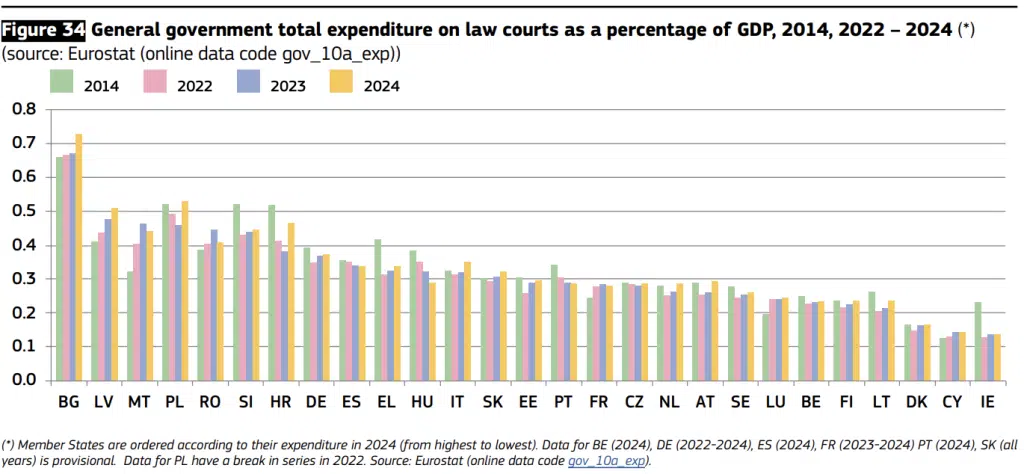 This in itself would not be a problem, as long as such funding buys society predictability, quality, and independence from the judicial authorities. It appears, however, that the system absorbs funding without generating trust. And this is shown quite unambiguously by the data presented in the Justice Scoreboard.
Figure 2: Perceived judicial independence — citizens and businesses, EU member states
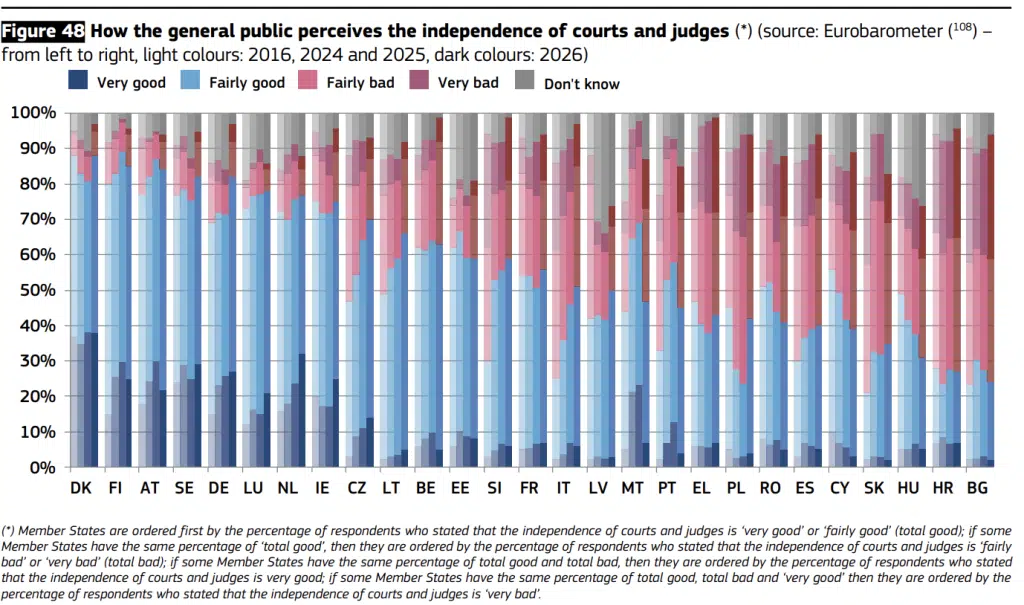 Bulgaria ranks last in the EU in terms of judicial independence, both in the eyes of the public and of business. Both indicators have worsened compared to last year’s assessment — among citizens, Bulgaria has fallen from 25th place to last, and among businesses, from second-to-last to last.
Figure 3: Perceived reasons for lack of judicial independence
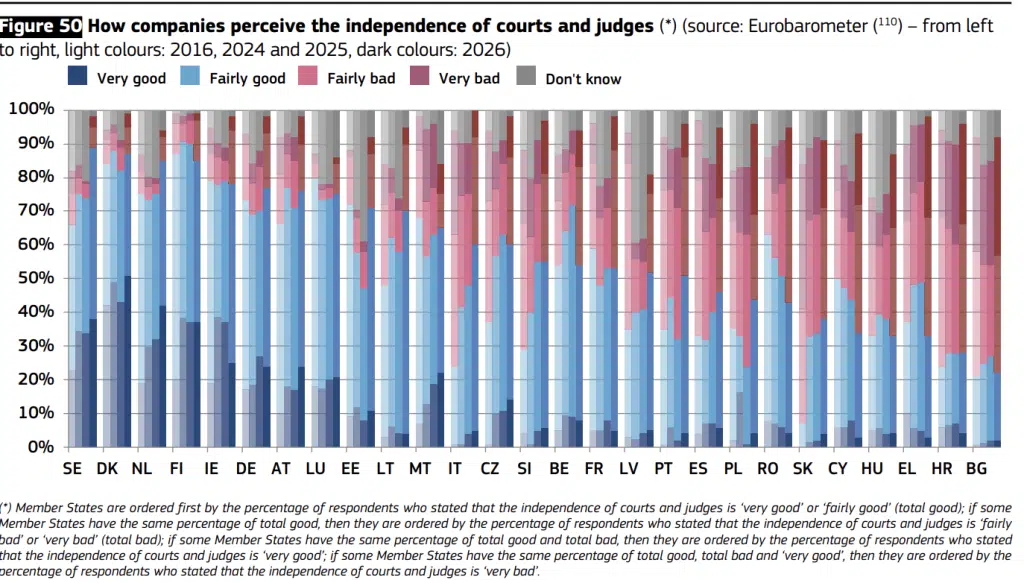 Both groups consider the main reasons for the perceived lack of independence to be:
- Interference or pressure from economic or other special interests;
- Interference or pressure from the government and politicians.
For the second year in a row, the Justice Scoreboard places emphasis on the link between justice and the functioning of the EU single market. For Bulgaria, this is a particularly serious challenge.
A country whose judicial system continues to be perceived as dependent on political and economic influence will find it hard to attract investment, encourage entrepreneurship, and build trust in its institutions. This raises the harder question: can a system whose human resources are the product of years of negative selection, and in which the mechanisms for professional advancement have been subordinated to informal influence, be reformed through legislative changes alone, or is it necessary to consider more radical measures to rid it of magistrates compromised by political, economic, or internal-corporate ties, one of the main causes of the chronic deficit of public trust?
The article was originally published in Bulgarian at: https://ime.bg/articles/pyrvi-po-harchene-posledni-po-doverie-bylgariya-prodylzhava-da-e-rekordor-v-es-po-razhodi-za-sydebnata-vlast/