





- Foreign visitors spend almost 50% more in Poland than Polish visitors spend abroad. Foreigners, mainly from neighboring countries, spent PLN 46.6 billion on goods and services in Poland in 2024, mostly in border areas. Poland’s appeal as a shopping destination stems from the relatively low prices of many goods and services.
- The large share of alcoholic beverages and tobacco products in foreign visitors’ purchases generates higher state budget revenue from both VAT and excise duty. We estimate that between 7.1% and 15.9% of the state’s revenue from excise duty on tobacco products came from sales of cigarettes consumed outside Poland.
- Non-residents’ spending in 2024 was equivalent to around 1.3% of Poland’s GDP. Purchases by foreign visitors also matter greatly to local economies. Foreign visitors’ spending in Lubelskie and Podkarpackie voivodeships in 2024 was equivalent to around 3% of these regions’ GDP, and in the regions bordering Germany it amounted to around 2.3% of GDP.
- The Polish government has many tools to help Polish retailers remain competitive. The most important measures include a predictable excise tax policy, breaking up monopolies and reducing state ownership in the fuel market, refraining from unjustified restrictions on alcohol sales, and reducing checks at the EU’s internal borders.
Poland has established a position, unique in Europe, as a shopping hub for people living in the border regions of neighboring countries. Consumers come to Poland from every direction to buy goods and services for their own use. This is possible thanks to the country’s location: its long border with wealthier Germany, good transport links with Czechia, and proximity to Ukraine. For obvious reasons, following the outbreak of war in Ukraine, arrivals from Russia and Belarus have not regained their pre-COVID-19 importance.
This position has been made possible by the clear competitive advantage of lower prices. The cost incurred by a consumer from another country to buy goods in Poland consists of the prices of those goods (price differences largely reflect differences in taxes) and the cost of travel (which depends on the distance from home and transport connections). Each consumer calculates whether travelling several dozen kilometers from home to shop is sensible. Restrictions and prohibitions, for example on crossing borders, also determine the scale of trade. The Polish government can influence almost all these variables.
Shopping Tourism: The Scale
In 2024, Poland’s border was crossed 286.4 million times, mostly by foreigners (160.4 million crossings).[1] Non-residents most frequently crossed the border with Germany (70 million times), Czechia (almost 28 million) and Ukraine (more than 17 million). Most entered and left the country on the same day. In 2024, foreign visitors spent PLN 46.6 billion in Poland, mainly on goods, while Polish visitors spent PLN 31.1 billion abroad, with services accounting for the larger share. Non-residents’ spending in Poland was equivalent to around 1.3% of Poland’s GDP. Foreign visitors spent an average PLN 585 on purchases in Poland.
Table 1: Foreigners’ crossings of Poland’s border and average spending per foreign visitor in Poland in 2024
| Border | Crossings (million) | Average spending (PLN) |
| Lithuania | 5.6 | 580 |
| Slovakia | 14.7 | 387 |
| Czechia | 27.6 | 351 |
| Germany | 70.0 | 500 |
| Ukraine | 17.3 | 837 |
| Russia | 0.6 | 360 |
| Belarus | 2.7 | 562 |
| Sea border | 0.7 | 1,261 |
| Airports’ border | 21.2 | 1,100 |
| Total | 160.4 | 585 |
Source: FOR calculations based on Statistics Poland (GUS) data.
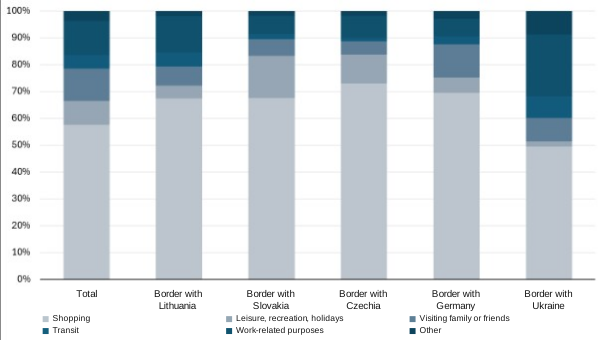
Shopping is the most popular purpose of visits to Poland (Figure 1). More than two-thirds of those crossing the border from neighboring EU countries come to Poland to shop. Interestingly, the proportion of people crossing the border with Ukraine to shop on the Polish side is also high, at 49.6%. Only 23% of Ukrainians crossed the border for work-related purposes. Belarusians also came to Poland relatively often to shop (38.1%), although traffic from that direction, as from Russia, has declined since the outbreak of the COVID-19 pandemic and subsequently Russia’s invasion of Ukraine. By comparison, among Polish residents travelling to another country in 2024, shopping accounted for just under 23% of trips, while leisure was the most popular purpose (43.7%).
Figure 1: Purpose of foreigners’ crossings of Polish border in 2024
 Source: FOR calculations based on Statistics Poland (GUS) data.
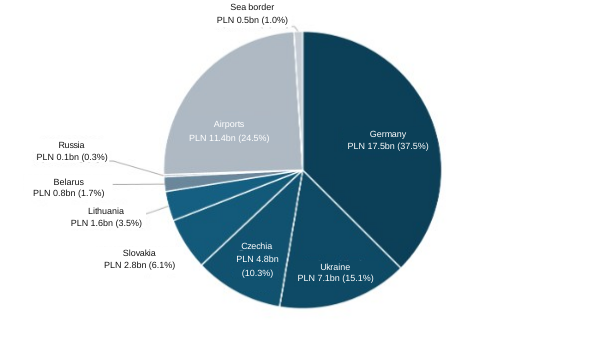
Foreigners crossing Poland’s land border spent a total of PLN 34.7 billion in 2024. Visitors arriving from Germany spent the most on purchases in Poland (PLN 17.5 billion), followed by those from Ukraine (PLN 7.1 billion) and Czechia (PLN 4.8 billion). Purchases by people crossing Poland’s border at airports also accounted for a significant share of non-residents’ spending (PLN 11.4 billion) (Figure 2).
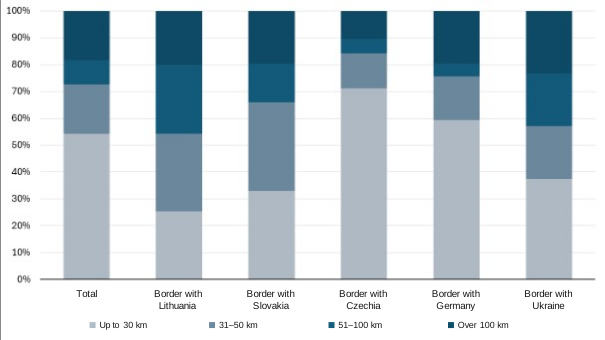
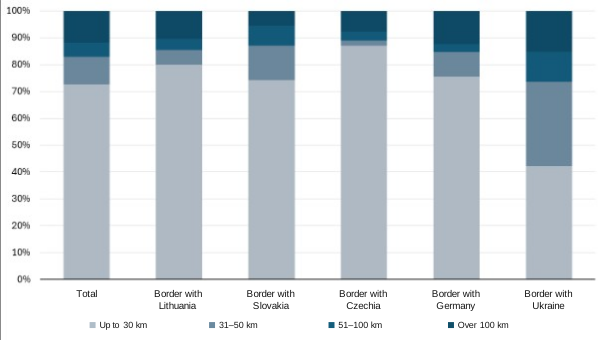
Almost three-quarters of foreigners crossing Polish land border lived within 50 km of the border (Figure 3). Distance from the border also mattered greatly in their choice of shopping location in Poland. More than 80% of non-residents visiting Poland shop within 50 km of the border, and almost three-quarters within 30 km (Figure 4).
Figure 2: Foreign visitors’ spending in Poland by border crossed in 2024
 Source: FOR calculations based on Statistics Poland (GUS) data.
Figure 3: Foreigners crossing Polish land border by distance of their place of residence from the border in 2024
 Source: FOR calculations based on Statistics Poland (GUS) data.
Figure 4: Foreigners crossing Polish land border by distance of their shopping location from the border in 2024
 Source: FOR calculations based on Statistics Poland (GUS) data.
Two-thirds of the amount spent in Poland in 2024 by foreigners crossing the land border went to retailers operating within 50 km of the border, and more than half of the value of purchases was made within 30 km. Foreign visitors made one-quarter of their total spending on purchases in Poland more than 100 km from the border. They spent 8.4% of the total between 51 and 100 km from the border. Average spending by foreign visitors rises with distance from the border. Within 50 km, they spend an average of PLN 405; between 51 and 100 km, PLN 792; and more than 100 km away, PLN 1,064. These differences should come as no surprise. Since travel costs increase with distance, longer trips become worthwhile when purchases are correspondingly larger.
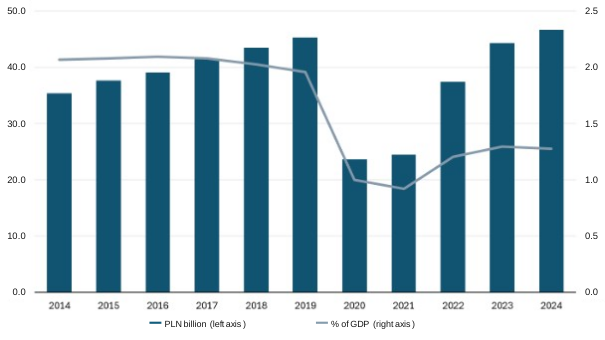
Shopping tourism grew rapidly until the outbreak of the COVID-19 pandemic. The restrictions on movement accompanying the pandemic caused foreign visitors’ spending in Poland to fall by almost half in 2020. In 2024, nominal spending by non-residents, which is not adjusted for inflation, was still only slightly higher than in 2019, by just under 3%; in real terms, however, it had fallen by around one-third.
This decline becomes apparent when we compare non-residents’ spending with GDP. Whereas spending was equivalent to around 2% of GDP in 2014–2019, it fell below 1% of GDP during the two pandemic years and now stands at around 1.3% of GDP (Figure 5). Traffic from Belarus and Russia has not recovered because of Russia’s invasion of Ukraine in 2022. However, compared with 2019, the number of border crossings from the other EU countries and Ukraine has also fallen, by around 10% on average, while nominal spending by non-residents arriving from those directions was at a similar level in 2024 to five years earlier.
Figure 5: Foreign visitors’ spending in Poland in nominal terms and as a percentage of GDP
 Source: FOR calculations based on Statistics Poland (GUS) and Eurostat data.
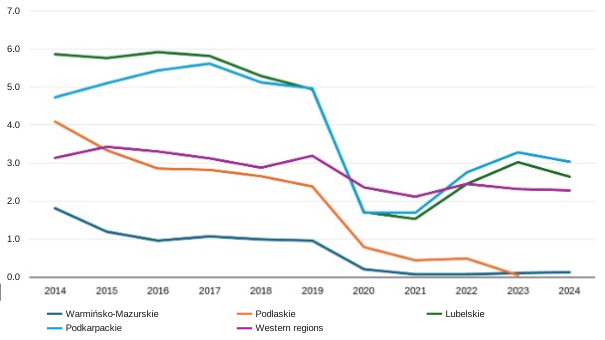
Sales to foreign visitors are an important part of the economies of border regions. Statistics Poland (GUS) publishes data for the regions bordering non-EU countries: Warmińsko-Mazurskie, Podlaskie, Lubelskie, and Podkarpackie. Limited traffic from Russia and Belarus has brought shopping tourism in Warmińsko-Mazurskie and Podlaskie to a standstill for several years. It remains important, however, for Lubelskie and Podkarpackie, which border Ukraine: spending by foreign visitors in these regions in 2024 was equivalent to around 3% of GDP, compared with around 5% in 2019.
Although GUS does not publish data for the regions bordering EU countries, shopping tourism is also significant for them. To illustrate its importance, we compared spending within 100 km of the border by foreigners arriving from Germany with the combined GDP of the western regions: Zachodniopomorskie, Lubuskie, and Dolnośląskie. In 2024, non-residents crossing the Polish–German border spent PLN 11.6 billion within 100 km of the border. This amount was equivalent to 2.3% of the western regions’ GDP. Here too, shopping tourism has become less important than before the COVID-19 pandemic: until 2019, the amount was equivalent to around 3% of these regions’ GDP (Figure 6).
Figure 6: Foreign visitors’ spending as a percentage of border regions’ GDP
 Source: FOR calculations based on Statistics Poland (GUS) and Eurostat data.
What Do Foreign Visitors Buy in Poland?
According to GUS, out of total spending of PLN 46.6 billion, foreign visitors spent PLN 13.3 billion on services, mainly accommodation and food services, and PLN 33.2 billion on goods. Of the latter, PLN 22.9 billion went on non-food goods,[2] PLN 6 billion on food and non-alcoholic beverages, and PLN 4.4 billion on alcoholic beverages and tobacco products. Spending on tobacco products predominated in the last category: non-residents spent PLN 3.4 billion on these products in Poland, 37 times as much as Polish visitors spent abroad. Foreigners’ purchases of tobacco products may, however, be larger.
KPMG estimates that in 2024 around 8.68 billion cigarettes legally purchased in Poland were taken abroad (434 million packs, representing 17.4% of legal cigarette sales in Poland), of which 5.53 billion cigarettes went to Germany.[3] In 2024, a pack of cigarettes cost an average of PLN 17.70,[4] implying revenue of almost PLN 7.7 billion from legal sales of cigarettes taken abroad, more than twice the amount indicated by GUS data.[5]
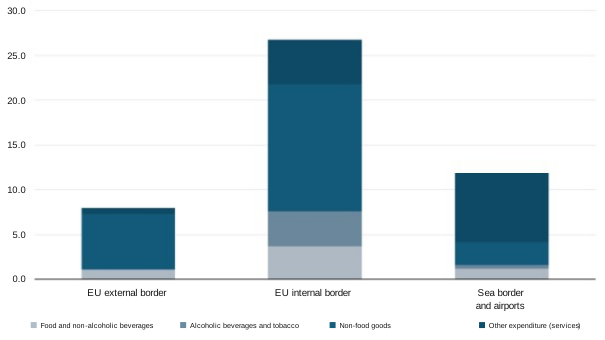
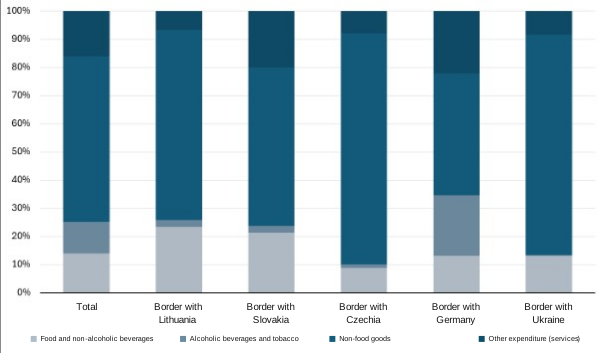
The composition of spending by non-residents crossing Polish border varies according to their country of arrival. In 2024, almost 80% of spending by foreigners crossing the EU’s external border went on non-food goods. They spent relatively little on services (8.4%) and almost nothing on alcoholic beverages and tobacco products (0.1%). By contrast, non-food goods accounted for a relatively smaller share of spending by non-residents crossing an internal EU border (53.1%), while services (18.5%) and purchases of alcoholic beverages and tobacco products (14.6%) were more important.
In the last category, consumers arriving from Germany predominated, accounting for more than 85% of spending on these goods. Food and non-alcoholic beverages accounted for a similar share in both cases, at around 14%. Foreigners crossing the sea border and at airports allocated almost two-thirds of their spending to services, leaving the other spending categories with small shares (Figure 7).
A more detailed analysis shows the relatively high popularity of food and non-alcoholic beverage purchases among foreigners arriving from Lithuania and Slovakia; the relatively large share of alcoholic beverages and tobacco products in purchases by foreigners crossing Poland’s border with Germany; the relatively high share of non-food goods in the purchases of non-residents entering Poland from Czechia and Ukraine; and the relatively large share of services in spending by foreigners arriving from Germany and Slovakia. The smallest relative share of spending on food and non-alcoholic beverages is recorded among visitors from Czechia; on alcoholic beverages and tobacco products, among foreigners crossing the Polish–Ukrainian border; on non-food goods, among people entering Poland from Germany; and on services, among non-residents arriving from Lithuania (Figure 8).
Unfortunately, GUS does not provide data on the specific goods that foreign visitors buy in Poland. Reports from border areas suggest that cigarettes, fuel and butter are the most popular purchases among Germans,[6] along with fireworks in the run-up to New Year’s Eve.[7] Czechs buy gardening supplies, furniture and interior finishing materials,[8] as well as cleaning products and food, although the latter is not confirmed by GUS data.[9] They also, contrary to GUS data but in line with KPMG estimates,[10] come to Poland for cigarettes.[11] Slovaks buy meat, dairy products and fuel.[12] Lithuanians come for groceries, household chemicals, toilet paper and alcohol.[13] Food, consumer electronics and household appliances, building materials and clothing are popular among Ukrainians.[14]
Figure 7: Composition of foreign visitors’ spending in Poland by border crossed in 2024 (PLN billion)
 Source: FOR calculations based on Statistics Poland (GUS) data.
Figure 8: Composition of foreign visitors’ spending in Poland by land border crossed in 2024
 Source: FOR calculations based on Statistics Poland (GUS) data.
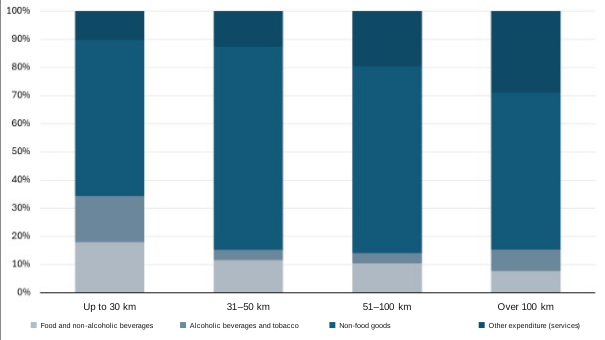
As distance from the border increases, spending on services becomes relatively more important, while spending on food, non-alcoholic and alcoholic beverages, and tobacco products becomes less important. In 2024, foreigners shopping within 30 km of the border allocated almost 18% of their spending to food and non-alcoholic beverages and more than 16% to alcoholic beverages and tobacco products; by comparison, services accounted for 10% of their spending. More than 100 km from the border, food, non-alcoholic beverages, alcohol and tobacco together accounted for around 15% of total spending, while services accounted for almost 29% (Figure 9).
The composition of spending also varies with the length of stay. Foreigners visiting Poland for one day spent a total of PLN 20 billion in 2024, or an average of PLN 348 per person. Just 9.5% of this spending went on services, totaling slightly less than PLN 2 billion. They spent relatively large amounts on food and non-alcoholic beverages, just under 18%, or PLN 3.6 billion, and on alcoholic beverages and tobacco products, 15.5%, or PLN 3.1 billion. Foreign visitors who stayed for at least one night spent a total of PLN 26.6 billion, averaging PLN 1,197 per person. They allocated more than 43% of this amount to services, a total of PLN 11.5 billion. They spent PLN 3.7 billion, or 14%, on food, non-alcoholic and alcoholic beverages, and tobacco products. The two groups spent similar amounts on non-food goods, around PLN 11.5 billion each (Figure 7).
Figure 9: Composition of foreign visitors’ spending in Poland by distance of their shopping location from the land border in 2024
 Source: FOR calculations based on Statistics Poland (GUS) data.
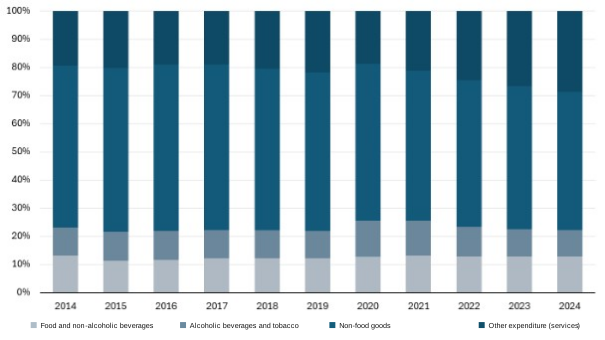
The growing role of services in the composition of spending by foreign visitors to Poland is striking. In 2014, they spent just under PLN 7 billion on services, 19.5% of total spending; in 2024, they spent more than PLN 13 billion, or 28.6% of the total. Services are the only category of foreign visitors’ spending in Poland that did not fall relative to GDP over this period, remaining at around 0.4% of GDP. Purchases of food, non-alcoholic and alcoholic beverages, and tobacco products have maintained a stable share of spending, together accounting for more than 20%. By contrast, non-food goods have become less important, falling from 57.3% of total spending in 2014 to 49.1% in 2024 (Figure 10).
Figure 10: Composition of foreign visitors’ spending in Poland
 Source: FOR calculations based on Statistics Poland (GUS) data.
Shopping Tourism as a Source Of Support For the State Budget
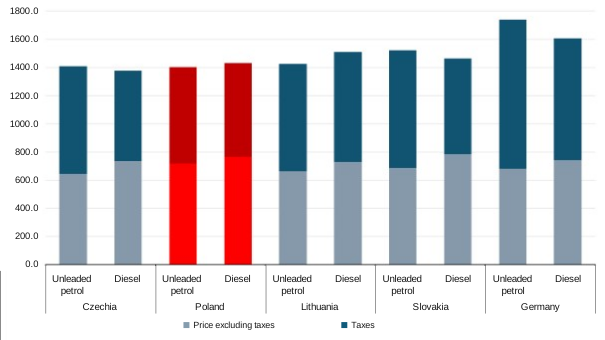
The data cited above indicate a substantial share of excisable goods in spending by foreign visitors, particularly those crossing an internal EU border. GUS does not report fuel spending, but the accounts from border towns mentioned earlier suggest that such purchases are popular among Germans. Price differences may also support this conclusion: last year, unleaded petrol was almost 24% more expensive in Germany on average, and diesel more than 11% more expensive (Figure 11).[15]
Figure 11. Average price of 1,000 litres of unleaded petrol and diesel in euros in 2025
 Source: FOR calculations based on European Commission data (Weekly Oil Bulletin).
Sales of all excisable goods yield relatively high tax revenue for the state compared with their prices. Last year, taxes accounted for almost half the price of fuel. According to the WHO, taxes accounted for almost 35% of the price of beer and almost 63% of the price of vodka in 2024.[16] In 2023, excise duty accounted for an average of more than 62% of the final price of a pack of cigarettes.[17] Adding VAT shows that over 80% of cigarette sales revenue goes to the state budget.
Based on GUS data, we estimate that of the PLN 3.4 billion from sales of cigarettes to foreign visitors who entered Poland, PLN 2.8 billion went to the state budget, including almost PLN 2.2 billion in excise duty. If we base the calculation on KPMG data, of the PLN 7.7 billion from sales of cigarettes subsequently consumed outside Poland, PLN 6.2 billion went to Polish public finances, including PLN 4.8 billion in excise duty. Thus, between 7.1% (GUS) and 15.9% (KPMG) of state revenue from excise duty on tobacco products, which totalled PLN 30.2 billion,[18] came from sales of cigarettes consumed abroad.
Total state revenue from indirect taxes on cigarettes taken out of Poland, comprising excise duty and VAT, was equivalent to 0.1–0.2% of GDP. We also estimate that of the PLN 900 million spent by foreign visitors on alcoholic beverages, more than PLN 350 million went to the state budget, including more than PLN 180 million in excise duty.
Poland’s Price Competitiveness
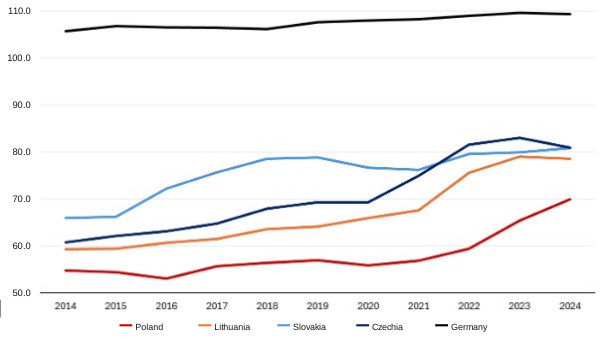
In 2024, Poland was the European Union’s fourth-cheapest country for goods and services intended for individual consumption, as distinct from collective consumption provided by the state. Poland’s price level for this category was 69.9% of the EU average. Over the years, however, prices across the EU have converged, making Polish goods and services increasingly less competitive on price. The same is true of the other Central and Eastern European countries. In 2014, prices of goods and services intended for individual consumption in Poland were 54.7% of the EU average. By comparison, Germany’s price level relative to the EU average rose only slightly, from 105.7% in 2014 to 109.3% in 2024 (Figure 12).
Figure 12: Price level of goods and services intended for individual consumption as a percentage of the EU-27 average
 Source: FOR calculations based on Eurostat data.
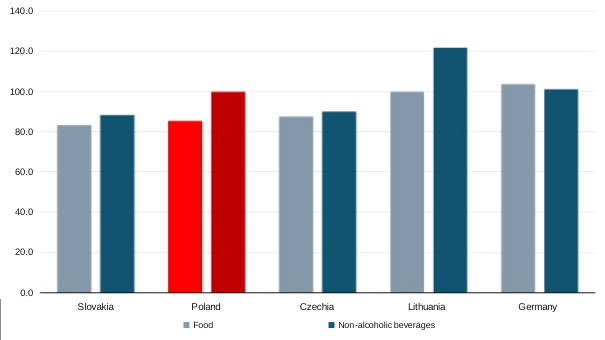
We have already noted that fuel prices are lower in Poland than in Germany. The same applies to food prices, which, despite their relative increase in recent years, were 14.5% below the EU average in 2024. Food prices in Germany and Lithuania are close to the EU average, while in Poland’s southern neighbors they are similar to those in Poland. Non-alcoholic beverage prices in Poland were similar to those in Germany but considerably lower than in Lithuania. Czechia and Slovakia, however, were price-competitive in this category (Figure 13).
Figure 13: Price level of food and non-alcoholic beverages as a percentage of the EU-27 average in 2024
 Source: FOR calculations based on Eurostat data.
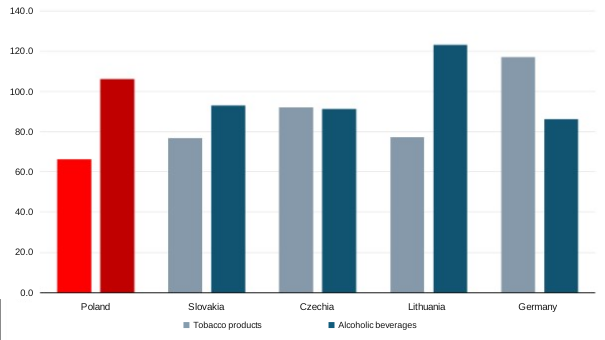
Figure 14: Price level of alcoholic beverages and tobacco products as a percentage of the EU-27 average in 2024
 Source: FOR calculations based on Eurostat data.
Alcoholic beverages were more expensive in Poland than the EU average, and Lithuania was the only neighboring country where alcohol cost more. Among the countries analyzed, alcoholic beverages were cheapest in Germany. Tobacco prices, by contrast, were clearly lower in Poland than in neighboring countries, especially Germany (Figure 14). Alongside the relatively lower cost of transport, this is certainly one reason why foreign visitors spent almost four times as much on tobacco products in Poland as on alcohol.[19]
Maintaining the Competitiveness of Shopping Tourism in Poland
Shopping tourism is sensitive to price differences, geographical proximity and legal restrictions. Foreign visitors do not buy goods and services that are cheaper in their own countries: cigarettes are bought mainly by Germans, rather than Ukrainians. Trade, especially in goods, is greatest in border areas. The lack of free movement of goods and people across the EU’s external borders has clearly held back trade with Russia and Belarus. Legal restrictions on sales hours are another constraint.
Excisable goods are a significant component of cross-border trade, and their prices depend heavily on the taxes imposed by the state. Keeping Polish retailers of these products competitive on price requires a predictable state policy on excise duty. Sharp increases in excise duty on alcoholic beverages or tobacco products that overturn the arrangements set out in an earlier multi-year roadmap would clearly damage Polish retailers’ price competitiveness. Harmonization of excise rates across the EU would likewise be harmful from Poland’s perspective.
Breaking up monopolies and reducing state ownership in the fuel market could also support cross-border trade. Unleaded petrol and diesel cost less in Poland than in Germany because taxes are lower: net prices, excluding excise duty and VAT, were higher in Poland in 2025 than in every neighboring EU country. One factor behind this is the dominance of Orlen, which controls almost two-thirds of Poland’s fuel market following its merger with Lotos.
There are also non-tax barriers to cross-border trade. The most important is the presence of the EU’s external border itself. People and goods crossing the border from Russia, Belarus and Ukraine are subject to border and customs checks, often detailed and preceded by hours of queuing. It also matters that these people are entering or leaving the EU customs territory, which exposes them to restrictions on carrying certain goods. The Polish government has little influence over this, however, especially in the case of people arriving from Russia and Belarus.
The Polish government does have tools to support cross-border trade to the west and south. Faster minimum wage growth than in neighboring countries increases the costs of running businesses, including shops and hotels. In 2024, Poland’s minimum wage relative to average earnings was the highest of all EU countries.[20] Rising labor costs translate into higher prices. Greater restraint in minimum wage increases is advisable here, and ideally the process of setting the minimum wage should be depoliticized.[21]
Restrictions on alcohol sales proposed by various political groups would also make shopping trips to Poland less attractive. These include bans on sales at certain outlets, such as petrol stations,[22] or at certain times, such as a nationwide ban on night-time alcohol sales.
Temporary checks at the border with Germany, on both the Polish and German sides, also harm trade. Last autumn, Poland once again extended checks at its borders with Germany and Lithuania, this time until 4 April 2026.[23] Germany has been conducting checks since October 2023, officially to curb illegal migration from neighboring countries, including Poland. Checks on both sides cause queues at the border, increasing the time and cost that foreign visitors arriving from Germany must devote to shopping in Poland.
Given the growing importance of services in Polish economy and in foreign visitors’ purchases, it is worth examining the barriers to this sector’s development, particularly regulatory and administrative ones. As price levels converge, cross-border trade in goods is gradually becoming less important. Poland can, however, build competitive advantages in services, including innovative services.
According to GUS, most foreign visitors’ spending on services goes on accommodation and food services. Yet, medical tourism is a rapidly developing area, both globally and in Poland, encompassing a wide range of treatments intended to restore health and improve subjectively perceived quality of life. It is estimated that 320,000 foreign visitors came to Poland for medical procedures in 2021, spending PLN 700 million, and that the medical services market is growing at 15% a year.[24] Some countries have made entry easier for people seeking medical treatment. South Korea, for example, has simplified visa procedures for patients and those accompanying them.[25]
Poland’s position as a shopping hub for neighboring countries brings numerous benefits to local economies and the national economy. The large share of excisable goods in foreign visitors’ spending also generates additional state budget revenue. The Polish government has tools that can help Polish retailers remain competitive. It is important that it removes barriers to cross-border trade rather than creating new ones.
Publication partner: the Polish Chamber of Commerce (Polska Izba Handlu).
References
[1] All data on border crossings and spending by foreign visitors come from Statistics Poland (GUS), Ruch graniczny oraz wydatki cudzoziemców w Polsce i Polaków za granicą [Border traffic and expenditure of foreigners in Poland and Poles abroad], comprising annual analyses and statistical reports and quarterly statistical releases.
[2] GUS includes in this broad category consumer goods (such as clothing and footwear, household furnishings and personal hygiene products) and non-consumer goods (such as fuels, oils and lubricants, machinery and tools, fertilisers and seeds, and metallurgical, metal and electrical products).
[3] KPMG, Illicit cigarette consumption in Europe: Results for the calendar year 2024, 11 June 2025, p. 171.
[4] According to the Ministry of Finance, the weighted average retail selling price of 1,000 cigarettes in 2024 was PLN 885.17. See Obwieszczenie Ministra Finansów z dnia 16 lutego 2025 r. w sprawie średniej ważonej detalicznej ceny sprzedaży papierosów oraz średniej ważonej detalicznej ceny sprzedaży tytoniu do palenia w roku 2024 [Notice of the Minister of Finance of 16 February 2025 on the weighted average retail selling prices of cigarettes and smoking tobacco in 2024], source.
[5] It should be remembered, however, that KPMG estimated consumption outside the country of sale regardless of the consumer’s nationality. It therefore also included consumption abroad of cigarettes purchased in Poland by Polish people, for example those travelling abroad on holiday. On the other hand, KPMG’s estimates cover only conventional cigarettes, excluding other tobacco products such as smoking tobacco and so-called novel tobacco products, and, as the authors themselves acknowledge, may be understated even within that scope. See KPMG, Illicit cigarette consumption in Europe: Results for the calendar year 2024, pp. 224, 305.
[6] M. Terlik, Odwiedziliśmy polski bazar na granicy z Niemcami. „Widać, że u nich coraz gorzej”, Onet, 5 September 2025, source.
[7] M. Mroczek-Kowalik, Sylwestrowy raj po drugiej stronie Odry. Niemcy masowo kupują fajerwerki w Polsce, Gazeta Prawna, 28 December 2025, source.
[8] H. Sidorska, Już nie spożywka i rzeczy do ogrodu. Oto co teraz Czesi kupują w Polsce, Interia Biznes, 3 April 2025, source.
[9] Czesi szturmują targowiska w Polsce. Oto co najczęściej kupują, Onet Śląsk, 5 August 2025, source.
[10] According to KPMG, Czechia was the second-largest destination after Germany for outflows of legally purchased Polish cigarettes (1.06 billion cigarettes). Poland was the largest source of cigarette inflows into Czechia, where cigarettes originating in Poland accounted for 8.7% of total consumption. See KPMG, Illicit cigarette consumption in Europe: Results for the calendar year 2024, pp. 72, 171.
[11] PC, Czesi masowo kupują jeden produkt w Polsce. Media czeskie oburzone, WP Wiadomości, 6 January 2025, source.
[12] K. Stańczyk, Słowacy szturmują polskie sklepy. Kupują nie tylko masło, ale i napoje, Onet Kobieta, 26 March 2025, source.
[13] O. Stępień, Coraz rzadziej przyjeżdżają do Polski na zakupy. „To straszne, jak wszystko podrożało”, Onet Kobieta, 6 December 2025, source.
[14] B. Bartman, Mimo wojny na Ukrainie, liczba odpraw Tax Free rośnie, TVP3 Rzeszów, 8 February 2023, source.
[15] Calculations based on data from the European Commission’s Weekly Oil Bulletin.
[16] World Health Organization, Tax: Total taxes on alcoholic beverages, source.
[17] J. Gigol, J. Kudła, B. Walczyk, K. Walczyk, R. Woźniak, Wpływ podatku akcyzowego na rynek wyrobów tytoniowych w Polsce, Instytut Finansów Publicznych, Warsaw, 4 November 2024, p. 44, source.
[18] Supreme Audit Office (NIK), Wykonanie budżetu państwa w 2024 r. w części 77 – Podatki i inne wpłaty na rzecz budżetu państwa, Warsaw, June 2025, p. 10, source.
[19] By comparison, total spending on alcohol in Poland is slightly higher than spending on tobacco products. According to NielsenIQ, Polish consumers spent PLN 50.3 billion on alcohol in 2024 (see M. Brzózka, Polacy przepijają 50 mld zł. Czy spożywanie procentów to dzisiaj obciach?, XYZ, 16 January 2025, source. Based on state excise revenue, we estimate that around PLN 48.4 billion was spent on tobacco products in Poland in the same year.
[20] G. Hawryluk, Polska z najwyższą płacą minimalną w Unii Europejskiej, FOR Communication 14/2024, Civil Development Forum, 21 May 2024, source.
[21] R. Trzeciakowski, Za dużo polityki w płacy minimalnej, FOR Communication 25/2018, Civil Development Forum, 17 September 2018, source.
[22] G. Hawryluk, Zakazy zamiast rozwiązań. Dokąd zmierza polska polityka alkoholowa?, FOR Analysis 5/2025, Civil Development Forum, 2 December 2025, source.
[23] Ministry of the Interior and Administration, MSWiA przedłuża tymczasowe kontrole na granicach z Niemcami i Litwą do 4 kwietnia 2026 r., 1 October 2025, source.
[24] J. Szyman, Dynamiczny wzrost turystyki medycznej w Polsce i na świecie, LinkedIn, 12 June 2023, source.
[25] A. Białk-Wolf, Rozwój placówki medycznej poprzez internacjonalizację jako elementu turystyki medycznej, in: Stan sektora szpitali prywatnych, Polish Association of Private Hospitals, Gdynia, 2023, p. 10, source.