



For years, the Nordic countries have been cited in Polish public debate as evidence that a larger state and higher public spending are the recipe for prosperity. This analysis shows that the sources of Scandinavian success lie elsewhere: in economic freedom, fiscal discipline, a flexible labor market, and strong institutions. It examines a model that is simplified far more often than it is genuinely understood, and explains why copying it without its liberal foundations would be a costly illusion for Poland.
- Contrary to popular myths, the success of the Nordic countries did not arise from high public spending. Denmark, Sweden, Finland and Iceland are among the world’s most economically free countries, while Poland remains far behind them in international rankings of economic freedom.
- Swedish fiscal policy exemplifies responsible management of public finances. Following the crisis of the 1990s, Sweden undertook far-reaching reforms that included reducing public spending, deregulation, privatization and changes to the pension system.
- Denmark’s flexicurity model shows that effective social policy is about helping people find new jobs rather than protecting particular jobs. Its foundation is a flexible labor market that allows the economy to adapt quickly to change and limits the costs of economic crises.
- State capacity is one of the most important foundations of the Nordic countries’ success. Strong institutions and effective administration enable them to implement public policies successfully and maintain an extensive system of public services. Poland remains well behind the Nordic countries in terms of state capacity.
- Transplanting the Nordic model to Poland would be far more difficult and costly than representatives of the left suggest. Polish social policy is based primarily on cash transfers, while the Nordic model focuses on public services. Increasing spending on public services while maintaining large transfers is not feasible in conditions of a high general government deficit.
The Polish left often invokes the success of the Nordic countries, presenting Denmark, Sweden, Norway or Finland as models to follow and arguing that Poland should adopt the policies characteristic of their welfare states. Much less attention is paid, however, to the liberal elements of these countries’ economic policies, such as stable public finances and a high degree of economic freedom.
Moreover, advocates of implementing the Nordic model often assume that selected elements can be introduced without significant changes in other areas of public policy. This approach overlooks important institutional, economic and social differences between Poland and the Nordic countries. In reality, policies typical of the Nordic model are difficult to reconcile with the current shape of Polish economic policy.
This paper seeks to clarify the most common myths about the Nordic model in Polish public debate. The gap between Poland and the Scandinavian countries primarily concerns the state of public finances and the functioning of the labor market, rather than the scale of the welfare state.
The Nordic Model: An Example for Liberals?
The Nordic model is often presented in a simplified way that reduces it almost entirely to an efficient and generous welfare state. This picture does not capture the system’s full character: these countries enjoy a high degree of economic freedom. It is this element that enables the model to function effectively and explains why the Nordic countries are often cited by economic liberals, who stress that free-market reforms underpinned their success (Hammond 2018; Karlson 2018, pp. 63–107).
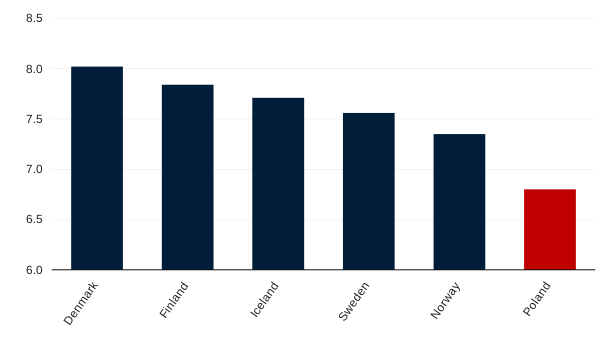
International indices of economic freedom confirm this. Denmark ranks ninth in the Fraser Institute’s ranking for 2023, Finland ranks between 11th and 20th, Iceland between 21st and 30th, and Sweden between 31st and 40th; all four countries are in the index’s top quartile. Norway ranks 48th. By comparison, Poland is on 76th place (Gwartney, Lawson, Murphy 2025).
Figure 1: Economic freedom in Poland and the Nordic countries in 2023
 Source: FOR’s own calculations based on Fraser Institute data.
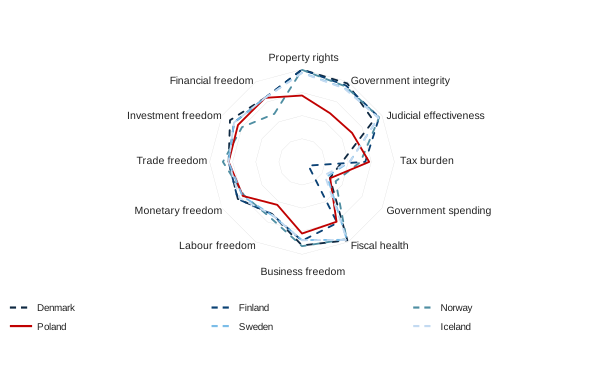
A similar picture emerges from the economic freedom ranking published by the Heritage Foundation. Denmark and Norway are in the top ten, Sweden, Finland and Iceland rank 11th, 13th and 16th respectively, while Poland is 40th (Kim 2026). The Heritage Foundation also publishes detailed assessments of individual areas, such as the labor market, public finances and monetary policy. Poland performs worse than the Nordic countries in most of these categories.
The tax burden is an exception. Taxes in Poland remain relatively low compared with the Nordic countries, but this certainly does not mean that the Polish tax system works well. On the contrary, it is complicated and chaotic. As the Ministry of Finance points out, fiscal burdens in Poland are uneven. The system has both progressive and regressive features. In practice, the heaviest burdens fall on people with the lowest incomes and taxpayers around the middle percentiles of the income distribution. Those with the highest incomes more often use forms of taxation and social contributions that result in lower effective fiscal burdens (Ministry of Finance 2024, p. 130).
The simplicity of the tax system is equally important. In 2019, the time required to comply with tax obligations in Poland was between 2.5 and four times longer than in the Nordic countries. This explains why Poland’s tax system performs poorly in international tax competitiveness rankings. In the latest edition of the International Tax Competitiveness Index, Poland ranked 35th out of the 38 countries analyzed (Leszczyłowska, Mengden 2025).[1]
The picture of the Nordic countries as state-dominated economies is false. They combine an extensive welfare state with a relatively high degree of economic freedom, effective institutions and stable rules for doing business.
Figure 2: Economic freedom in selected areas in 2026
 Source: FOR’s own calculations based on Heritage Foundation data.
Figure 3: Time required to comply with taxes, in hours, in 2019
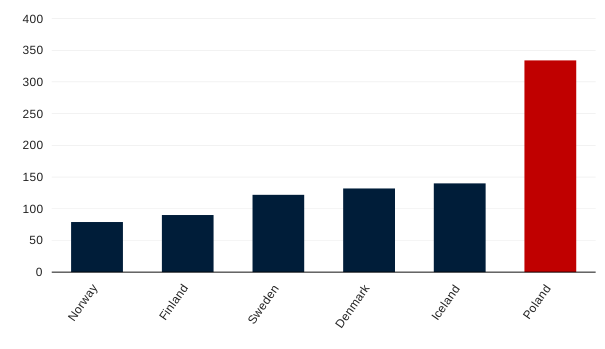 Source: FOR’s own calculations based on World Bank data.
Compared with the Nordic countries, Poland performs poorly in institutional areas such as property rights protection, government integrity and judicial effectiveness. It also fares worse in the functioning of its labor market and the state of its public finances. Comparisons between Poland and Sweden nevertheless need to take account of important historical and social differences.
Sweden has developed strong liberal traditions since the Frihetstiden, or “Age of Liberty”, a period admired by Enlightenment thinkers. The country also has high levels of social capital (Sivesind, Selle 2010). These factors undoubtedly support the durability of a model that combines free-market economic policy with an extensive welfare state and strong, effective institutions (Bergh, Bjørnskov 2011). Despite more than three decades as a liberal democracy, Poland still has a relatively low level of social trust.
Among the policies used in the Nordic countries, two areas seem particularly worthy of attention from a Polish perspective: sound public finances and a flexible labor market. Good examples are Swedish fiscal policy, which can serve as a model for countries struggling with high general government deficits, and Denmark’s labor market model, flexicurity, which combines employment flexibility with protection for workers.
Swedish Responsibility
Sweden has long been regarded as an example of responsible management of public finances (Figure 4). Between 2013 and 2023, its average general government deficit was just 0.3% of GDP. By comparison, the EU average was around 2.6% of GDP, and Poland’s was close to 3%. This does not mean, however, that Sweden has always enjoyed such a stable fiscal position. In the 1990s, the country experienced a deep economic crisis that caused a sharp deterioration in its key macroeconomic indicators. At its peak, the public sector deficit reached 10% of GDP.[2]
The Swedish authorities nevertheless used the crisis as a catalyst for extensive reforms. They broadened the value added tax base, reduced marginal income tax rates, strengthened central bank independence, introduced strict fiscal rules, reformed the pension system, and carried out deregulation and privatization (Flodén 2013).
The way in which fiscal consolidation was carried out is particularly interesting. A country associated with high taxes and an extensive welfare state reduced the scale of public spending, treating this as a central part of repairing public finances. The literature suggests that reforms based primarily on the expenditure side are the most durable and effective (Alesina, Ardagna 2013). Sweden’s experience fits this finding well.
The crisis was severe enough that the left, which was in government at the time, also decided to introduce reforms increasing competition in public services. As a result, private providers took on a greater role. The share of employment in private entities delivering publicly funded services rose substantially, reaching 17.2% in 2010 (Svanborg-Sjövall 2014).
Figure 4: Public expenditure and revenue as a percentage of GDP in Sweden
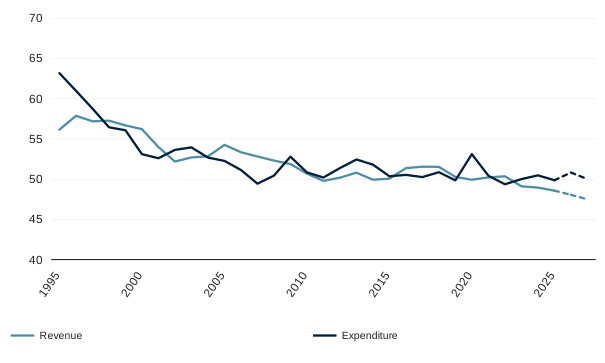 Source: FOR’s own calculations based on AMECO data.
Sweden used the crisis to reform its education and pension systems. School vouchers were introduced in 1992, increasing the private sector’s share of education.[3] Some critics attribute Sweden’s subsequent decline in PISA rankings to the introduction of vouchers.[4] This interpretation is, however, too simplistic. During the same period, teacher licensing rules,[5] curricula and teaching methods also changed.[6] It is therefore difficult to attribute the observed changes unambiguously to the voucher system alone.
Moreover, some studies suggest that competition between schools can improve educational standards. These effects remain visible even after accounting for factors such as grade inflation and pre-reform trends (Böhlmark, Lindahl 2015). Pupils in independent schools also achieve better PISA results on average than those in public schools, even after socio-economic factors are taken into account (Heller-Sahlgren 2024). Crucially, the benefits of school choice accrue primarily to disadvantaged pupils, including those from immigrant backgrounds or less affluent families (Trumberg, Urban 2020).
Figure 5: Employment in Sweden’s public services sector
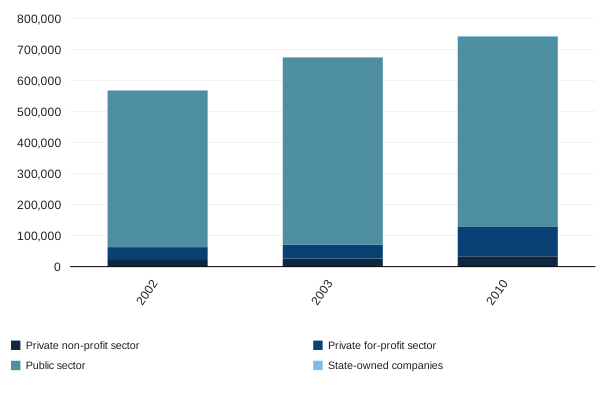 Source: FOR’s own calculations based on Svanborg-Sjövall 2014.
During the same period, Sweden also undertook a comprehensive pension reform. In 1998, it moved away from the traditional defined-benefit model towards a defined-contribution system, supplemented by funded elements and countercyclical mechanisms.[7] The reform created incentives for people to remain in work longer (Laun, Palme 2023). These changes reduced the pension system’s costs to public finances and the economy, including over the long term (Focacci, Öylü, Motel-Klingebiel, Kelfve 2023).
Sweden’s example challenges many widely held beliefs in debates about political economy and public finances. It shows that public debt can be reduced significantly, provided that reforms are pursued consistently. In Poland, it is commonly believed that substantial public finance reforms are politically difficult. Yet, the Swedish Social Democrats who carried out the reforms described above went on to win successive elections (Alesina, Carloni, Lecce 2011).
Figure 6: Public debt as a percentage of GDP
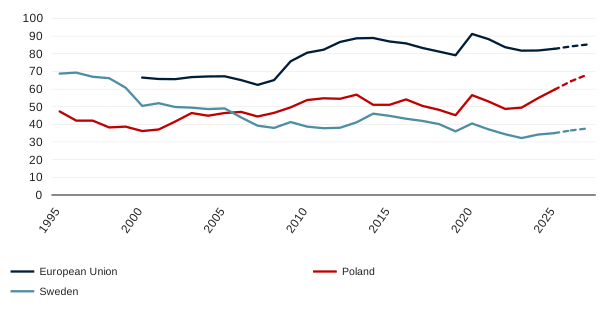 Source: FOR’s own calculations based on AMECO data.
Danish Prudence
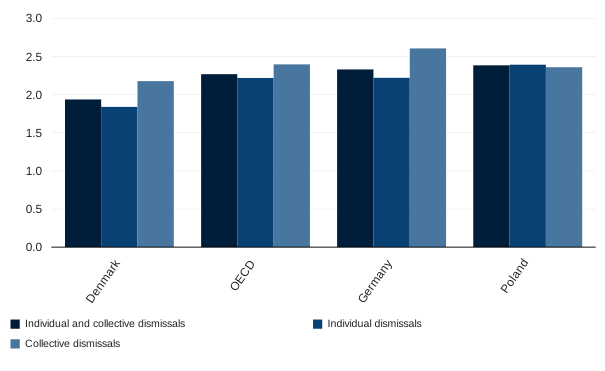
Denmark also uses policies that could inspire Poland. One of the most interesting is its labor market model, known as flexicurity. It rests on three complementary pillars: employment flexibility, a support system for people out of work, and active labor market policies that help workers acquire new skills and adapt to changing economic conditions (Guzikowski 2016). Thanks to this model, Denmark remained among the leaders of the Employment Flexibility Index for many years (Lithuanian Free Market Institute 2019). The flexibility of the Danish labor market is also reflected in the OECD’s Indicators of Employment Protection.
Figure 7: Employment protection, on a scale of 0–6, in 2019
 Source: FOR’s own calculations based on OECD data.
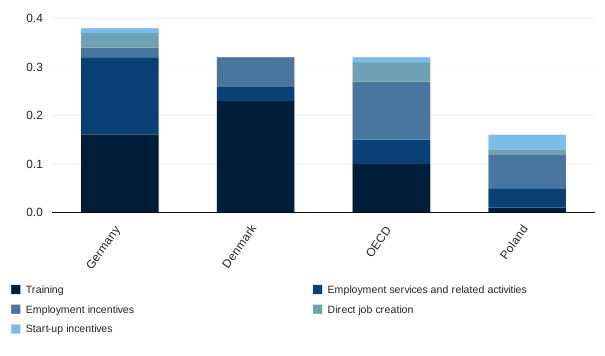
The second pillar of this model is active labor market policy (Figure 8), which improves the match between workers’ skills and labor market needs and encourages people to take up employment. Denmark spends around 0.32% of GDP on this, most of it on vocational training.
Figure 8: Spending on active labor market policies as a percentage of GDP in 2022
 Source: FOR’s own calculations based on OECD data.
Introducing policies similar to the Danish model in Poland would not be easy and would probably face resistance from some trade unions and sections of the public. The potential benefits could nevertheless be considerable. It should be remembered that the model’s effectiveness depends on its elements complementing one another. Generous unemployment benefits or active labor market policies make sense primarily when accompanied by a sufficiently flexible labor market. Otherwise, they may impose excessive costs on taxpayers and reduce the efficiency of the system as a whole.
Easier Said Than Done
Transferring the Nordic countries’ experience to Poland is no simple task. We are comparing policies operating in countries with high levels of social capital, developed civil societies and long liberal traditions with Poland, which joined the ranks of democratic, free-market countries only after 1989. Calls to implement the Nordic model in Poland therefore face serious constraints, both economic and related to political economy.
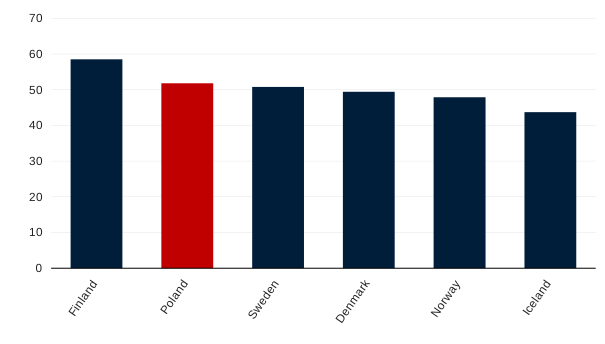
The level of public spending deserves attention first. In 2026, Poland’s public expenditure-to-GDP ratio will be higher than that of every Nordic country except Finland. Contrary to a widespread narrative on the left, Poland is by no means a “low-cost state”.
Figure 9: Public expenditure as a percentage of GDP in 2026
 Source: FOR’s own calculations based on AMECO data.
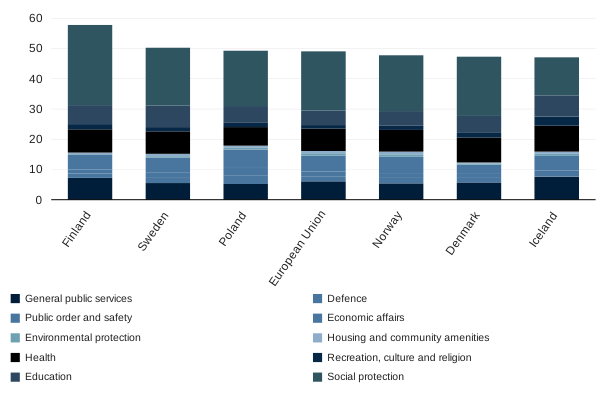
However, the composition of public spending differs between Poland and the Nordic countries. Poland allocates a larger share of public resources to economic affairs, internal security and defense. Within economic expenditure, public debt servicing costs play an important role, reflecting irresponsible fiscal policy. At the same time, Poland devotes relatively fewer resources to healthcare.
The way social policy is conducted in Poland also remains a major challenge. The “welfare state” model created by Law and Justice is based primarily on cash transfers, such as the “800+” benefit. By contrast, policies characteristic of the Nordic countries focusses much more often on developing public services.
Figure 10: Composition of public expenditure as a percentage of GDP in 2024
 Source: Own calculations based on Eurostat data.
Maintaining the current scale of cash transfers while significantly increasing spending on public services, as representatives of the Polish left would like, would require higher taxes. Without tax increases, it would mean a further rise in a deficit that is already the highest in the EU.
If we want to draw inspiration from the Nordic countries’ experience, we should not confine ourselves to copying isolated policies with attractive-sounding names. We need to consider the entire institutional model and recognize that it also relies on more liberal policies that receive little attention in Polish public debate. Fiscal discipline, as well as extensive public services, is an integral part of the Nordic model.
This is where potential problems arise. Surveys show that Poles expect a wide range of public services and benefits while being reluctant to accept higher tax burdens (Kiełczewska, Sawulski 2021). In these circumstances, proposing further increases in public spending without identifying sources of funding can hardly be considered fiscally responsible.
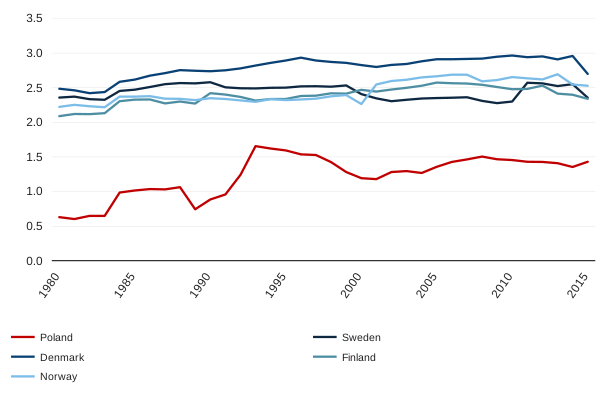
A final issue that appears relatively rarely in the debate about the Nordic model is state capacity: the state’s ability to perform its tasks effectively. The index developed by Jonathan Hanson and Rachel Sigman measures this capacity by assessing, among other things, administrative performance, tax collection efficiency, the quality of official statistics and the state’s ability to maintain order and security (Hanson, Sigman 2021).
Figure 11: State Capacity Index
 Source: FOR’s own calculations based on Hanson, Sigman 2021.
In this respect, Poland still lags well behind the Nordic countries. Although the transition brought a significant improvement in the quality of state institutions, the gap remains large. In 2015, the Nordic countries were among the world leaders in this ranking, which undoubtedly supported effective public policy implementation and high-quality public services.
Conclusion
Many myths about the Nordic countries circulate in Poland. The left often portrays them as a kind of welfare paradise which policies should be transplanted to Poland as quickly as possible. The problem is that this vision is selective and overlooks elements that do not fit the left’s image of the state, such as responsible fiscal policy or a flexible labor market. Moreover, introducing the Nordic model is sometimes presented as an almost cost-free undertaking, whereas in practice it would require accepting higher taxes.
The purpose of this paper is not to criticize the Nordic model, but to offer a more balanced view of how it works and its place in Polish public debate. The Nordic countries use many policies that could inspire Poland, both more liberal ones, such as Sweden’s fiscal responsibility, and those of a social character, exemplified by some elements of Denmark’s flexicurity model.
Nordic success is not the result of high public spending. It stems from a combination of substantial economic freedom, effective institutions, responsible fiscal policy, a flexible labor market and high-quality public services.
References
Alesina, A., Ardagna, S. (2013), The Design of Fiscal Adjustments, Tax Policy and the Economy 27(1).
Alesina, A., Carloni, D., Lecce, G. (2011), The Electoral Consequences of Large Fiscal Adjustments, Working Paper 17655, National Bureau of Economic Research, December.
Bergh, A., Bjørnskov, C. (2011), Historical Trust Levels Predict the Current Size of the Welfare State, Kyklos 64(1).
Böhlmark, A., Lindahl, M. (2015), Independent Schools and Long-Run Educational Outcomes: Evidence from Sweden’s Large Scale Voucher Reform, Economica 82(327).
Flodén, M. (2013), A role model for the conduct of fiscal policy? Experiences from Sweden, Journal of International Money and Finance 34.
Focacci, C.N., Öylü, G., Motel-Klingebiel, A., Kelfve, S. (2023), The value of pension reforms for late working life: evidence from Sweden, International Journal of Sociology and Social Policy 43(13–14).
Guzikowski, M. (2016), Celowość wprowadzenia koncepcji flexicurity w Polsce [The case for introducing the concept of flexicurity in Poland], Optimum. Studia Ekonomiczne 1(79).
Gwartney, J., Lawson, R., Murphy, R. (2025), Economic Freedom of the World: 2025 Annual Report, Fraser Institute.
Hammond, S. (2018), The Free-Market Welfare State: Preserving Dynamism in a Volatile World, Policy Essay, Niskanen Center, May.
Hanson, J., Sigman, R. (2021), Leviathan’s Latent Dimensions: Measuring State Capacity for Comparative Political Research, The Journal of Politics 83(4).
Heller-Sahlgren, G. (2024), Vad kan vi lära av PISA 2022? Faktorer bakom svenska elevers resultat [What can we learn from PISA 2022? Factors behind Swedish pupils’ results], Näringslivets skolforum.
Karlson, N. (2018), Statecraft and Liberal Reform in Advanced Democracies, Stockholm.
Kiełczewska, A., Sawulski, J. (2021), Postawy Polaków wobec płacenia podatków i roli państwa w gospodarce [Poles’ attitudes towards paying taxes and the role of the state in the economy], Polish Economic Institute, December.
Kim, A.B. (2026), 2026 Index of Economic Freedom, The Heritage Foundation.
Laun, L., Palme, M. (2023), Pension Reform, Incentives to Retire and Retirement Behavior: Empirical Evidence from Swedish Micro-data, Working Paper 31800, National Bureau of Economic Research, October.
Leszczyłowska, A., Mengden, A. (2025), Konkurencyjność polskiego systemu podatkowego według rankingu Tax Foundation—edycja 2025 [The competitiveness of Poland’s tax system according to the Tax Foundation ranking: 2025 edition], FOR Communication 16/2025, Civil Development Forum, 20 October.
Lithuanian Free Market Institute (2019), 2020 Employment Flexibility Index: EU and OECD Countries.
Ministry of Finance (2024), Stan polskich finansów publicznych 2016–2023. Biała Księga [The state of Poland’s public finances, 2016–2023. White Paper], April.
Sivesind, K.H., Selle, P. (2010), Civil Society and Social Capital in Scandinavia, in: H.K. Anheier, S. Toepler (eds), International Encyclopedia of Civil Society, New York.
Svanborg-Sjövall, K. (2014), Privatising the Swedish Welfare State, Economic Affairs 34(2).
Trumberg, A., Urban, S. (2020), School Choice and Its Long-Term Impact on Social Mobility in Sweden, Scandinavian Journal of Educational Research 65(4).
[1] Or 32nd place if an error in Poland’s reporting to the OECD is taken into account. See M. Skawiński, Duży spadek Polski w rankingu konkurencyjności podatkowej. Po części przez… błąd w raporcie [Poland’s sharp fall in the tax competitiveness ranking: partly due to… a reporting error], XYZ, 30 October 2025.
[2] L. Jonung, F. Andersson, Fiscal policy is no free lunch: Lessons from the Swedish fiscal framework for fiscal targeting, CEPR, 5 June 2019.
[3] E. Lakomaa, On the pros and cons of the Swedish voucher system, ECAEF, 21 May 2024.
[4] R. Fisman, Sweden’s School Choice Disaster, Slate, 15 July 2014.
[5] E. Lakomaa, op. cit.
[6] T. Sanandaji, Sweden Has an Education Crisis, But It Wasn’t Caused by School Choice, National Review, 21 July 2014.
[7] K. Lundberg, Retirement: Lessons from the Swedish reforms, Fondation pour l’innovation politique, April 2020.