





According to Europol data, minors who are victims of sexual exploitation in Europe predominantly come from the V4 countries, with Hungary being particularly overrepresented. Whether they are family members or members of criminal organizations, those involved in child trafficking primarily operate in the online sphere. New victims are very often identified through some form of online activity, and it can be argued that child trafficking and online sexual abuse are overlapping problems.
As part of the Seeing the Unseen project, Republikon Institute conducted a quantitative study on the extent of digital harms affecting children and the factors influencing them, with the aim of facilitating coordinated action. In order to combat online exploitation, we need to understand what children’s experiences in the online sphere are like and how access to technology increases the associated risks. During the research, we surveyed young people aged 18–25 in the V4 countries; this article focuses primarily on the Hungarian findings.
Parental Attitudes
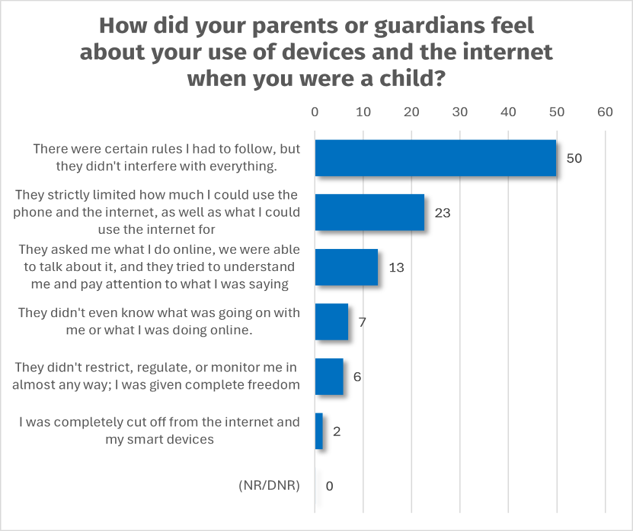
Internet restrictions have become common practice among Hungarian parents. Three-quarters of respondents said that their online access had been regulated in some way during their childhood. Twenty-five percent of respondents described parental control as strict, 50% as moderate, while only 6% said they had been given complete freedom during their childhood. Within the V4 region, Hungarian parents are the strictest when it comes to their children’s online activities. In every other country, the proportion of respondents whose internet access was heavily restricted by their parents was lower.
Digital Education
Digital education plays a very important role in preventing online abuse, which is why we paid particular attention to this topic. Overall, the research produced a positive result, as almost every young person in Hungary had received some form of digital education, whether through a school subject, a one-off presentation, or parental assistance.
More than half of respondents encountered such education at school, while only 18% identified their parents as sources of help on the subject. Only 6% of Hungarian respondents said that they had received no digital education whatsoever. Widespread digital education is characteristic of the region as a whole: even in Poland, the least successful of the V4 countries in this respect, 71% of respondents said that they had received some form of digital education.
Screentime
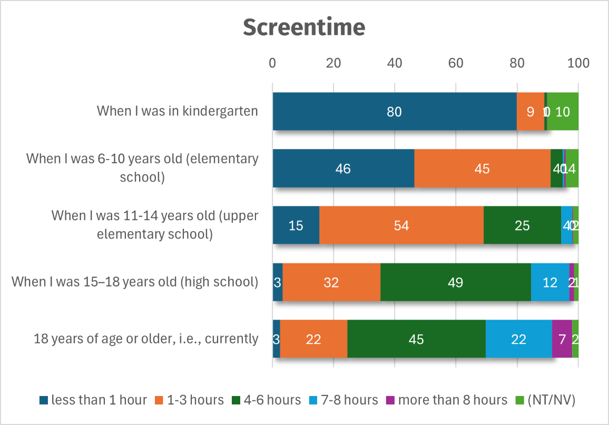
Over the past few years, the amount of time spent in front of screens has increased across all age groups. Overall, however, screen time increases with age. Eighty percent of respondents said that during their preschool years they spent less than one hour a day in front of a screen.
Among children aged 6–10, the proportion spending less than one hour and those spending 1–3 hours in front of screens was already roughly equal. Among 11–14-year-olds, a quarter were already spending 4–6 hours a day looking at screens. By secondary school, half of respondents were spending more than four hours online, while 12% reported spending as much as 7–8 hours a day in front of screens. Screen time peaked at around the age of 18: in this age group, 30% spent more than seven hours online, while almost half of respondents reported 4–6 hours of screen time.
The increase in screen time with age is characteristic of the entire region, with differences mainly in the proportions of individual age groups. Up to the age of 14, Hungarian kids have the lowest screen time, which may be connected to stricter parental attitudes. Above the age of 14, however, Hungarian teens are already among those with the highest levels of screen time in the region.
Most Common Apps
This screen time can take place across a wide range of platforms, and the research therefore examined their use as well. Facebook and its messaging application, Messenger, reach the largest number of users in Hungary, with 84% of respondents reporting regular use. YouTube ranks second, with four-fifths of respondents describing themselves as frequent users. Instagram comes third but reaches considerably fewer people, with half of respondents identifying themselves as active users. It is followed by TikTok, Snapchat, and finally X, formerly Twitter. Interestingly, Facebook is this dominant only in Hungary: in none of the other V4 countries does it have such a high reach, and in Slovakia it does not even rank among the three most popular platforms.
Number of Confidants
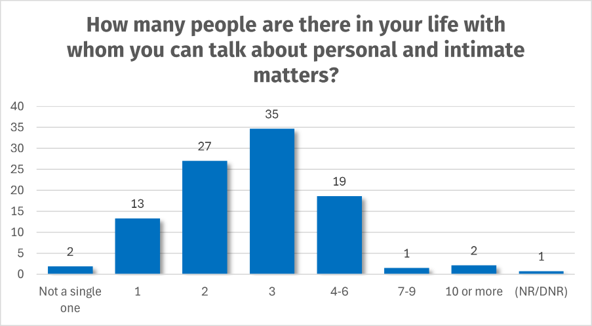
When analyzing whom people could turn to in the event of online harassment, we also examined their personal networks. Only 2% of Hungarian respondents said that they had no one with whom they could share confidential matters. More than one-third reported having three close confidants, while 57% in total said that they had at least three people they could confide in. This gives Hungarian respondents the most extensive network of confidants in the V4 region, and family background may offer one possible explanation. Since the overwhelming majority of respondents grew up in two-parent households and more than three-quarters have siblings, these close family members can easily form part of their circle of confidants.
Social Life
Continuing with social relationships, we asked respondents how frequently they participated in social activities compared with their peers. In Hungary, the majority, 59%, felt that they socialized as often as other people, while 16% felt that they socialized more frequently, and 24% said that they socialized less often than others. These figures suggest that Hungary has the most balanced perception of social life in the region. Among Polish and Slovak respondents, those who reported having an average level of social activity were also in the minority.
Exposure to Online Abuse
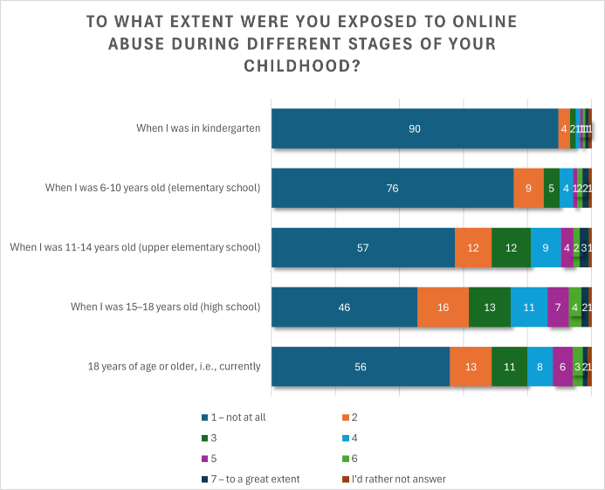
When asked whether they had experienced any form of online abuse, 54% of Hungarian respondents answered yes, with 10% describing the attacks they experienced as particularly severe. Another 40% reported less severe or only occasional abuse, while the remaining 45% could not recall experiencing anything of this kind during their childhood. The fact that almost half of Hungarian respondents did not experience online abuse is a particularly striking statistic. In Poland, only 18%, and in Slovakia just 10% said that they had not experienced any form of online abuse.
Age Groups
Understanding online harassment also requires examining the age at which it tends to occur. The responses clearly show that online harassment occurs most frequently among early adolescents, particularly during the final years of primary school, followed by high school. Among 11–14-year-olds, trolling, exclusion and humiliation are the most common forms of abuse, while personal attacks, stalking and sexually motivated harassment are considerably less frequent. This age group is the most exposed to online harassment in all V4 countries, although the differences in prevalence described in the previous section remain.
Seeking Help
When asked whom they would turn to for help in the event of harassment, respondents primarily chose people within their close personal networks. Eighty-two percent said that they would turn to their parents if they encountered such a problem, followed by personal (offline) friends and then other close family members, whom almost three-quarters of respondents would approach for support. Only after these groups came official institutions, such as the police, helplines and psychologists. Online friends, colleagues and the media ranked lowest.
Among Hungarian respondents, schools, teachers and doctors were trusted less than average, while the police and other official institutions were more popular sources of help than in the other V4 countries.
When seeking help, respondents most frequently identified resolving the problem as quickly as possible, feeling safe, and being taken seriously as their priorities. These were also among the most important considerations in the other countries surveyed. A positive finding is that feelings of shame did not emerge as a significant factor influencing whether someone sought help. Another interesting result is that Hungarians had higher expectations of those providing assistance: compared with respondents in other countries, they selected a greater number of the available criteria as important.
Did Not Seek Help
It is also very important to examine the cases of those who experienced online harassment but did not seek help. In Hungary, almost half of those who experienced abuse, 45%, said that they had not sought any kind of help. The most common reason was that the victim did not consider the situation serious enough to seek assistance. Other frequent reasons included “I thought I could handle it on my own” and “I was afraid to ask for help.” Only a small proportion of respondents cited fear of the aggressor or a desire to avoid conflict as reasons for not seeking help.
Across the V4 region, almost half of minors who experience abuse do not seek help, and in other countries as well, the most common reason is that they do not consider the situation serious enough to warrant assistance.
Based on the research, it can be observed that individuals with a more extensive social life and greater satisfaction with their current situation are less likely to be exposed to online abuse. Higher self-esteem functions as a protective factor, while close family relationships are also associated with less frequent online harassment.
In contrast, social isolation appears to increase the risk of online abuse the most, and the more online platforms a person uses, the more exposed they may be to such abuse. Online presence is also closely related to the Abuse Threshold Index, according to which the more accepting a person is of any form of abuse, the more likely they are to become a victim themselves.
Conclusions
Overall, online harassment is a widespread problem in Hungary. Almost half of Hungarian children experience some form of abuse online during their lifetime, and although regular harassment is less common, nearly half of victims do not seek help. Early adolescents are particularly vulnerable to online harassment, and even those with broad social networks would primarily turn to close friends and family members for assistance. Thus, in the fight against online harassment, we must first focus on vulnerable groups – such as young people who have limited offline social interaction, a strong online presence, and low self-esteem.