


1. A Ban on Night-Time Alcohol Sales Is Necessary to Improve Safety and Cleanliness in Cities
Facts: According to crime statistics, online rankings, and residents’ opinions, Poland— including Warsaw and other large Polish cities—ranks among the safest places in Europe. The image is similar when it comes to satisfaction with the cleanliness of cities and streets[1]. There are therefore no well-grounded reasons to introduce regulations covering entire cities or the whole country. At most, problems occur in specific locations.
Moreover, there are no data on what share of problems related to safety or cleanliness results from purchasing alcohol in shops at night.
2. Night-Time Prohibition Is the Only Way to Ensure Peace and Quiet for People Living Near Liquor Stores
Facts: If there are problems with noise or disturbances of public order near alcohol sales outlets, it is possible to revoke the license to sell alcohol. Cities should therefore focus on enforcing the existing rules, which are a far more precise and proportionate approach: they interfere much less with bystanders while still ensuring peace and quiet for nearby residents. There is no need to introduce additional restrictions if the lighter ones are not being enforced, especially since those could solve problems locally.
3. The Sales Ban Substantially Improves Safety and Reduces the Number of Interventions by the Police and Municipal Services
Facts: According to the annual reports of the Kraków Municipal Guard[2] for 2022–2024 (night-time prohibition was introduced there in mid-2023), the number of residents’ reports increased in the following categories: intoxicated persons, drinking alcohol in prohibited places, public order and peace, and cleanliness and order. Depending on the category, the number of reports rose by 6% to 30% compared to 2022. Meanwhile, reports concerning the safety of persons and property declined.
The Municipal Guard also detected more violations of the Act on Upbringing in Sobriety and Counteracting Alcoholism in both 2023 and 2024 than in 2022—by 11% and 7%, respectively. The number of intoxicated persons transported to the Municipal Centre for Addiction Prevention (MCPU) also rose slightly (in 2024, it was 1.3% higher than in 2022). In 2024, above 45% more offences against public decency were recorded than in 2022. Overall, in 2024 more than 21% more public order offences were recorded.
Table 1: Residents’ reports, detected offences and interventions by the Kraków Municipal Guard in selected categories, 2022–2024.
| Category | 2022 | 2023 | 2024 | Change 2024/2022 |
| Reports | ||||
| Intoxicated persons | 9941 | 9862 | 10565 | 6.3% |
| Public order and peace | 5048 | 5667 | 5847 | 15.8% |
| Drinking alcohol in prohibited places | 8043 | 9749 | 10493 | 30.5% |
| Cleanliness and order | 3551 | 3457 | 4222 | 18.9% |
| Safety of persons and property | 1629 | 1274 | 1069 | -34.4% |
| Interventions and offences | ||||
| Violations of the Act on Upbringing in Sobriety and Counteracting Alcoholism | 22313 | 24693 | 23905 | 7.1% |
| Intoxicated persons transported to MCPU | 3879 | 3600 | 3930 | 1.3% |
| Offences against public decency | 5942 | 8317 | 8626 | 45.2% |
| Public order offences | 32911 | 39375 | 39918 | 21.3% |
Source: Kraków Municipal Guard
4. Night-Time Prohibition Will Substantially Relieve ERs
Although the media sometimes claim that 30% of ER patients are there due to alcohol-related injuries[3], and that queues in ERs shortened by several dozen percent after introducing a night-time retail alcohol sales ban[4], it is difficult to find data that would confirm this. In public debate, “back-of-the-envelope” assessments and statements by individual people are often repeated.
There are no publicly available aggregate data on ER patients and the share of people under the influence of alcohol, nor on cases in which alcohol contributed to the health impairment (for example, if a tree branch falls on someone who is intoxicated, their condition had no impact on the event itself).
According to Statistics Poland (GUS), emergency departments and admission rooms served 4 million patients in 2023 and 4.1 million in 2024[5]. According to the National Health Fund (NFZ)[6], in 2023 about 26 thousand people were admitted to ERs due to health disorders caused directly by alcohol consumption; including all related categories, this figure was 32 thousand. At the same time, a total of 127 thousand people were reportedly admitted to ERs in a state of intoxication[7].
The Ministry of Health reports that alcohol testing was performed on 210.5 thousand patients[8]. It is therefore difficult to estimate alcohol-related harm precisely; however, one can roughly estimate that such cases account for between 0.7% and, at most, 4% of patients.
The XYZ portal obtained data from several hospitals[9] in large cities. These data suggest that patients who had consumed alcohol or were under its influence most often accounted for 2–4% of ER patients.
At the Emergency Department of the University Hospital in Kraków, people admitted due to alcohol-related injuries accounted for only 0.14% of patients, while the total number of ER patients increased in recent years. At the J. Dietl Specialist Hospital in Kraków, the number of ER patients also increased, although the number of people admitted due to the toxic effects of alcohol declined, and their share in total ER patients fell from 3.9% to 2%.
It is therefore hard to blame alcohol for ER overcrowding and the overall number of ER patients, at least in the analyzed departments, did not fall. Patients whose presence in the ER is linked to alcohol consumption constitute only a small fraction of all cases.
5. Night-Time Prohibition Reduces Alcohol Consumption
Facts: The Director of the Administrative Affairs Department of the Kraków City Hall admits that “businesses did not suffer” after introducing the night-time alcohol sales ban. The prohibition did not affect the volume of alcohol sales, and the industry’s revenues did not decline[10].
This could suggest that any positive effects attributed to night-time prohibition would have occurred even without the restriction, since it did not change alcohol sales.
Moreover, even if “the industry did not suffer”, a logical outcome of such regulation is a shift in demand from night shops to convenience stores and large retail chains. This means that small entrepreneurs running specialist alcohol shops are the ones who suffer (and may even be forced to close), while chains operating mainly during the day gain—along with local restaurants during night hours.
6. Poles Drink a Lot of Alcohol and We Should Counter This by Any Means Necessary
Facts: In 2024, alcohol consumption per capita in Poland was the lowest (8.77 litres of pure alcohol) since 2005[11], and since 2021 there has been an uninterrupted downward trend in alcohol consumption. We drink about 10% less than in 2019 or 2021. Given that consumption is declining naturally, it does not seem that additional regulations and restrictions are needed.
Figure 1: Consumption of individual alcoholic beverages per person of litres of pure alcohol, 2003–2024.
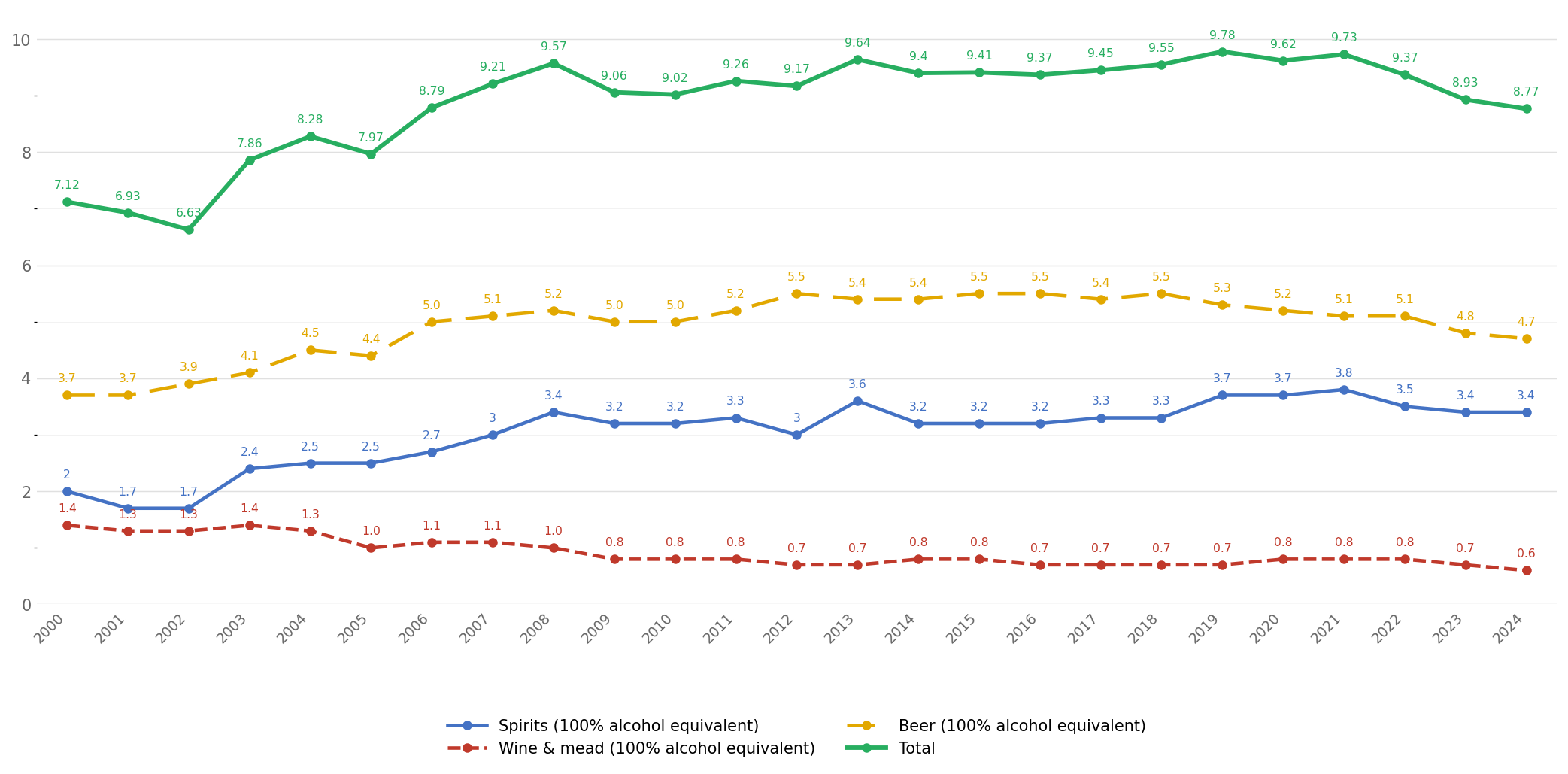 Source: FOR calculations based on data from Statistics Poland (GUS) and the State Agency for the Prevention of Alcohol-Related Problems (KCPU)
The decline in consumption is likely even larger, because—following KCPU—we relied on GUS data that consistently assume beer has an alcohol content of 5.5%. Meanwhile, the Polish Brewers’ Employers Association reports that in 2024 the largest drop in sales concerned strong beers (almost 4% year-on-year)[12]. This is also indicated by data on beer production and excise revenues. In 2023, beer production in Poland was 2% higher than in 2010, and excise revenues were 12% higher, even though the excise rate increased by as much as 27% over that period. On this basis, one can infer that the average beer today has about 1–1.5 degrees Plato less than a dozen years ago. This suggests it likely contains less alcohol, meaning the decline in pure alcohol consumption among Poles is probably even larger.
In addition, Eurostat data[13] show that both the frequency of drinking alcohol and the frequency of heavy episodic drinking are not particularly high in Poland. By these measures, Poland is most often well below the EU average. The share of abstainers or people who drink very rarely is also relatively low in Poland. In Croatia, Italy, or Spain, the share of both non-drinkers and very frequent drinkers is high.
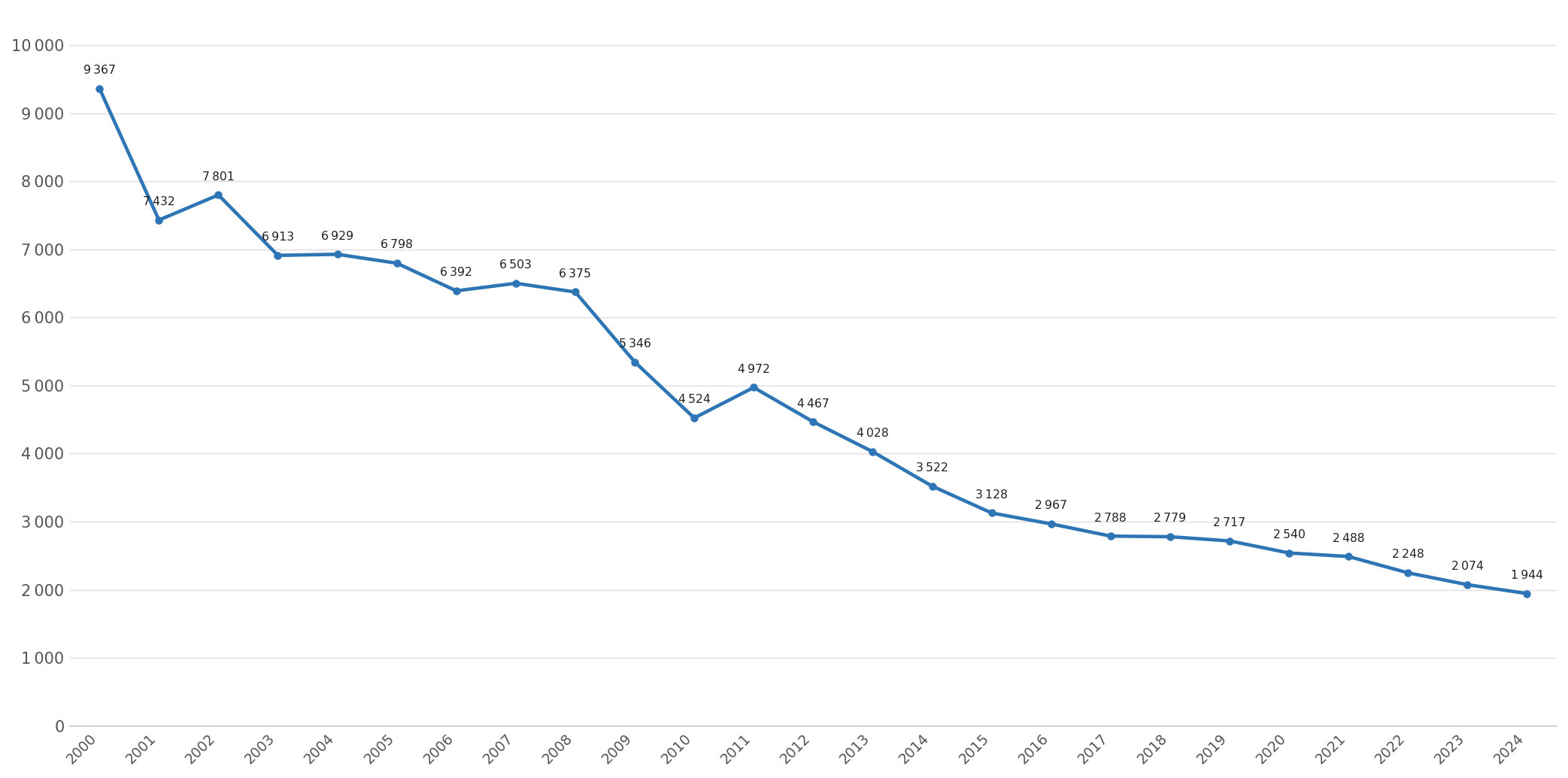
Statistics on road accidents involving intoxicated participants have also fallen significantly and almost continuously. In 2024, there were nearly five times fewer such accidents than in 2000. There were also about 30% fewer than before the pandemic and almost 60% fewer than in 2010.
Figure 2: Road accidents in Poland involving intoxicated persons, 2000–2024.
 Source: Polish Police Headquarters
7. 80% of Warsaw Residents Support Night-Time Prohibition
Facts: The “social consultations” showing that 80% of Warsaw residents want night-time prohibition—most of them in the strictest form (covering the entire city and for the longest possible hours)—were not representative. They were the results of an online survey completed by only about 9 thousand people, i.e., less than 0.5% of the capital’s residents. There is also no certainty that only Warsaw residents participated. The group was clearly not representative: participation was dominated by people most interested in the matter, which was promoted in groups campaigning for a night-time alcohol ban.
It is difficult to obtain reliable data on public support for a night-time alcohol sales ban, and there is an even greater lack of surveys offering respondents a choice between several solutions. Nationwide polls do not give an clear picture: according to some, support for prohibition is 46% (with the same share opposed)[14]; according to others, it is 48%[15] or 68%[16].
Written by Gabriel Hawryluk & Mateusz Michnik
References:
[1] G. Hawryluk, P. Oliński, STANOWISKO Forum Obywatelskiego Rozwoju w sprawie propozycji wprowadzenia za-
kazu nocnej sprzedaży alkoholu w Warszawie, Forum Obywatelskiego Rozwoju, 1.07.2024.
[2] See: Annual reports of the Kraków Municipal Guard.
[3] TVN24.pl, Ekspertka: jedna trzecia pacjentów SOR-ów trafia tam po alkoholu, 18 September 2025.
[4] M. Mieśnik, Nocna prohibicja zmniejszy kolejki na SOR-ach. “U nas są krótsze o 30 proc.” wiadomosci.wp.pl, 14 September 2025.
[5] Statistics Poland (GUS), Pomoc doraźna i ratownictwo medyczne w 2024 r., 27 March 2025.
[6] K. Lurka, Ilu pijanych na SOR?, Termedia.pl, 3 March 2025.
[7] Valuemed.pl, SOR-y przeciążone przez pijanych pacjentów. Lekarze alarmują o narastającym problemie, 26 September 2025.
[8] https://sejm.gov.pl/INT10.nsf/klucz/ATTD5VJRF/%24FILE/z00530-o1.pdf
[9] Ł. Grzesiczak, Lewica chce ograniczeń sprzedaży alkoholu, bo „SOR-y zamieniają się w izby wytrzeźwień”. Jakie są
fakty?, XYZ.pl, 1 October 2025.
[10] P. Konieczny, Pół roku nocnej prohibicji w Krakowie. Znamy efekty, RMF24.pl, 16 February 2024.
[11] Statistics Poland (GUS), Dostawy na rynek krajowy oraz spożycie niektórych artykułów konsumpcyjnych na
1 mieszkańca w 2024 r., 1 September 2025.
[12] Polish Brewers’ Employers Association – Browary Polskie, Piwo na fali zmian – ZPPP podsumowuje
rynek w 2024 roku, 20 February 2025.
[13] Eurostat, Alcohol consumption statistics.
[14] Business Insider, Zakaz nocnej sprzedaży alkoholu. Polacy mocno podzieleni [SONDAŻ], 17 January 2025.
[15] Polish Press Agency (PAP), Sondaż: co druga osoba popiera nocną prohibicję w miastach, 27 July 2024.
[16] Business Insider, Tylu Polaków popiera nocną prohibicję [SONDAŻ], 23 September 2025.