



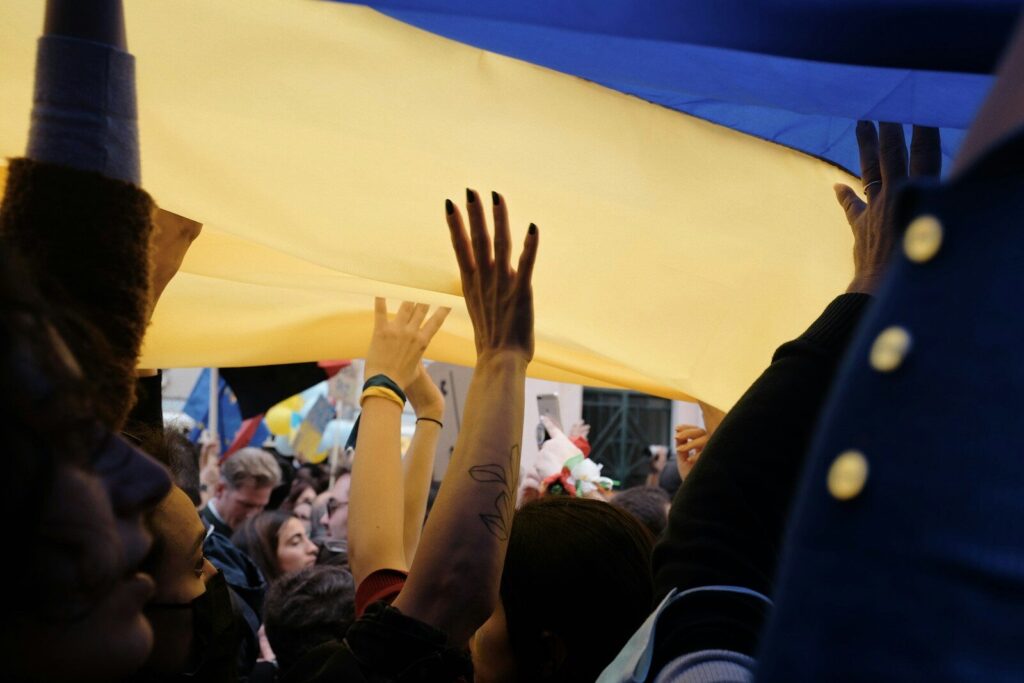
The protests that began in Ukraine in July 2026 are often described simply as demonstrations demanding the return of former Defense Minister Mykhailo Fedorov. This is only partly accurate.
Fedorov was undoubtedly a symbolic figure for the protest movement. But the protests have gradually become about something broader: how wartime personnel decisions are made, whether the authorities are required to explain them, and what should guide Ukraine’s military during the war in which technological adaptation has become essential.
The crisis began with a broad government reshuffle. Prime Minister Yulia Svyrydenko resigned, which under Ukraine’s constitutional system meant the resignation of the entire Cabinet of Ministers. President Volodymyr Zelenskyy initially presented the changes as government renewal, with preparation for another difficult winter among the new Cabinet’s key priorities. Yet the most politically consequential result was the removal of Fedorov after only six months as defense minister.
This led many Ukrainians to suspect that replacing the prime minister and Cabinet had also provided a mechanism for removing a minister whose dismissal would otherwise have been much harder to explain. This interpretation remains an inference rather than an established fact, naturally.
The explanation for Fedorov’s dismissal then shifted toward his deep disagreement with Commander-in-Chief Oleksandr Syrskyi. The conflict was not merely personal. Fedorov represented a model of warfare based on technology, drones, data, decentralization, faster procurement and greater autonomy for commanders. His critics in the military establishment represented a more centralised model of command. Fedorov himself later described the disagreement as a conflict of “world view” rather than a personal dispute.
This distinction explains why the protests should not be understood purely as a personality cult around a popular minister. For many participants, Fedorov became the symbol of a particular philosophy of how Ukraine should fight a larger enemy: asymmetrically, technologically and with institutions capable of adapting faster than Russia.
The government’s subsequent decisions made the original explanation even harder to understand. Under growing public pressure, Zelenskyy dismissed Syrskyi and appointed Mykhailo Drapatyi, a younger commander associated with military reform, technological adaptation and greater responsibility at lower levels of command. The decision was broadly welcomed by protesters.
But it created an obvious question. If the supposedly irreconcilable conflict between Fedorov and Syrskyi had been one of the principal reasons for removing Fedorov, why didn’t Fedorov return to the Defense Ministry after Syrskyi himself was removed?
No convincing public answer followed.
The search for Fedorov’s successor added to the sense of improvised decision-making. Interior Minister Ihor Klymenko was initially the president’s preferred candidate, but his potential nomination quickly encountered political and public resistance. The authorities then turned to Yevhenii Khmara, a respected security-service officer and combat veteran who had led the SBU’s “Alpha” and “Omega” special operations unit. His appointment as acting defense minister was received much more favourably and appeared to help lower the immediate level of public anger.
Yet, the broader personnel reshuffle generated new controversies. Vitalii Kim, the former governor of Mykolaiv Oblast, was appointed Minister for Veterans Affairs despite having no military service or previous experience in veterans policy. Protesters began demanding that the position instead be held by someone with direct understanding of military and veteran experience.
In August, protesters also criticised the appointment of former defense minister Rustem Umerov as head of the Foreign Intelligence Service despite his lack of intelligence experience. Umerov’s earlier tenure at the Defense Ministry had itself been controversial, including an anti-corruption investigation related to procurement.
By mid-August, the movement’s message had therefore expanded. Protesters were still demanding Fedorov’s reinstatement, but they were also demanding dialogue, transparency and responsibility for personnel decisions. On August 16, organisers explicitly called on the president to explain controversial appointments and argued that society had still received no meaningful dialogue despite a month of demonstrations. This may be the most important aspect of the protests.
Ukraine is fighting an existential war, and wartime governments inevitably require greater freedom to make rapid decisions. But the protests suggest that Ukrainian society does not interpret wartime unity as an obligation to accept unfounded and unexplained decisions — particularly when those decisions concern the institutions responsible for fighting the war.
For many Ukrainians and servicemen, Fedorov came to represent a belief that Ukraine cannot defeat a much larger enemy with an older, heavily centralised model of warfare. It has to be faster, more technological, more decentralised and more flexible.
The political mistake may therefore have been not merely dismissing a popular minister. It was removing the embodiment of that approach without clearly explaining why — and then making subsequent decisions that appeared to undermine the explanations that had been offered.
The longer the government avoids that conversation, the less the protests are about one personnel decision and the more they become about something fundamental: whether Ukrainian society is still entitled to demand an explanation from its leaders during wartime and without elections.
Written by Nikita Khramov