





Priorities. Practically every ministry, every coalition, even every group sitting at a table in a pub has a whole list of them. But so as not to sound too self-deprecating, this is not just a problem in the Czech Republic. For three and a half years, we have been hearing that defense is our European priority. I would very much like to agree with that. But then I looked at the figures on support for Ukraine, which is currently at war with the country that poses the greatest security risk to Europe.
According to the often-cited Kiel Institute, at the end of June 2025, Czech aid to Ukraine reached €1.41 billion, which is just over CZK 34 billion for a period of three and a half years. Just to give you an idea, the Czech Republic’s planned spending on social benefits this year alone is just under CZK 917 billion.
Another interesting comparison is that, according to the National Energy and Climate Plan, the Czech Republic’s financial allocation for decarbonization is expected to reach CZK 2,800 billion by 2030. To support Ukraine, we have spent a whopping 1.2% of the amount that should be allocated to decarbonization, or 3.7% of this year’s social benefits expenditure, for the entire duration of the conflict.
Let’s also look at the problem from a European perspective. For example, for the years 2019-2024, the European Union announced four basic priorities, the first of which was aimed at the security of EU citizens and the third at green policy. So take another look at the figures mentioned above to understand what our real priorities are. Not to mention that in order to finally start collectively noticing our underfunded defense, we needed the return of war to Europe and an extremely unpredictable American president.
We Are Spending The Same on Defense as We Did Twenty Years Ago
However, it must be acknowledged that the rate of growth in defense spending among EU countries reached a record high of 19% between 2023 and 2024, which is a relatively unprecedented increase even in the context of longer time
series. Nevertheless, I would temper the enthusiasm and celebrations about how much we are now investing in defense. If we look at defense spending within the EU from a longer-term perspective, taking 2005 as the starting point, and only indexing this total expenditure from 2005 based on the GDP deflator, we can say that in 2024 we have only managed to return (in real terms, not nominal terms) to the 2005 level.
Note: Unlike the HICP (Harmonized Index of Consumer Prices), the GDP deflator includes all goods and services produced in the economy, i.e., not only what households consume, but also corporate investment, government spending, and net exports. It is calculated as the ratio of nominal GDP to real GDP and is more suitable for macroeconomic comparison, while the HICP is more suitable for monitoring what ordinary citizens feel in their wallets.
Chart: Time series of defense spending within the EU
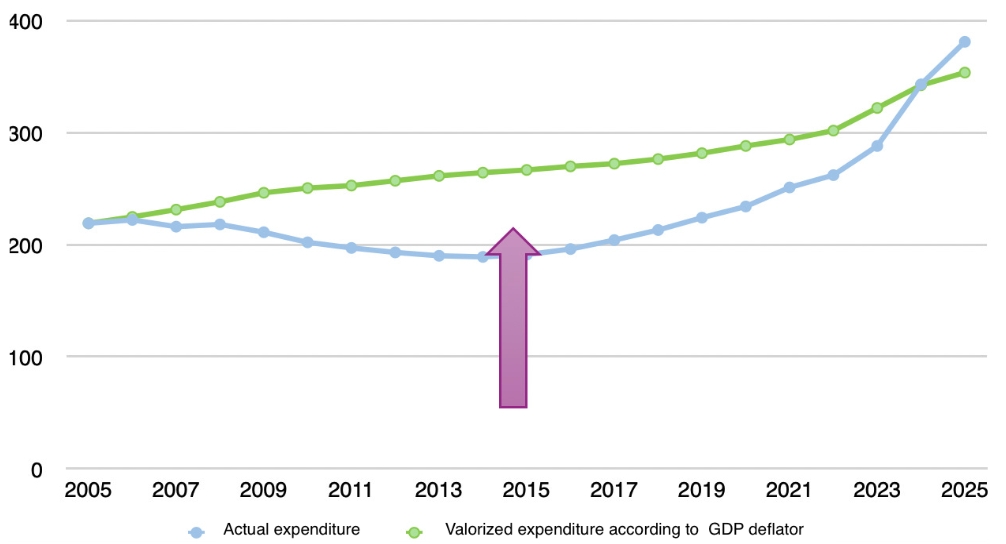
I would also like to point out that in 2005, the European Union spent 1.5% of GDP on defense, not the 2% agreed by NATO members at the Riga summit in 2006. This means that although we reached the 2005 level in 2024, these expenditures were half a percentage point lower than what our allied commitments currently require. The “gap” between the two curves is clearly visible, showing how much defense has been underfunded.
Table: Defense debt incurred within the EU (in billions of euros)
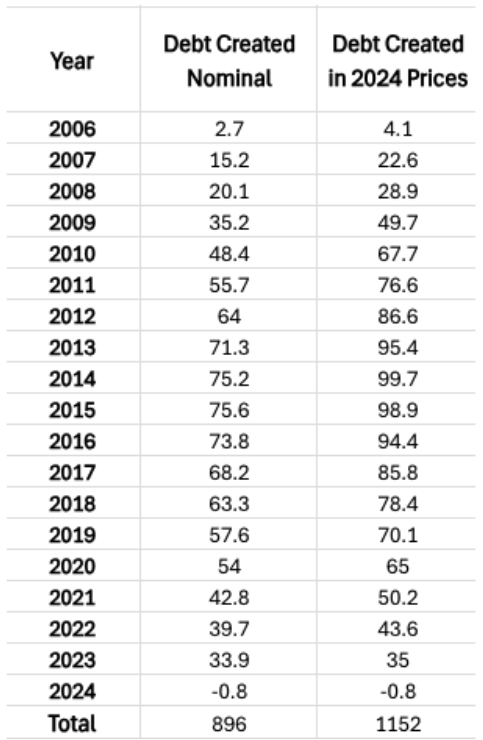
The table shows how much debt the European Union has accumulated in terms of defense capabilities (measured, of course, by the amount of funds allocated) for each year. Ultimately, this amounts to a “debt” of €1,152 billion (from the perspective of 2024), which translates to CZK 28 trillion, or just over thirteen Czech state budgets.
What You Can Buy for One Billion
I recognize that issues such as social transfers or housing expenditures may be more appealing to the electorate than defense. It’s hard to take a photo of yourself as a politician standing next to a new howitzer and have ordinary families applaud you for what a great achievement it is.
Judge for yourself – for one billion crowns, you could finance a salary increase of more than 2,000 crowns per year for state and subsidized organizations, a salary increase of just under 5,000 crowns per year for teachers in regional schools, or two army helicopters. You can probably answer the question yourself as to which of these purchases would be the least popular with the majority of the population.
Let’s return for a moment to the issue of Ukraine, whose support we compared with spending on decarbonization and the amount of social transfers. Especially after Donald Trump’s resurgence, I feel that if Ukrainians could shoot with European words of support, the Russians would defend Vladivostok tooth and nail.
The first time Donald Trump declared that he would end the war in Ukraine within 24 hours, voices began to be heard in Europe saying how evil Trump was, wanting to sell Ukraine to Russia – and that is something we definitely do not want. I understand that we don’t want Ukraine to lose, but rhetorically speaking, what have we as Europe done to improve the situation? Where are the large sums of money or weapons packages that we have started sending to Ukraine since then?
Let’s do a little exercise – let’s first look at the following events:
- May 2023 – Trump’s now famous statement that he will end the war within 24 hours
- November 2024 – Trump’s election victory
- February 2025 – Trump and Zelensky’s war of words in the Oval Office
- March 2025 – Formation of the so-called coalition of the willing at a meeting of leaders in London
- August 2025 – Trump’s talks with Putin in Alaska
What do these five events have in common? Apart from Donald Trump, of course. Personally, I see two common denominators – firstly, I have noticed relatively strong gestures and statements from Europe towards Trump about what is right and how he should behave and what he should do, but these have not been followed up by any major tangible European response.
Trump made his famous statement about ending the war within 24 hours back in May 2023. At the time, part of Europe was horrified about what would happen to Ukraine, whose territory Trump would surely exchange for a fragile ceasefire. We, as Europe, expressed words of support, saying that we would not let Ukraine fall, and then there was silence.
Just Moralizing, No Action
When Trump won the election, some saw it as a defeat for Ukraine because a pro-Russian candidate had won. In response to an undignified row in the Oval Office, when it seemed that Ukraine had lost its ally in the United States, European leaders showered President Zelensky with huge supplies of equipment, weapons, and ammunition so that Ukraine could defend its homeland… just kidding… they showered him with words of support. However, Europe gathered at a summit in London to solemnly announce the formation of a coalition of those willing to continue helping Ukraine – that is all.
Well, that is how it is with everything, I do not even need to continue. Lots of talk, twice as much moralizing, especially towards everyone else, but very little action of our own.
After all, we in Europe are masters at lecturing and moralizing to everyone around us. Towards Israel, which, if it had listened to our lordly advice, might not even exist anymore. And towards the United States, which has been doubly true lately. We can rightly reproach Trump for many things, but his pressure on Europeans to start paying for their own security is definitely not one of them.
And instead of collectively bowing our heads and acknowledging that we have been taking advantage of the American security umbrella over Europe for decades without contributing to it in an appropriate manner, some people are able to proclaim delusions in their election campaigns that our armament must be housing. This is presumably so that Russian troops in Czechia can enjoy comfortable, high-quality housing.
American Taxpayers Will No Longer Contribute To Us
However, this is not just about the fact that we have long failed to fulfill our NATO commitments and now (for some) the wicked orange villain from the US wants us to contribute adequately. European “claims” on money from the pockets
of American taxpayers even extend to cultural events, to which Americans also contributed from their taxes, for example through the USAID program.
I certainly do not dispute that programs to support minorities or Ukrainian refugees are a worthy cause, but again I ask: shouldn’t we pay for such projects ourselves? Let us remember that, despite the Green Deal, we live on an exceptionally rich continent. So what gives us the right to complain that American taxpayers will no longer contribute to our activities?
Environmental protection is a noble goal, but we should admit as soon as possible that what worries us most at present is the security situation in Europe. Once we admit this, the next step should be to realize that we simply cannot afford all
of our declared priorities—I am not just talking about defense and decarbonization, but also, for example, the highly costly energy sector.
If I had to guess, I would say that decarbonization will win out. For Ukraine, this means that it must hold on to Kyiv for another thirty years until we complete the green transition, and then we will definitely help them. After all, even after the
Russians repeatedly violated NATO airspace, Europe did not respond with strong words, as it often did in the past… The European Commission also proposed manufacturing EU electric cars and sanctions against Israel.
Written by Jakub Kuneš, Liberal Institute, Centre for Economic and Market Analyses
Continue exploring:
Poland’s Green Energy Transition: Progress and Persistent Challenges