




Bulgaria is about to enter the excessive deficit procedure for the second time in its recent history. At present, all expectations are focused on the government, which must propose a regular budget for 2026 and give a clear signal that it is reversing the trajectory of public finances. Against this backdrop, it is important to look once again at the fiscal history of the last 25 years, in order to understand where today’s problem is rooted and what possible solutions exist.
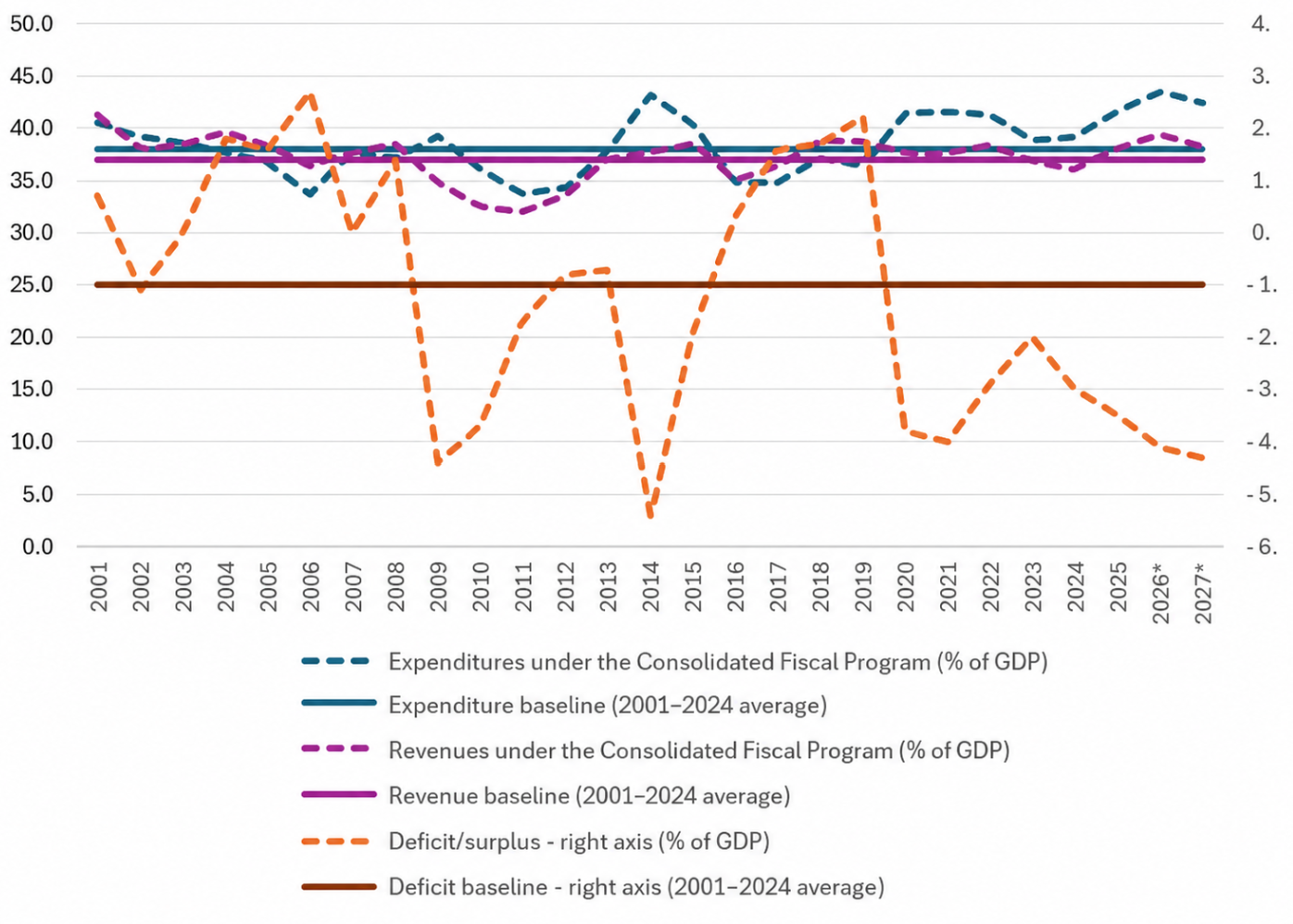
Figure 1: Fiscal indicators for Bulgaria (2001–2027)* Consolidated budget revenues and expenditures as a share of GDP, 2001–2027
 Source: IME, based on Eurostat data. *For 2026 and 2027, the Commission’s forecast has been used.
First Crisis, Excessive Deficit, and the Collapse of KTB
Over the past more than two decades, the country has recorded two long periods of budget deficit. The first runs from 2009 to 2015 and covers the global financial crisis, the subsequent European debt crisis, and the collapse of Corporate Commercial Bank (KTB). Bulgaria fell into a deep economic crisis in 2009, which collapsed budget revenues and opened up a large deficit. It is very important here to understand the origin of the deficit in that period — the collapse in budget revenues, which is not characteristic of the current fiscal drama.
In 2008, budget revenues reached EUR 14 billion after years of very strong growth. In 2009, revenues fell to EUR 12.8 billion, and by 2010 they had dropped further to EUR 12.2 billion — a 12% decline in nominal terms over two years. That amounts to a downward correction of more than 6 percentage points of GDP in revenues — from 38.5% in 2008 to 32% in 2010. The hole in revenues gradually put pressure on budget expenditures as well, but these nevertheless grew in nominal terms — from EUR 13 billion in 2008 to EUR 13.7 billion in 2010. Logically, in 2010 Bulgaria entered the excessive deficit procedure, with a reported deficit of 4.4% for 2009 and 3.7% for 2010.
Over the following two years, Bulgaria managed to improve the fiscal picture by curbing spending growth. In 2011, the increase in expenditures was only EUR 300 million in nominal terms — under 1% growth in consolidated budget spending. Expenditures accordingly also marked their lowest point relative to the size of the economy, at 33.7% of GDP. The picture was similar in 2012, when public spending increased by only 3.6% overall. At the same time, revenues gradually recovered, returning to 2008 levels by 2012.
Thus, Bulgaria exited its first excessive deficit procedure in 2012, having weathered a shock to the revenue side of the budget in 2008–2010 and brought spending under control in 2010–2012. Here comes an interesting turn — the highest deficit in the country’s recent history, caused by the collapse of KTB in 2014. Bulgaria recorded a deficit of 5.4% of GDP, but this did not trigger a new procedure, since it was clearly a one-off payment rather than systemic pressure on the budget. This proved correct, as the balance quickly corrected and the budget even ran a surplus in 2016. The first period of budget deficits ended after 7 years in the red (2009–2015).
The Pandemic, Political Instability, and a Spending Crisis
The second episode covers the entire period since the pandemic (2020–ongoing), marked by record spending growth, a steadily deteriorating deficit trajectory, and a rising trend in government debt. In 2020, the pandemic and the accompanying restrictions plunged the country’s economy into a deep recession, from which it nevertheless managed to recover as early as 2021. The hit to revenues was milder and relatively short-lived, but expenditures crossed the 40%-of-GDP threshold for the period 2020–2022.
Bulgaria recorded a deficit of 3.8-4.0% of GDP in 2020 and 2021, but did not enter the excessive deficit procedure, since the European Commission had activated the general escape clause — meaning the severe impact of the pandemic was taken into account and the deviation from fiscal rules was permitted. In the period 2022–2024, Bulgaria was already in a difficult period of political instability and began its odyssey of extended budgets, but still managed to keep the fiscal balance under control, including meeting the eurozone criterion and receiving a positive convergence report (spring 2025).
The warning lights on the budget, however, are flashing. On the revenue side, various one-off measures are used to patch the balance only temporarily. On the spending side, the pressure is enormous: as early as 2024, new public-sector pay rules were adopted, leading to a 30–50% increase in salaries in the security services. As a result, in 2025 expenditures under the consolidated program reached 41.7% of GDP. At the end of the year, the government proposed a budget with spending at 45% of GDP along with tax increases, which triggered (together with concerns about corruption) record protests and led to yet another election.
Logically, in 2026 Bulgaria is on track to enter the excessive deficit procedure once again. The Commission’s assessment makes clear that although the criterion was met in 2025 (with the defense-spending allowance), a deviation from the reference value is expected in 2026 and 2027. At the same time, the country has no adopted budget and has not presented a clear path for consolidation and reversing the budget trajectory. In this sense, the procedure should serve a disciplining function and support the government’s attempt to put forward a sound framework for public finances.
Lessons from the Periods of Excessive Deficit
A review of the two deficit periods reveals several significant differences. In 2010, Bulgaria entered the procedure because of an economic crisis and a shock to the revenue side of the budget. In 2026, it is entering the procedure because of uncontrolled growth in budget spending, and this during a period of economic growth and rising revenues. The sharp deterioration in the budget balance is not the result of an economic crisis. It stems from structural weaknesses on the spending side, which need to be addressed in the new budget.
In summary, the data for 2001–2027 (using the Commission’s forecast for 2026 and 2027) point to clear reference values. For the period 2001–2024, average revenues under the consolidated program stood at 37% of GDP — a level Bulgaria is currently significantly above. For the same period, average expenditures stood at 38% of GDP. This threshold has been breached during the collapse of KTB, during the first shock of the pandemic, and at present — but now without any justification.
For the period as a whole, the reference value for the deficit is 1% of GDP, a level that is manageable and keeps debt from growing. If the new budget targets a medium-term return to these reference values — above all with regard to spending and the deficit — then the end of the second excessive deficit procedure could come relatively soon.
The article was originally published in Bulgarian at: https://ime.bg/articles/kratka-istoriya-na-prekomernite-defitsit-v-bylgariya/