




- This coming weekend, Poland and other EU countries will once again switch to summer time. As every year, this refreshes the debate over the economic and social rationale for changing the time. EU law, however, obliges us to do so.
- Time changes were intended to save energy. Their effect on energy consumption is now less significant, and most Poles would like to adopt summer time (UTC+2) permanently.
- Poland has exceptionally early sunrises and sunsets, which leads to a less-than-optimal use of daylight. A change in Poland’s time zone also seems worth considering.
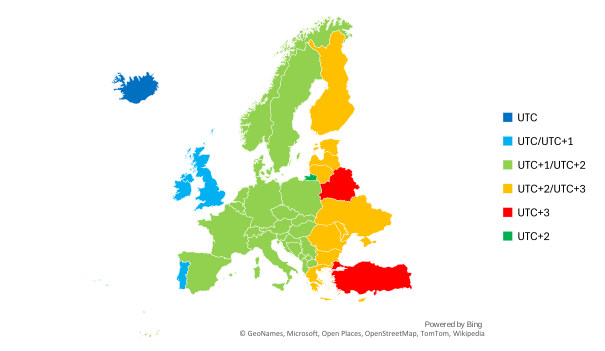
European Union countries use different time zones, ranging from UTC to UTC+2. Under EU Directive 2000/84/EC, however, they must all switch to summer time on the last Sunday in March, moving the clocks forward by one hour. Changing the clocks is criticized for its costs and lack of tangible benefits.
Research shows that almost 80% of Poles oppose clock changes and three-quarters would prefer permanent summer time (UTC+2).[1] In a consultation conducted by the European Commission, 84% of EU citizens opposed changing the clocks and more than three-quarters said it affected them negatively.[2] Although many EU countries and citizens would like to abandon this practice, agreement on the matter has yet to be reached.
Although many countries around the world once changed their clocks, the practice is now in decline. It is mainly used in Europe, across the vast majority of the continent. Worldwide, a total of 55 countries change the clocks in at least part of their territory, and 51 do so throughout all or almost all of their territory. Of these, 43 are European countries and 27 are EU member states.
Outside Europe, summer time is largely used in English-speaking countries: New Zealand, almost all of the United States, and parts of Canada and Australia. Elsewhere, it is used only by Egypt, Israel, Lebanon, most of Chile and a few Caribbean islands.[3]
Why Are the Clocks Changed?
Poland has changed its clocks continuously since 1977. Saving electricity was one of the arguments in favor. Although the clock change itself generates certain costs, that argument has some justification, since the practice introduces summer time instead of retaining standard time, commonly called winter time, throughout the year. The current debate, however, is more about adopting Central European Summer Time permanently, and legislative proposals take that approach too.[4] Retaining winter time, which applied throughout the year in Poland after the Second World War before seasonal clock changes were introduced, could increase summer energy use: in June, the sun would set at 20:00 and rise at 03:00.
Energy savings are now much less significant. Light bulbs and street lighting consume far less energy than a few decades ago, while lighting accounts for a smaller share of total energy use in homes and offices. The operation of computers, household appliances and air conditioning is not linked to the availability of daylight. In industry too, lighting is a much less important source of energy consumption. Moreover, many factories operate around the clock, and day length remains the same regardless of the time zone chosen.
Changing the Time Costs Us
The very act of adjusting the clocks twice a year creates various difficulties and costs for individuals, groups and entire industries. Clock changes disrupt the circadian rhythm, which may adversely affect health, well-being and concentration and increase stress levels or the risk of depression, at least in the short term.[5] For this reason, they may temporarily reduce productivity and cause more human errors and misunderstandings.
Shifting the clocks also has wider consequences, creating additional costs and challenges in logistics, banking and factories operating around the clock. It requires additional working hours to plan the entire transition appropriately. Clock changes also create problems in passenger transport. On the last Sunday in October, trains stand at stations for an hour to keep to the timetable.
Table 1: Natural time zones and official time used in European countries and territories*
| Country/territory | Natural time zones: share of territory | Winter / year-round official time | Summer official time |
| Azores (Portugal) | UTC−2: 100% | UTC−1 | UTC |
| Iceland | UTC−2: 10%, UTC−1: 90% | UTC | Same all year |
| Canary Islands (Spain) | UTC−1: 100% | UTC | UTC+1 |
| Portugal (mainland) | UTC−1: 80%, UTC: 20% | UTC | UTC+1 |
| Ireland | UTC−1: 70%, UTC: 30% | UTC | UTC+1 |
| Spain (mainland) | UTC−1: 5%, UTC: 95% | UTC+1 | UTC+2 |
| United Kingdom | UTC: 100% | UTC | UTC+1 |
| Belgium | UTC: 100% | UTC+1 | UTC+2 |
| France (mainland) | UTC: 100% | UTC+1 | UTC+2 |
| Netherlands | UTC: 100% | UTC+1 | UTC+2 |
| Luxembourg | UTC: 100% | UTC+1 | UTC+2 |
| Switzerland | UTC: 30%, UTC+1: 70% | UTC+1 | UTC+2 |
| Norway (mainland) | UTC: 15%, UTC+1: 70%, UTC+2: 15% | UTC+1 | UTC+2 |
| Germany | UTC: 10%, UTC+1: 90% | UTC+1 | UTC+2 |
| Italy | UTC: 3%, UTC+1: 97% | UTC+1 | UTC+2 |
| Albania | UTC+1: 100% | UTC+1 | UTC+2 |
| Austria | UTC+1: 100% | UTC+1 | UTC+2 |
| Bosnia and Herzegovina | UTC+1: 100% | UTC+1 | UTC+2 |
| Croatia | UTC+1: 100% | UTC+1 | UTC+2 |
| Montenegro | UTC+1: 100% | UTC+1 | UTC+2 |
| Czechia | UTC+1: 100% | UTC+1 | UTC+2 |
| Denmark | UTC+1: 100% | UTC+1 | UTC+2 |
| Corsica (France) | UTC+1: 100% | UTC+1 | UTC+2 |
| Kosovo | UTC+1: 100% | UTC+1 | UTC+2 |
| Malta | UTC+1: 100% | UTC+1 | UTC+2 |
| Slovakia | UTC+1: 100% | UTC+1 | UTC+2 |
| Slovenia | UTC+1: 100% | UTC+1 | UTC+2 |
| Hungary | UTC+1: 100% | UTC+1 | UTC+2 |
| Serbia | UTC+1: 97%, UTC+2: 3% | UTC+1 | UTC+2 |
| Sweden | UTC+1: 97%, UTC+2: 3% | UTC+1 | UTC+2 |
| Kaliningrad Oblast (Russia) | UTC+1: 92%, UTC+2: 8% | UTC+2 | Same all year |
| Poland | UTC+1: 88%, UTC+2: 12% | UTC+1 | UTC+2 |
| North Macedonia | UTC+1: 85%, UTC+2: 15% | UTC+1 | UTC+2 |
| Greece | UTC+1: 50%, UTC+2: 50% | UTC+2 | UTC+3 |
| Latvia | UTC+1: 20%, UTC+2: 80% | UTC+2 | UTC+3 |
| Lithuania | UTC+1: 15%, UTC+2: 85% | UTC+2 | UTC+3 |
| Romania | UTC+1: 15%, UTC+2: 85% | UTC+2 | UTC+3 |
| Finland | UTC+1: 7%, UTC+2: 93% | UTC+2 | UTC+3 |
| Estonia | UTC+1: 4%, UTC+2: 96% | UTC+2 | UTC+3 |
| Belarus | UTC+2: 100% | UTC+3 | Same all year |
| Bulgaria | UTC+2: 100% | UTC+2 | UTC+3 |
| Cyprus | UTC+2: 100% | UTC+2 | UTC+3 |
| Moldova | UTC+2: 100% | UTC+2 | UTC+3 |
| Ukraine | UTC+1: <1%, UTC+2: 92%, UTC+3: 8% | UTC+2 | UTC+3 |
Why Move Away from “Natural Time”?
A country’s location within a “natural time zone” should not be an argument for adopting the corresponding official time. It is true that the vast majority of Poland lies in UTC+1, with only a little over one-tenth of its area in UTC+2, the zone corresponding to summer time. Today, however, official time in most countries is adapted primarily to society’s needs and geographical location, which determines the length of the day.
Around 10% of Germany’s territory lies in the UTC time zone, with the remainder in UTC+1. The Benelux countries and France lie entirely in UTC, while Spain’s Galicia even lies in UTC−1, with the rest of Spain in UTC. All these countries use UTC+2 in summer. Most countries using Eastern European Time lie either entirely in that zone or partly in UTC+1 as well. In summer, they use UTC+3. Europe as a whole moves its time zones forward, gaining longer afternoons and evenings and avoiding dawn at 03:00 in June.
Throughout the year, Poland uses an official time corresponding to a zone that theoretically covers part of its territory. In this respect, it is effectively an exception in Europe. Countries often use an official time that does not follow from their natural time zone. Apart from Poland, only a few countries have at least part of their territory aligned with natural zonal time throughout the year.
Of these, only North Macedonia and Ukraine are comparable cases, although Ukraine’s territory in UTC+3 consists mainly of areas currently occupied by Russia. Serbia and Sweden overlap with the natural zone corresponding to their summer time across only a few per cent of their territory. Norway extends across three time zones, with around 15% of its territory in UTC+2, but these areas lie above the Arctic Circle and have very low population density, accounting for around 1% of Norway’s population. A much larger share of Norway’s population lives in UTC. In addition, Russia’s Kaliningrad Oblast uses UTC+2 year-round, which is the “correct” zone for around 8% of its territory.
In a post-industrial society with varied lifestyles, the time adopted should aim to optimize the use of daylight. This is particularly important in countries such as Poland, where sunshine and daylight are scarce for a large part of the year and have a significant effect on health, well-being and concentration. It hardly seems a risky assumption that more people are asleep at 06:00 or even 07:00 than at 16:00 or 17:00. Part of society simply sleeps through some of the few hours of daylight available in winter.
Sunsets That Come Too Early
The eastern boundary of the time zone used by most European countries runs through Poland. Among countries using the same official time, the only areas further east than eastern Poland are the very sparsely populated north-eastern parts of Norway and Sweden, which in any case experience polar night or the midnight sun for a large part of the year.
Geographical location means that countries have different needs when choosing official time. Using the same time zone in Poland and Spain has very different consequences. For Poland, the main consequence is early sunsets.
Map 1: Official time zones in European countries
 On the first day of winter, the sun sets in Warsaw at 15:25. Among European capitals, an earlier sunset is observed only in Tallinn, Helsinki, Oslo and Stockholm. In the first three cities, the difference compared with Warsaw is no more than around a quarter of an hour. In all four, the day is much shorter than in Warsaw at that time, lasting only around six hours.
If Poland retained summer time, sunset in Warsaw at the start of winter would occur at a similar time to Zagreb or Amsterdam, while sunrise would be similar to Paris, Brussels or Vilnius. Warsaw would then rank around tenth among capitals with the latest sunrise, roughly corresponding to its position in terms of day length at that time of year: only thirteen capitals then have shorter days than Warsaw.
We Have Too Little Sunshine
Poland is among the countries with relatively few hours of sunshine each year. Although we cannot influence the weather or cloud cover, we can influence whether we maximize the potential hours of sunshine available to us. We need more sunshine, especially in winter. More sunshine has a positive effect on well-being and mental health, improves brain function, increases energy levels and reduces stress.[6]
Map 2: Annual number of days with sunrise after 08:00, by district
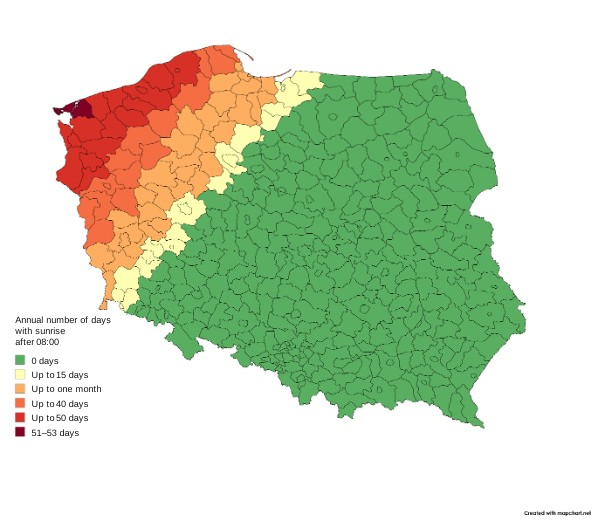 Source: FOR analysis using mapchart.net.
In Warsaw at the start of winter, dawn begins shortly after 07:00 and civil twilight ends a few minutes after 16:00. In Suwałki, the sun sets as early as 15:07 and it is dark at 15:51. In the Bieszczady Mountains, meanwhile, sunrise occurs at around 07:20, with dawn beginning at 06:45. Given Poland’s short winter days, this does not seem justified. Of course, the situation is somewhat different in other Polish towns.
On 22 December, the sun does not rise in Świnoujście until 08:20, an hour later than in Ustrzyki Górne, but dawn begins at 07:36. By mid-February, however, the day there starts at 07:23 and it is light from 06:46. The sun sets at 17:10. Moving the clocks forward by an hour would not produce very late sunrises for most of the year, especially since dawn in eastern Poland then begins at around 06:00 and darkness falls after 17:00.
Currently, around 5% of Poland’s population lives in areas where sunrise occurs after 08:00 for more than one month of the year. Fewer than a quarter of Poland’s residents experience sunrise after 08:00 at all. For many of them, sunrise is only a few minutes after 08:00, and this lasts for just a few days each year. Most Poles live further south or east, closer to the boundary between natural time zones and in areas with slightly longer winter days. In Warsaw, Kraków, Katowice, Rzeszów and Lublin, the latest sunrise occurs between 07:30 and 07:45. In Świnoujście, sunrise is after 08:00 on 53 days of the year, but in Suwałki sunset is before 16:00 for almost three months. Winter time applies not only around December and January, when the sun does indeed rise late, but for five months of the year.
Table 2: Selected Polish towns and cities by the number of days a year with sunrise after 08:00 and sunset before 16:00
| Town/city | Sunrises after 08:00 | Sunsets before 16:00 |
| Świnoujście | 53 | 49 |
| Suwałki | 0 | 89 |
| Cisna | 0 | 67 |
| Bogatynia | 18 | 28 |
| Kutno | 0 | 66 |
| Warsaw | 0 | 74 |
| Kraków | 0 | 58 |
Source: FOR calculations.
Which Time Should We Adopt?
Some studies, mostly from the United States or Western Europe, point to harmful effects of summer time on our bodies. We should remember, however, that these effects may differ according to geographical location. The northern border of the United States is at the same latitude as Poland’s southern border. The center of the United States corresponds to southern Italy or Turkey, and the southern states to North Africa. The closer to the equator, the smaller the variation in day length over the year.
In addition, some states are shifted forward from their natural time zone, following the example of certain European countries; this cannot be said of Poland. In some states, sunrise is already well after 08:00 in October, despite the longer day. Even studies critical of summer time find that its negative effects are more noticeable near the western boundaries of time zones.[7] Poland lies naturally at the eastern edge of UTC+1 and the western edge of UTC+2, while the 15° meridian, marking the center of UTC+1, runs near Poland’s western border. Western European countries often lie naturally in UTC, making the shift relative to solar time very noticeable.
Figure 1: Sunset in local time and day length on 22 December in European capitals
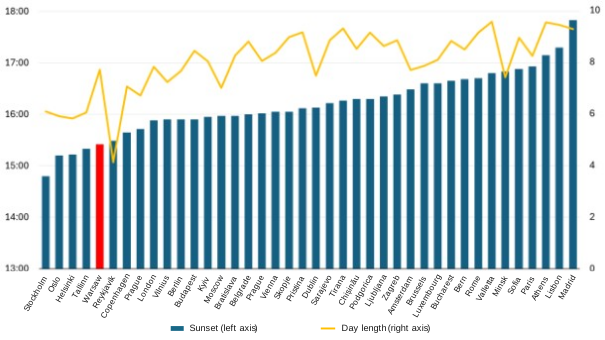 Source: FOR calculations based on timeanddate.com.
The idea of introducing permanent winter time in Poland because most of the country lies in that time zone seems to make little sense. It would mean that at the start of summer the sun would rise in Suwałki before 03:00, with civil dawn at 02:00. The sun would set there at 20:05, and in Ustrzyki Górne at 19:38. This would not only waste electricity but also restrict access to natural light, which has a fundamental effect on health and well-being. If UTC+1 was chosen as the year-round time zone, at the beginning of September the sun in the Bieszczady Mountains would rise at 04:46, with daylight from 04:15, and set as early as 18:14.
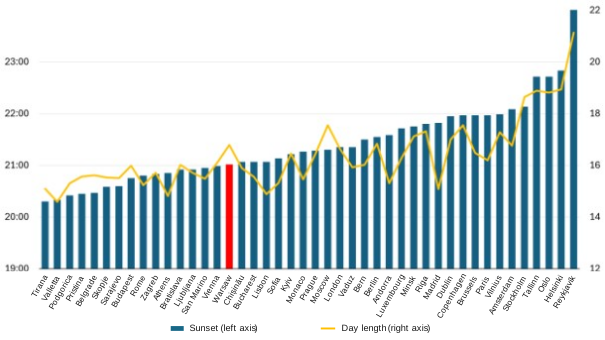
Although Warsaw currently has the thirteenth-longest day, at 16 hours and 47 minutes, among 44 European capitals on the first day of summer, it ranks only 29th by sunset time, at 21:01. In the capitals of only 15 European countries, the sun sets before 21:00 local time on 22 June. In all of them, the day is shorter than in Warsaw, and in most it is considerably shorter, by more than an hour.
Of the 28 European capitals with a later sunset than Warsaw that day, as many as 16 have a shorter day. The sun rises earlier than in Warsaw, at 04:14, only in the capitals of Norway, Finland, Sweden, Estonia, Russia, and Iceland. In all these cities except Moscow, the day is then extremely long. If Poland adopted UTC+1 as its official time throughout the year, only Reykjavík would have an earlier sunrise than Warsaw, and no other European capital would have such an early sunset.
Figure 2: Sunset in local time and day length on 22 June in European capitals
 Source: FOR calculations based on timeanddate.com.
Conclusion
Although changing the clocks itself creates costs and difficulties, from Poland’s perspective it seems less of a problem than choosing the appropriate time zone. Given contemporary lifestyles and the country’s geographical location, Poland should choose a time zone that would give us more daylight. Potential negative effects could arise only in Poland’s westernmost regions, while in the eastern part of the country summer time is aligned with solar time.
Since Poland cannot independently decide to adopt permanent summer time, because the European Union requires clock changes on the last Sundays of March and October, it could even consider switching to Eastern European Time, giving it the same official time as the Baltic states or Romania. If an end to seasonal clock changes were agreed at EU level, Poland should adopt summer time, UTC+2, throughout the year.
Table 3: Sunrise, sunset, civil dawn and civil dusk in Warsaw on selected dates under four variants of official time
UTC+1 / UTC+2 (current system)
| Date | Civil dawn | Sunrise | Sunset | Civil dusk |
| 22 Jan | 06:51 | 07:29 | 16:05 | 16:43 |
| 22 Feb | 06:01 | 06:35 | 17:02 | 17:37 |
| 21 Mar | 05:01 | 05:34 | 17:51 | 18:24 |
| 21 Apr | 04:47 | 05:24 | 19:44 | 20:21 |
| 21 May | 03:47 | 04:31 | 20:33 | 21:17 |
| 22 Jun | 03:25 | 04:14 | 21:01 | 21:50 |
| 22 Jul | 03:58 | 04:42 | 20:42 | 21:26 |
| 22 Aug | 04:54 | 05:31 | 19:45 | 20:22 |
| 23 Sep | 05:50 | 06:24 | 18:32 | 19:05 |
| 23 Oct | 06:41 | 07:15 | 17:24 | 17:59 |
| 23 Nov | 06:32 | 07:10 | 15:33 | 16:12 |
| 22 Dec | 07:02 | 07:43 | 15:25 | 16:07 |
UTC+2 / UTC+3
| Date | Civil dawn | Sunrise | Sunset | Civil dusk |
| 22 Jan | 07:51 | 08:29 | 17:05 | 17:43 |
| 22 Feb | 07:01 | 07:35 | 18:02 | 18:37 |
| 21 Mar | 06:01 | 06:34 | 18:51 | 19:24 |
| 21 Apr | 05:47 | 06:24 | 20:44 | 21:21 |
| 21 May | 04:47 | 05:31 | 21:33 | 22:17 |
| 22 Jun | 04:25 | 05:14 | 22:01 | 22:50 |
| 22 Jul | 04:58 | 05:42 | 21:42 | 22:26 |
| 22 Aug | 05:54 | 06:31 | 20:45 | 21:22 |
| 23 Sep | 06:50 | 07:24 | 19:32 | 20:05 |
| 23 Oct | 07:41 | 08:15 | 18:24 | 18:59 |
| 23 Nov | 07:32 | 08:10 | 16:33 | 17:12 |
| 22 Dec | 08:02 | 08:43 | 16:25 | 17:07 |
UTC+1 (winter time)
| Date | Civil dawn | Sunrise | Sunset | Civil dusk |
| 22 Jan | 06:51 | 07:29 | 16:05 | 16:43 |
| 22 Feb | 06:01 | 06:35 | 17:02 | 17:37 |
| 21 Mar | 05:01 | 05:34 | 17:51 | 18:24 |
| 21 Apr | 03:47 | 04:24 | 18:44 | 19:21 |
| 21 May | 02:47 | 03:31 | 19:33 | 20:17 |
| 22 Jun | 02:25 | 03:14 | 20:01 | 20:50 |
| 22 Jul | 02:58 | 03:42 | 19:42 | 20:26 |
| 22 Aug | 03:54 | 04:31 | 18:45 | 19:22 |
| 23 Sep | 04:50 | 05:24 | 17:32 | 18:05 |
| 23 Oct | 05:41 | 06:15 | 16:24 | 16:59 |
| 23 Nov | 06:32 | 07:10 | 15:33 | 16:12 |
| 22 Dec | 07:02 | 07:43 | 15:25 | 16:07 |
References
[1] Ministry of Development and Technology, Sondaż MPiT: niemal 80 proc. ankietowanych chce likwidacji zmiany czasu, Republic of Poland website, 17 April 2019, source.
[2] European Commission, Summertime Consultation: 84% want Europe to stop changing the clock, 31 August 2018, source.
[3] Seasonal clock changes are also observed in small areas of Mexico near the border.
[4] K. Rybak, Koniec ze zmianą czasu w Polsce – nie trzeba będzie przestawiać zegarków z drugiej na trzecią w nocy. Czy Polska może wyłamać się z europejskiego systemu zmiany czasu?, Forsal.pl, 25 March 2026, source.
[5] K. Kępińska et al., Zła zmiana. Negatywne konsekwencje zmiany czasu, Fundacja Republikańska, Stowarzyszenie Koliber, Warsaw, 2016, pp. 31–48, source.
[6] K. Taniguchi et al., Influence of External Natural Environment Including Sunshine Exposure on Public Mental Health: A Systematic Review, Psychiatry International 3(1), 2022, source; J. Wang et al., Association Between Sunlight Exposure and Mental Health: Evidence from a Special Population Without Sunlight in Work, Risk Management and Healthcare Policy 16, 2023, source.
[7] T. Roenneberg et al., Daylight Saving Time and Artificial Time Zones – A Battle Between Biological and Social Times, Frontiers in Psychology, 10, 2019, source.