





More than four years into Russia’s full-scale invasion, Ukrainian businesses continue to demonstrate remarkable resilience. Yet, the results of the latest New Monthly Enterprises Survey (NRES), conducted by the Institute for Economic Research and Policy Consulting (IER) in May 2026, suggest that signs of a slower economic recovery are becoming increasingly visible.
The key message from the survey is straightforward: the pace of recovery is slowing, but business confidence is holding steady. While enterprises report weaker current performance and shorter planning horizons, their medium- and long-term expectations remain surprisingly stable. At the same time, inflationary pressures appear to be easing, partially offsetting the persistent challenges posed by labor shortages and security risks.
The survey in May 2026, which covered 469 industrial enterprises across 21 regions of Ukraine, offers a unique monthly snapshot of how businesses are adapting to wartime conditions.
Recovery Is Losing Momentum
Perhaps the most striking result is the continued decline of the Business Activity Recovery Index (BARI), which measures how companies assess their current situation compared to a year earlier. In May, the index fell to -0.17, the lowest level since March 2023.
Figure 1: Business Activity Recovery Index (BARI)
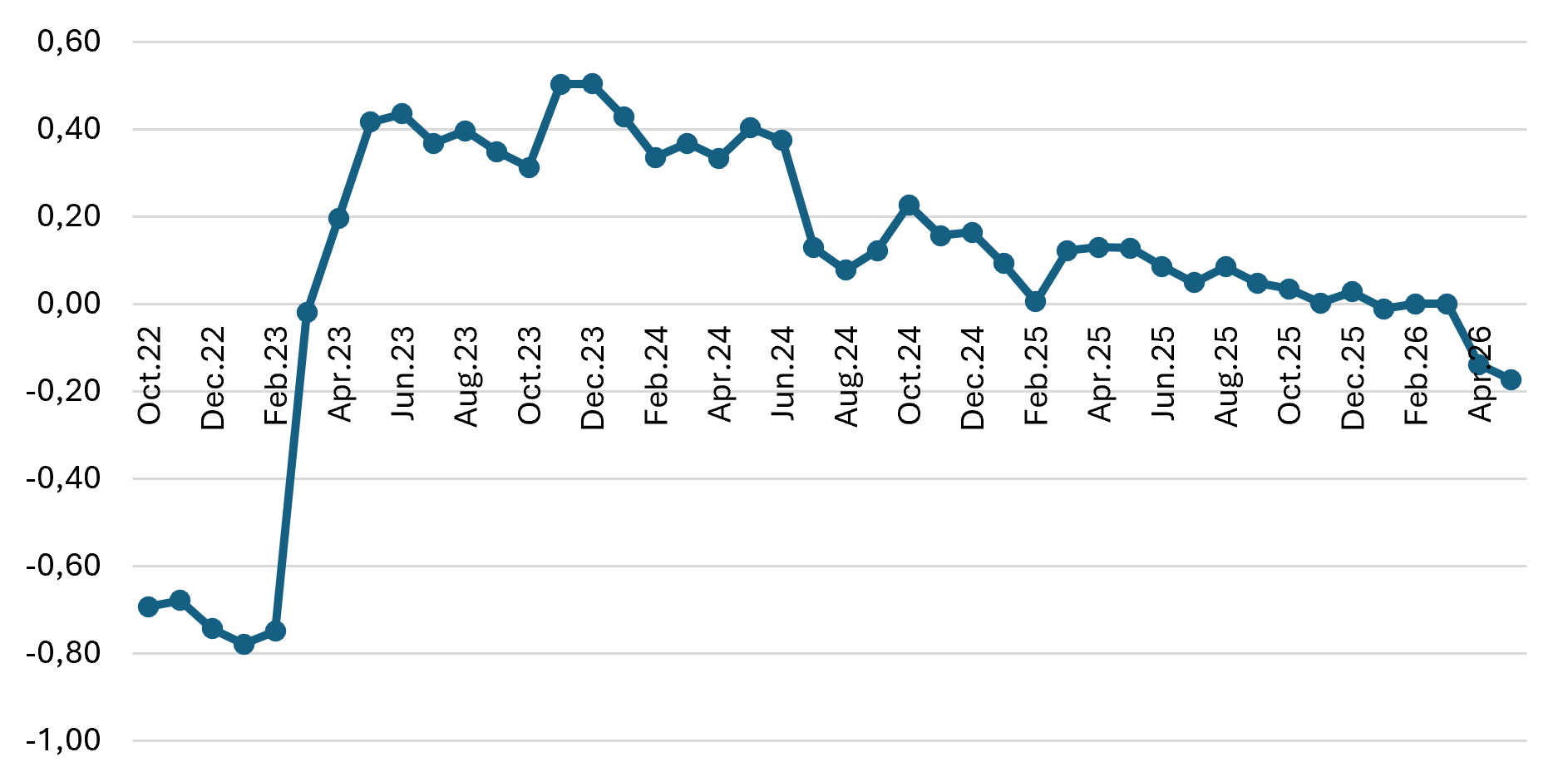 This means that the share of enterprises reporting a deterioration in business activity compared to the previous year now exceeds the share reporting improvements. Nearly one-quarter of surveyed firms reported that their situation had worsened compared to May 2025.
The slowdown is visible across several indicators. Production, sales, exports, and new orders all weakened in May compared to April. Expectations for the next three to four months also deteriorated for the second consecutive month.
The Industrial Confidence Indicator, a broader measure of business sentiment in manufacturing, also declined for the second month in a row.
Taken together, these results suggest that the post-shock recovery phase that characterized much of 2023 and 2024 has largely run its course. Ukrainian businesses are no longer rebounding from the initial disruptions of war. Instead, they are increasingly operating within a prolonged environment of uncertainty, labor shortages, and security risks.
The Warning Signal: Shrinking Order Books
One of the most concerning findings is the rapid contraction of order portfolios. The average order horizon declined from 3.8 months in March to 2.9 months in April and just 2.4 months in May. This trend indicates that companies have less visibility into future demand and fewer long-term customer commitments.
Today, a record 67% of surveyed enterprises have orders covering no more than two months of activity. Thirty percent operate almost “hand-to-mouth,” with less than one month of confirmed orders.
At the same time, the share of firms holding orders for twelve months or more has fallen from 6% to just 3%.
Figure 2: Duration of new orders, mean in months, % of respondents
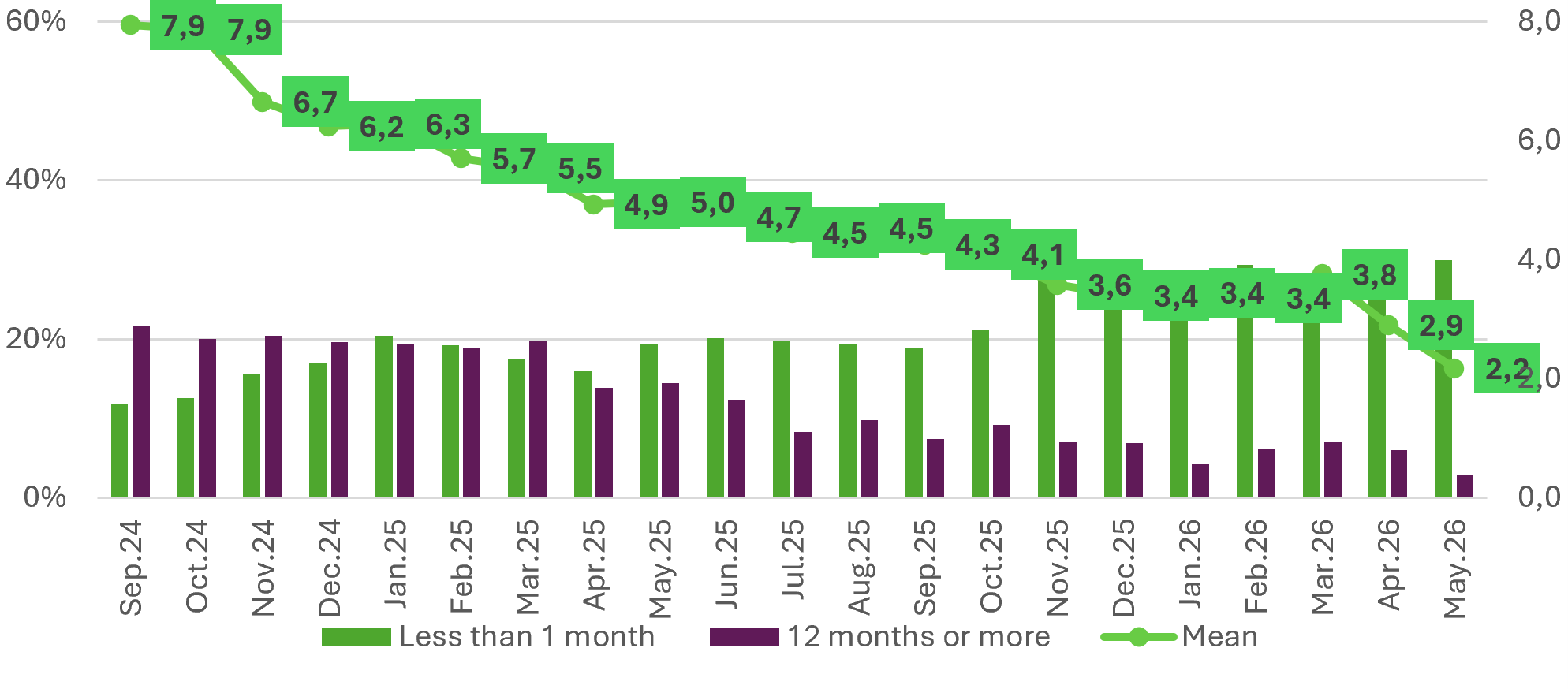 For businesses, order books often provide a more reliable signal of future economic activity than current production figures. The shrinking order horizon, therefore, suggests growing caution among customers and investors alike.
Confidence Remains Surprisingly Stable
Despite weaker current performance, business expectations have not collapsed. Long-term expectations remained largely unchanged in May. Among companies able to assess their prospects over a two-year horizon, nearly 85% expect to maintain their current scale of operations. Only 3% anticipate downsizing, while 12% plan expansion.
Similarly, expectations regarding business conditions over the next six months stabilized after worsening earlier this year.
This combination of slowing activity and relatively stable expectations reflects a pattern that has become increasingly characteristic of the Ukrainian economy during wartime. Businesses have learned to adapt to extraordinary uncertainty. Rather than expecting rapid growth, many enterprises focus on preserving operations, retaining staff, and maintaining market positions.
In other words, resilience today means stability rather than expansion.
Inflation Pressures Are Easing
One encouraging development is the gradual easing of inflation-related concerns. The share of enterprises reporting increases in raw material and input prices declined in May. Expectations of further price growth also weakened significantly. Only 44.5% of businesses now expect input prices to rise in the coming months, compared with more than half of respondents in April. Expectations regarding sales prices followed a similar trend.
While inflation remains one of the top concerns for Ukrainian businesses, its relative importance is gradually declining. This development may provide some breathing space for enterprises that have struggled with rising costs over the past several years.
The survey results suggest that businesses increasingly expect price growth to continue, but at a slower pace than before.
Labor Shortages Remain the Main Constraint
If inflation is becoming less problematic, labor shortages continue to worsen. For the third consecutive month, the lack of personnel remained the most important obstacle to doing business in Ukraine. Nearly seven out of ten enterprises identified labor shortages as a major challenge.
The difficulty of finding qualified workers remains particularly acute. More than 60% of surveyed firms reported increasing problems recruiting skilled employees. This challenge reflects several overlapping factors. Military mobilization continues to reduce the available workforce. Migration abroad has affected labor supply in many sectors. Demographic pressures that existed before the war have become even more pronounced.
As a result, labor shortages are no longer a temporary wartime disruption. They are increasingly emerging as a structural constraint on future economic growth.
Security Risks Continue to Shape Business Decisions
Security concerns remain another defining feature of Ukraine’s business environment.
Forty-four percent of surveyed enterprises reported that it remains dangerous to operate under current conditions. In several regions, including Kyiv, Odesa, Dnipropetrovsk, and Zaporizhzhia, the share of businesses citing security risks exceeded 80%.
Figure 3: % of respondents by regions of Ukraine consider war-related security risks as an impediment to doing business in Ukraine*
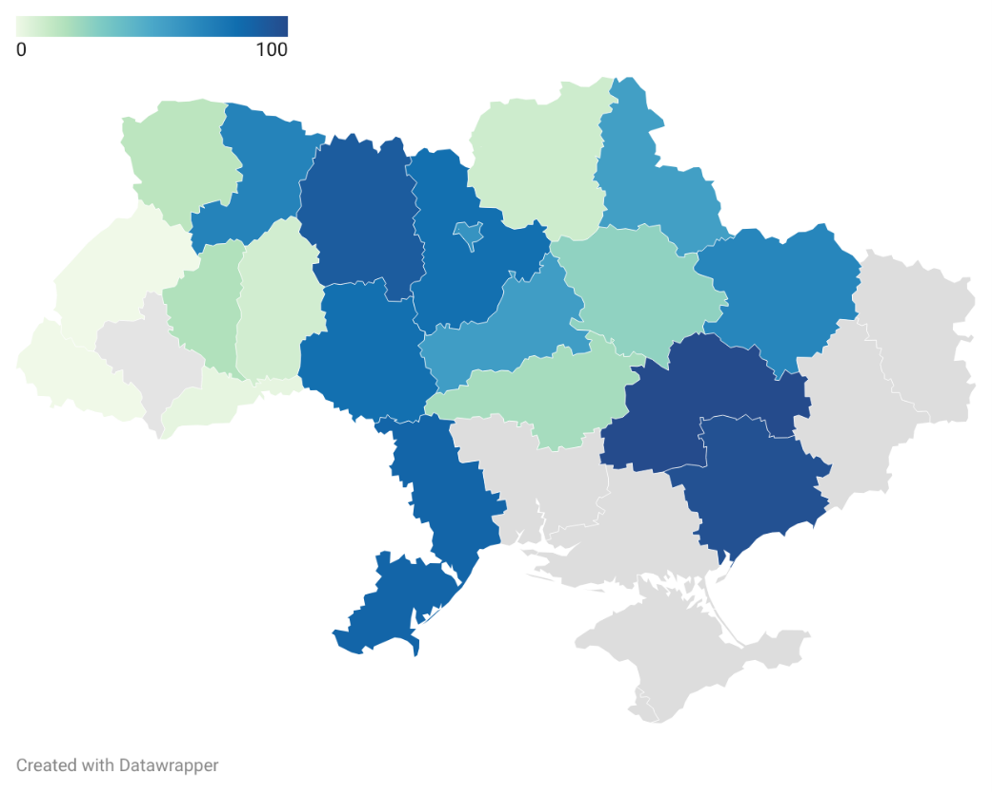 *grey colored oblasts when there is not enough data for calculations or the survey did not conducted
At the same time, disruptions related to electricity supply appear more manageable than in previous years. Although power outages still affect operations, they are no longer among the most critical constraints for most firms.
Businesses have invested heavily in adaptation measures, including backup power systems and operational adjustments. This adaptation demonstrates how Ukrainian enterprises continue to find practical solutions even under extraordinary circumstances.
Beyond Economics: The Challenge of Sustaining Resilience
The survey findings also point to a broader challenge that extends beyond traditional economic indicators. Today, the greatest threat to Ukraine’s economic resilience is not only labor shortages, security risks, or slowing demand. Increasingly, it is the gradual exhaustion of resources — financial, institutional, and human — that both businesses and society continue to devote to sustaining the war effort. After more than four years of full-scale war, resilience remains strong, but it is not unlimited.
This challenge is not confined to Ukraine. Russia’s war against Ukraine is not solely a military confrontation. It is also a cognitive and political struggle aimed at weakening democratic societies, undermining trust in institutions, spreading disinformation, and fueling populist narratives across Europe and the wider West.
From this perspective, the resilience of Ukrainian businesses is inseparable from that of European societies. Economic recovery in Ukraine depends not only on investment, reconstruction, and reforms, but also on the ability of democratic countries to maintain public support for Ukraine over time.
The Kremlin’s strategy increasingly relies on fatigue. As battlefield victories remain elusive, efforts to influence public opinion, deepen political polarization, and weaken international solidarity become even more important instruments of pressure. This makes the preservation of a united European front essential not only for Ukraine’s security but also for its economic future.
Ukraine, therefore, needs more than continued support from governments, European institutions, and international organizations. It also needs the sustained solidarity of citizens, local communities, businesses, media, and civil society organizations throughout Europe. Maintaining this support in the face of disinformation, war fatigue, and political polarization may prove just as important as any economic policy or reconstruction program.
Holding Steady
The May survey paints a nuanced picture of Ukraine’s economy. The recovery is clearly losing momentum. Business activity indicators are weakening, order books are shrinking, and growth expectations have become more cautious.
Yet, this is not a story of economic collapse. Businesses remain operational, expectations remain broadly stable, and inflation pressures are easing. Most importantly, enterprises continue to adapt despite ongoing labor shortages, security risks, and uncertainty.
Ukraine’s economy may be entering a slower phase of recovery, but the resilience that has characterized its business sector since 2022 remains intact. For now, Ukrainian businesses are doing exactly what the title of this month’s survey suggests: holding steady.