




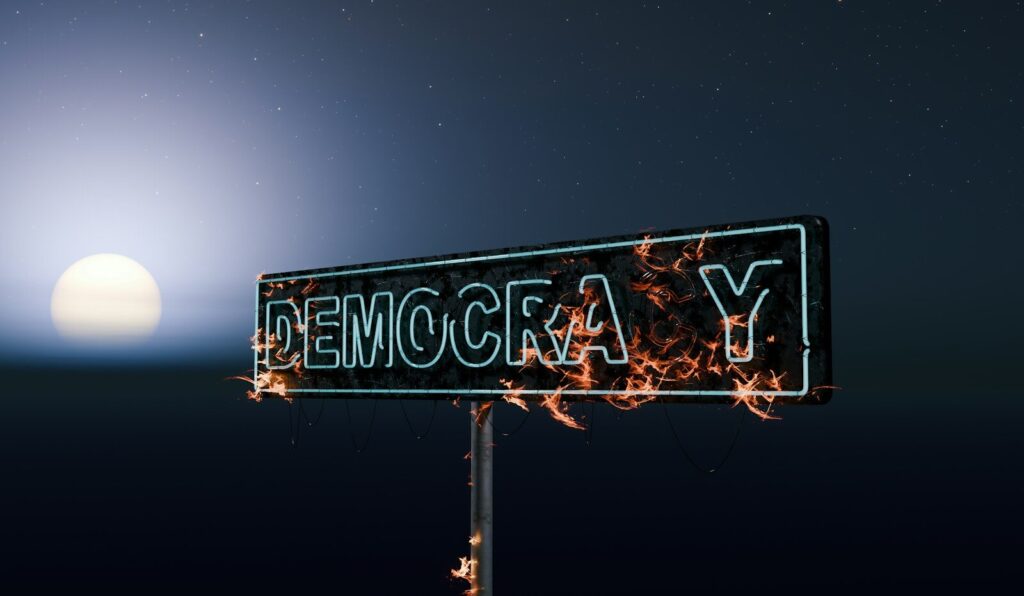
The question arises as to who affirms democracy and whether its affirmation can be effective when politicians on both sides of a political dispute pose as self-appointed defenders.
Does Democracy Always Win?
“Democracy always wins” – this was the caption The Left (Lewica) used for a photo of Deputy Prime Minister Gawkowski on their X (formerly Twitter) profile, in response to events at the Constitutional Tribunal. This institution has been the focal point of numerous disputes in Poland for years, fueling a constitutional crisis that is periodically brought back into the spotlight by politicians, commentators, and researchers.
However, democracy does not always win — a fact that will likely come as no surprise to most readers of this article. The 2026 V-Dem report refers to the period from 2000 to 2025 as “The Great Reversal.” At the forefront of the indicators supporting the thesis of a decline in democracy is freedom of expression, accompanied by similar downward trends regarding freedom of assembly, the fairness of elections, and media censorship.
When Is It Acceptable to Lie?
LinkedIn is perhaps not the first platform one would choose for academic debate. Nevertheless, one can surprisingly often find interesting discussions there — frequently more substantive than those on X, and less reliant on visuals than content found on Instagram. “As an academic, you should not lie to save democracy,” writes Dimiter Toshov in a post engaging with an article by Maxime Lepoutre titled “Affirming Democracy: Should We Exaggerate Support for Democracy to Save It?”, published in the journal Political Studies.
Lepoutre argues that while anti-democratic rhetoric must be countered, responding to it directly — without any mitigating measures — actually reinforces and legitimizes anti-democratic sentiments, potentially undermining the perception that support for democracy is widespread. In his article, he focuses specifically on how high-profile, serious attacks on democracy erode the expectation that others will adhere to democratic norms. Such direct responses are, therefore, counterproductive, especially given that, according to the author, citizens are more likely to support democracy themselves when they see others in their environment openly expressing their own support for it.
The author proposes two solutions that work best in tandem: first, highlighting attacks on democracy that are instigated specifically — and primarily — by members of the elite; and second, emphasizing public support for the democratic system, even to the point of overstating how widespread that support is. Lepoutre suggests that public figures — a category that Toshkov, quite rightly in my view, extends to include academics — should at times bend reality to counterbalance the negative consequences of responding to anti-democratic rhetoric and actions.
One example the author cites is the opposition’s victory in Poland’s 2023 parliamentary elections. During the campaign, politicians — led by Donald Tusk — stressed that citizens faced a final opportunity to save democracy; according to Lepoutre, this messaging contributed to a record-high voter turnout. However, as Ben Stanley points out in a comment on the aforementioned LinkedIn post by Toshkov, the affirmation of democracy — and the emphasis on the dangers posed by its collapse — is merely one of the factors that enabled the coalition led by Donald Tusk to form a government.
Everyone Loves Democracy
The debate surrounding the Constitutional Tribunal has become closely intertwined with the broader discussion on democracy and who is responsible for its destruction. When the Law and Justice (PiS) party introduced changes to the Constitutional Tribunal, it was not a “Committee for the Defense of the Constitutional Tribunal” that rose to its defense, but rather the “Committee for the Defense of Democracy.”
From the outset, the defense of the Tribunal was framed as a defense of democracy itself. Today, the roles have reversed: following the suspension of the president of the Constitutional Tribunal — an action taken by the Minister of Justice (involving Waldemar Żurek) — critics of the Civic Coalition government have compared Donald Tusk to General Jaruzelski, a figure synonymous with undemocratic rule.
Rhetoric, of course, is not everything. Numerous databases, academic papers, and philosophical schools measure democracy in far more comprehensive ways; simply calling oneself a “democrat” does not make one a democrat in reality. Nevertheless, as Lepoutre himself acknowledges, rhetoric is central and fundamental to his argument. It is precisely here that another — perhaps the most intriguing — problem with the author’s strategy of affirming democracy arises. According to a 2025 CBOS survey, 77% of Poles believe that democracy is the best form of government.
Moreover, this percentage has risen since 2024, while the number of people who completely disagree with this statement has fallen. Thus, the vast majority of Poles support the democratic system. However, Lepoutre cautions that such declarations may overstate the actual level of support — partly because respondents often feel a need to present themselves in a positive light. Citing more in-depth research, he also notes that in Poland, only 13% of those surveyed are strongly committed to liberal democracy, and less than half — even to some extent.
It is, therefore, important to look beyond the question — which has engaged the aforementioned discussants on LinkedIn — of whether academics and public figures should lie in defense of democracy. It is also worth considering the role of the very word “democracy.” What happens when, at the level of rhetoric — which is central to Lepoutre’s argument — both sides declare themselves to be pro-democratic, and the majority of their respective voters also support democracy? In such a scenario, could the strategy proposed by the author still be effective (especially in a country where, even without the suggested “noble lie,” nearly 80% of citizens support democracy)?
Written by Anna Kowal — a political scientist and an MA student specializing in the study of democracy and populism. She is a member of the ERC-funded CareCentury project team at Leiden University. She serves as Head of Agenda for the 19th International Congress of Polish Student Associations and is an intern with the regulatory and public relations team at Veolia Energia Polska.
The article was originally published in Polish at: https://liberte.pl/jak-afirmowac-demokracje/