




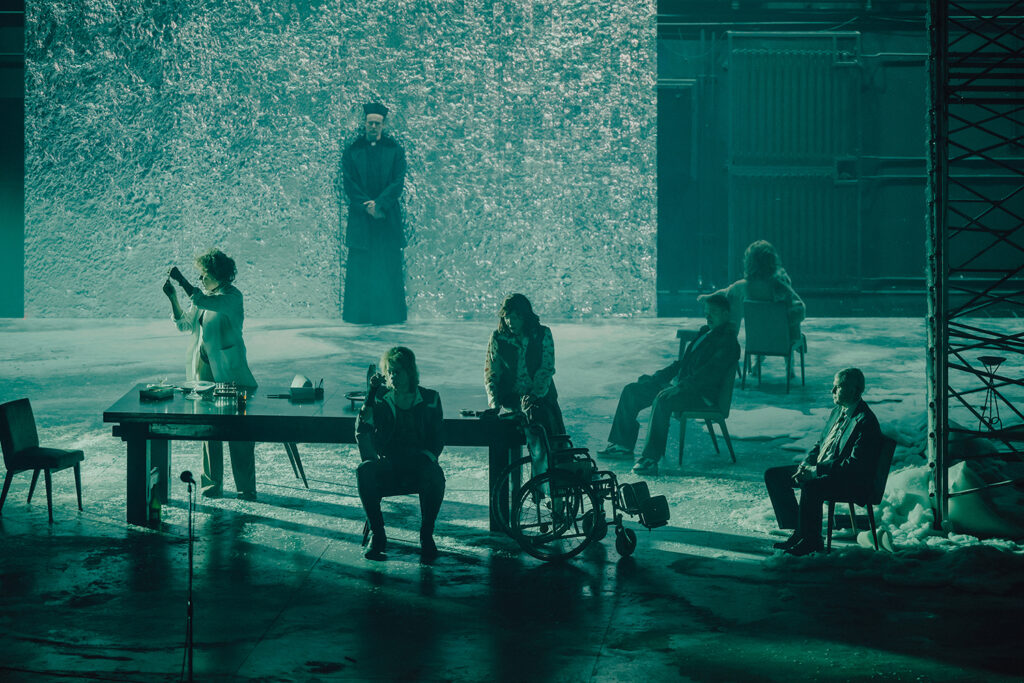
As part of my little “Theater Hall of Fame” Iha ve come across a performance after which it’s hard to simply return to everyday life and pretend that nothing happened. Angels in Warsaw at the Dramatic Theater is a play that offers no comfort in indifference. Nearly four hours pass surprisingly quickly, even though this is by no means an easy or lighthearted production. It is an emotionally demanding play, at times almost suffocating with tension, yet, at the same time, mesmerizing in its intensity.
The creators transport the audience to the 1980s, right into the midst of the AIDS pandemic — a time of fear, moral panic, social exclusion, and political indifference. It is a story about a world that learned to judge very quickly but took a very long time to learn to empathize. Here, the disease becomes more than just a medical problem — it is a symbol of society’s fear of otherness, of what defies conservative norms and convenient definitions.
Courtesy of the Dramatic Theater in Warsaw, Photo: Karolina Jóźwiak
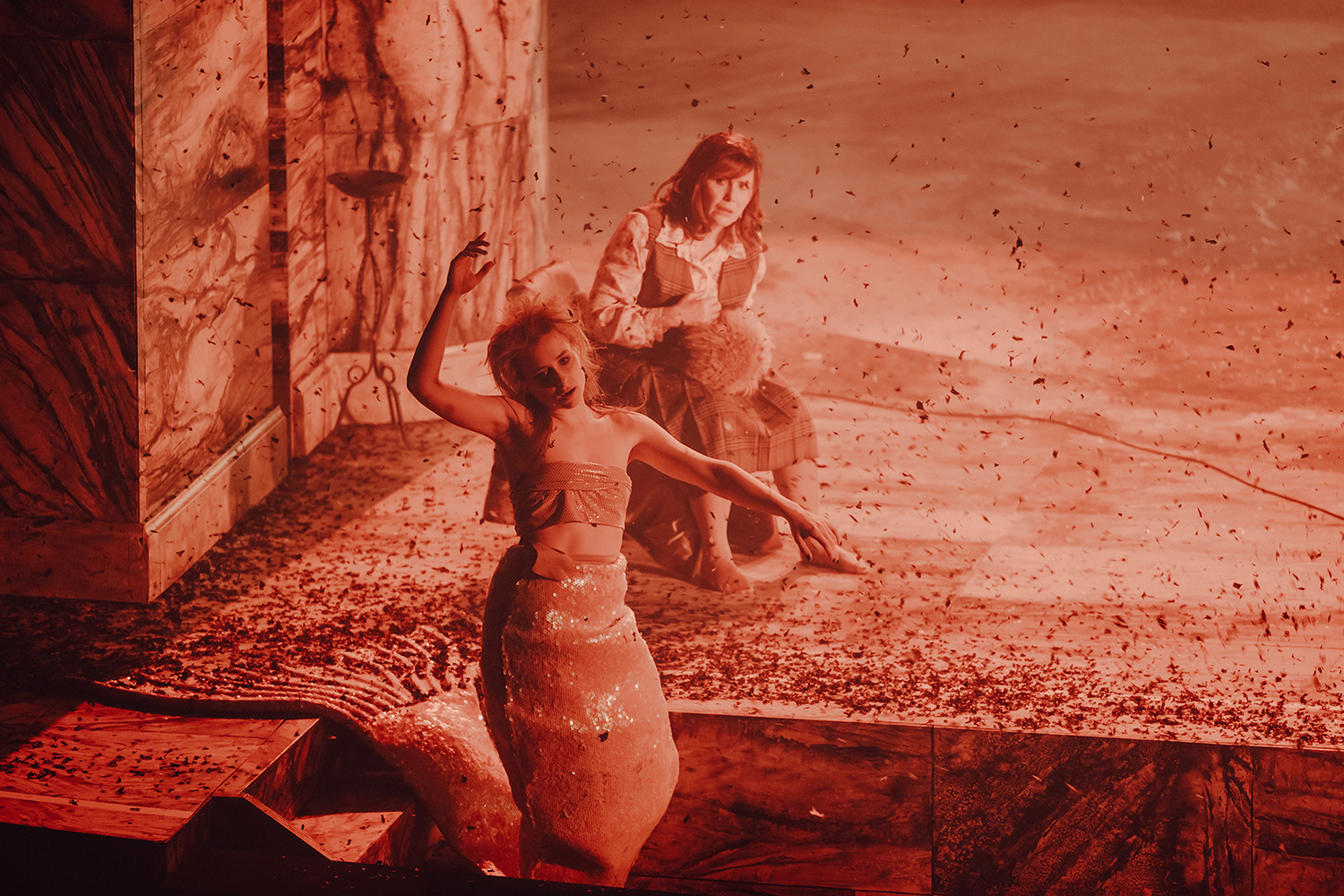
What is most powerful about this production, however, is that it does not reduce its characters solely to their suffering. *Angels in Warsaw* portrays people full of contradictions — loving, toxic, lost, tender, selfish, and heroic all at once. The relationships between the characters are ambiguous and, because of this, incredibly authentic. There are no simple divisions between good and evil here. There is simply a human being — with their fears, loneliness, need for closeness, and desperate attempt to find meaning.
The production’s form is one of its greatest strengths. The moving stage lends the entire piece a unique rhythm and dynamism. The spaces shift fluidly, almost like in a film, and the audience feels a sense of constant movement — as if the characters’ world never allows them to stop. This stage design harmonizes perfectly with the emotional chaos of the production. Thanks to this, even long dialogue scenes retain their tension, and the production breathes and pulses almost physically.
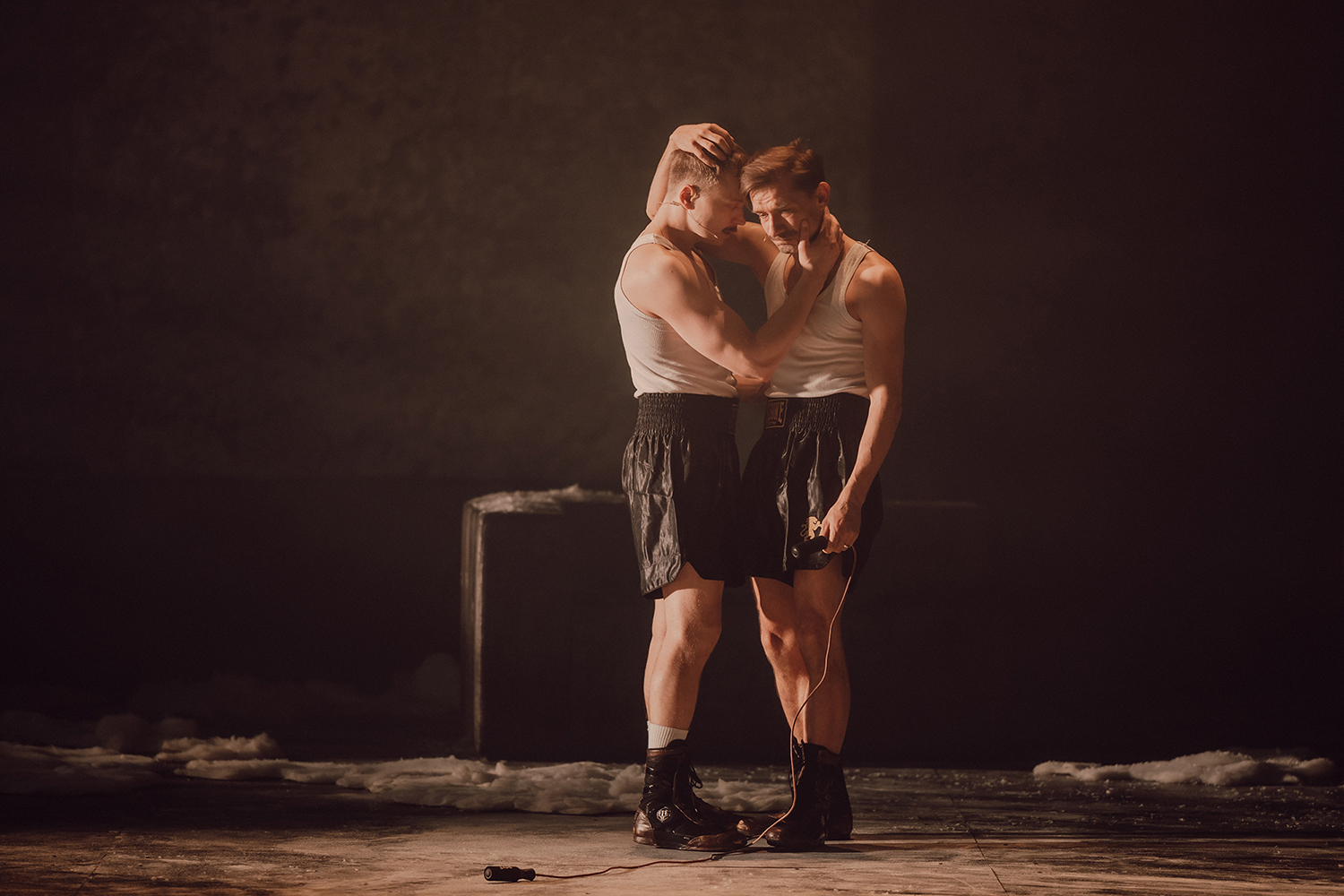
It’s also impossible not to mention the acting. Małgorzata Niemirska creates an incredibly poignant performance — restrained, yet full of emotional weight. Katarzyna Herman brings energy and restlessness to the stage that are impossible to ignore. Marcin Bosak, in turn, builds his character with tremendous intensity and an inner fracture that lingers in the memory. It is precisely thanks to such performances that the play does not become a journalistic manifesto, but a deeply human story.
Each performer brings their own sensitivity and strength to the stage, creating characters who are ambiguous, moving, and unforgettable. For is not there a moment when you want to hate the character played by Piotr Siwkiewicz, whose career path seems strangely familiar? Or to simultaneously blame and understand Konrad Szymański’s character, who was simply afraid… It is thanks to the entire cast that Angels in Warsaw is not merely a story about the past, but a living, pulsating testimony to human experience — with all its weight and light.
Courtesy of the Dramatic Theater in Warsaw, Photo: Karolina Jóźwiak
It is also worth appreciating how the production handles emotions without resorting to cheap emotional manipulation. It does not try to force the audience to feel moved. It doesn’t moralize directly. Rather, it compels the audience to look — sometimes at things that are very uncomfortable to see. And that’s probably why it has such a powerful impact. The audience does not leave the theater feeling they have watched an “important topic.” Rather, they leave wondering why so many mechanisms of social exclusion still seem all too familiar today.
Because even though the story takes place decades ago, it is hard to escape the realization that, as a society, we aren’t nearly as far along as we like to think we are. Years of democracy have passed; the language has changed, and the aesthetics of public debate have shifted, but the problem of accepting difference continues to resurface with surprising force. It is still easy to dehumanize those who live differently, love differently, or simply don’t fit into the comfortable image of “normality.”
And perhaps that is precisely why this play resonates so powerfully today. Because it’s not just about AIDS and the 1980s. It is about the mechanisms of social exclusion that are still very much alive. About fear cloaked in morality. About politics that, all too often, fears empathy more than radicalism. It’s about people who, for decades, had to fight not only for their own dignity but even for the basic right to be recognized by the state and society.
Leaving the theater, it is hard not to think that in a country so eager to talk about freedom, community, and values, there is still a lack of basic courage to address issues as fundamental as the legal recognition of the lives of LGBT+ people. And perhaps that is precisely why Angels in Warsaw is not a play about the past. It is a deeply painful play about the present.
Written by Sławomir Kalinowski – a Polish economist, researcher of social structure and changes taking place in rural Poland, a Professor at the Institute of Rural Development and Agriculture of the Polish Academy of Sciences (PAN), where he heads the Department of Rural Economics. Editor-in-chief of the academic quarterly Wieś i Rolnictwo (Rural Areas and Agriculture). A member of the Committee on Labor and Social Policy Sciences of the Polish Academy of Sciences. The initiator and co-founder of the Forum for the Exchange of Ideas.
The article was originally published in Polish at: https://liberte.pl/slawnik-teatralny-numer-10-anioly-w-warszawie/