




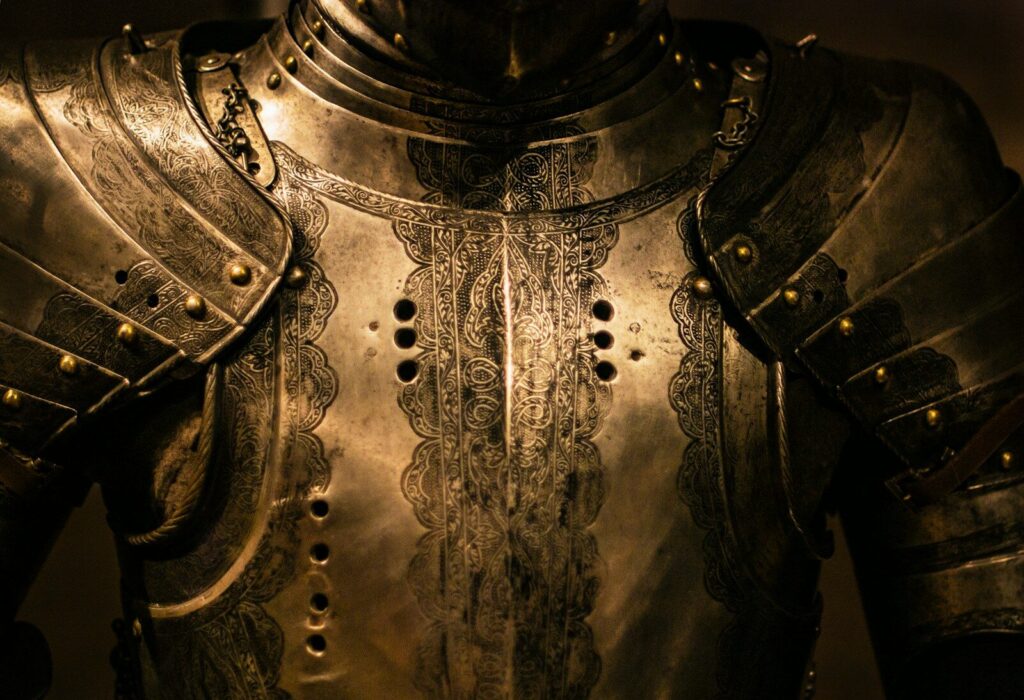
The chivalric ethos of yesteryear — both the mythologized version and the very real one — imposed very specific requirements. When it came to defending the homeland, the ruler, values, religion, or, ultimately, the “weaker ones” in the broadest sense, the matter was clear. In its most basic form, this ethos entailed justice, responsibility, solidarity, loyalty, bravery, honor, patriotism, and, finally, moderation — a catalog of virtues that one would still expect today from defenders of any kind.
In these conceptions of the game of honor and virtue, together with the concepts of chivalry — as Johan Huizinga wrote in The Autumn of the Middle Ages — the concept of the law of nations also took shape; subsequently, both became the breeding ground for the concept of pure humanity. Exactly the kind of humanity that — despite the debunking of past myths or even their humanization — we still wish to believe in today. Although this ideal has at times been — much like in Italo Calvino’s works — an empty suit of armor, we are left with an unshakable sense that there are values that are necessary and worth defending.
And not even because their persuasive power is too weak or their scope of application seems questionable to anyone. On the contrary. They require defense and protection as the stable foundation of our democracies. They require this not only because of external threats, but also when they become hostages to ideology, objects of appropriation, subjects of fascination with past meanings or interpretations, or, finally, due to increasing polarization, in which people are convinced that values always belong to someone else, by a process of elimination.
From this perspective, we can be certain that values will not defend themselves. Rights will not defend themselves. Freedom will not defend itself. And each of these elements of the order of liberal democracy is worth taking care of every day, but it is also worth—and necessary—to fight for them. In doing so, we need effective tools to safeguard them—not to preserve them in an unaltered state, but to understand their internal dynamics, their evolution, their reach toward everyone, and also our moment of making them our own. This — as Mirosław Dzielski reiterates — is the “reasoned safeguarding of freedom,” viewed not as something granted “once and for all,” but as something fragile and always requiring a renewed choice—my freedom, which is mindful of its limits, set by the harm done to another human being.
This is not, however, about an order secured exclusively by military means, although we outline its reasonable framework in our policies — indeed, we demand it from governments and institutions that safeguard peace and security. It is also about a sense of responsibility and courage — political, social, and civic — and, consequently, about action that does not lack the strength and determination to ensure that “safeguarding freedom” does not end merely with beautiful yet empty ideals, with grand words that lack concrete substance.
The foundations of liberal democracy — human rights, the rule of law, economic freedom, individual liberty, media independence, and freedom of science and education — require today not only rational voices, but also decisiveness and agency, which we have the right and duty to demand from our politicians in order to defend them. Here and now. Not promises and vague generalizations, but facts. It is not enough simply to “have expectations” and “think highly” of ourselves. For courage to act is needed on every side.
“The task of politicians, the task of public authorities that wish to protect freedom, is also to arm themselves so as not to be powerless in the face of the evil and lies that are spreading today with such brazenness and audacity throughout the world and on our continent,” — said Polish PM Donald Tusk during a laudatory speech delivered at the headquarters of the Gazeta Wyborcza daily, a speech honoring Danish Prime Minister Mette Frederiksen, who received the title of Gazeta Wyborcza’s Person of the Year. This is also a measure of “safeguarding freedom,” in which values and strength need not be mutually exclusive but are pieces of the same puzzle. They fit together, giving everyone a chance to find their place. You and me, too.
The article was originally published in Polish at: https://liberte.pl/wartosci-i-sila/