





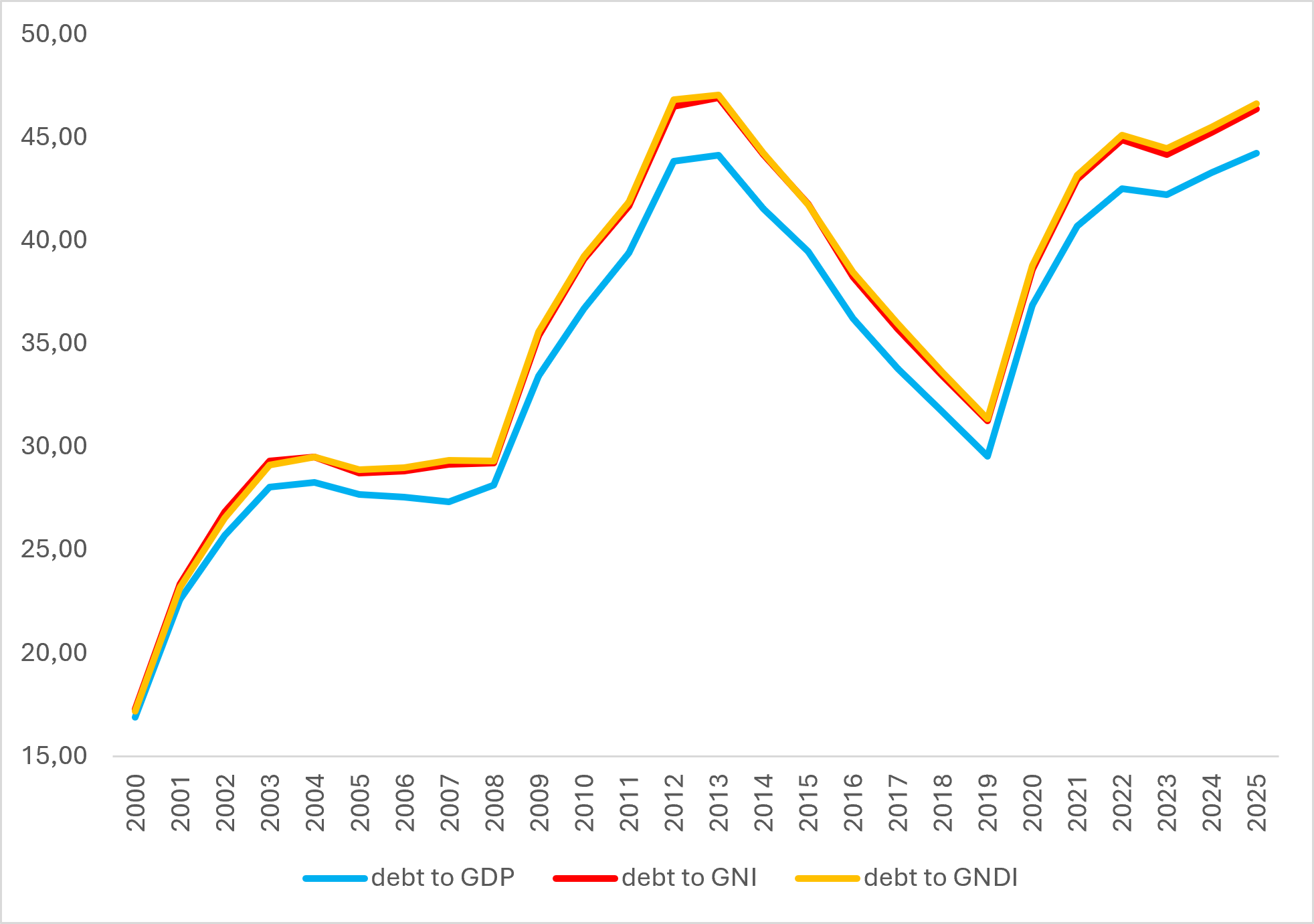
The ratio of public debt to GDP is one of the key indicators used to assess the state of public finances and for international comparisons. However, in the case of open economies with a significant presence of foreign capital, it may also be useful to monitor the debt-to-gross national income (GNI) ratio, which takes into account income flows between the domestic economy and abroad. At the end of 2025, Czech public debt stood at 44.25 % GDP, whilst as a ratio to GNI it reached 46.37 % and, relative to gross national disposable income (GNDI), as high as 46.63 %. The difference is not large enough to fundamentally alter the assessment of Czech public finances, but it does show that the debt-to-GDP ratio alone may not capture all the relevant characteristics of the economy.
The ability to make international comparisons is important for any debate on the state of the economy and public finances. Absolute figures, however, often do not tell the whole story. This is precisely why the budget balance and public debt are typically measured against gross domestic product. GDP provides a common basis for comparing countries of different sizes and economic structures, and is therefore one of the most widely used macroeconomic aggregates.
Like any indicator, however, GDP has its limitations. Discussions often focus on its ability to capture living standards, non-market production or the environmental impacts of economic activity. In the case of public finances, however, another question is relevant: whether GDP is always the most appropriate basis for measuring public debt. In countries where foreign ownership of factors of production plays a significant role in the economy, there may be a discrepancy between the value of output generated within the country’s territory and the income from that output that ultimately accrues to domestic residents.
In the Czech Republic, at the end of 2025, the general government (S.13) balance stood at −2.1 % GDP and public debt at 44.3 % GDP. These are standard indicators used in both Czech and European fiscal debates. However, the Czech economy also has a long-standing characteristic: a significant proportion of productive assets is owned by foreign investors. The output of companies with foreign owners is, of course, included in Czech GDP, as it is generated within the territory of the Czech Republic. However, part of the income generated by this economic activity subsequently accrues to foreign owners in the form of dividends, reinvested profits or interest.
This discrepancy can be captured using balance of payments data, specifically the primary income balance. This has been negative in the Czech Republic for a long time. More detailed data show, however, that the main reason for this is not compensation paid to employees, but primarily investment income, particularly from foreign direct investment. Typical examples include large companies such as Škoda Auto, Hyundai Motor Manufacturing Czech, Česká spořitelna or Komerční banka. These companies generate added value in the Czech economy, but a portion of their profits accrues to foreign owners.
This is where we come to the difference between gross domestic product and gross national income. Whilst GDP captures the output generated within the territory of a given economy, GNI also takes into account the balance of primary income in relation to other countries. If this balance is negative – as has long been the case in the Czech Republic – GNI is lower than GDP. Public debt expressed as a proportion of GNI is therefore, logically, higher.
At the end of 2025, the ratio of Czech public debt to GDP stood at 44.25 %, whilst using GNI in the denominator, it reached 46.37 %. A further step could be to use gross national disposable income, which, in addition to primary income, also takes into account the balance of secondary income – for example, certain current transfers between the domestic economy and abroad. In this case, the Czech public debt-to-GNDI ratio stood at 46.63 %. The difference compared with the debt-to-GDP ratio thus exceeded 2 pp in 2025.
Figure 1: Czech public debt compared to GDP, GNI and GNDI (in %)
 Source: Czech Statistical Office (2026), Czech National Bank (2026) and own calculations
This is not merely the result of a single year. Since 2000, the ratio of public debt to GNI has been, on average, 1.8 pp higher than the standard debt-to-GDP ratio. When using the GNI-to-debt ratio, the average difference was 1.9 pp. In individual years, the difference ranged from approximately 0.3 to 3 pp, reaching its highest levels in 2012 and 2013. From a long-term perspective, therefore, this does not represent a fundamental change in the state of Czech public finances, nor is it a purely negligible statistical deviation.
Ireland offers a much more striking example of how the structure of the economy can complicate the interpretation of GDP. In 2015, Irish GDP rose by approximately 26 % year-on-year due to transfers of intellectual property by multinational companies. This development also became known as ‘leprechaun economics’, a term coined by the economist Paul Krugman. The sharp rise in GDP was far from corresponding to a similarly marked improvement in the economic situation of Irish households or public finances, but largely reflected accounting and ownership shifts within multinational companies.
Since 2017, the Central Statistics Office of Ireland has therefore been publishing, alongside standard GDP, a modified gross national income (GNI*). This seeks to remove certain effects associated with multinational companies from the indicator, thereby providing a more accurate picture of the scale of the Irish economy’s income. The difference between the two indicators is significant. At the end of 2025, Ireland’s public debt stood at approximately 33 % GDP, whilst as a proportion of GNI* it stood at around 62 %.
The aim is not to claim that GNI or GNDI are generally better indicators than GDP. GDP remains a readily available, internationally comparable and well-established indicator. However, each of the three aggregates mentioned captures a different aspect of economic reality. GDP focuses on output generated within the territory, whilst GNI also takes into account how primary income is distributed between domestic residents and foreign countries. GNDI further extends this perspective to include secondary income.
This is not an argument for changing official fiscal indicators, nor is it a dramatically different assessment of the state of public finances. Rather, it is a matter of supplementing the standard view with a characteristic that is relevant to the Czech economy given its ownership structure. The same level of public debt may, in fact, appear slightly different depending on whether we relate it to the total output generated within the country’s territory or to the incomes that actually accrue to its residents.