



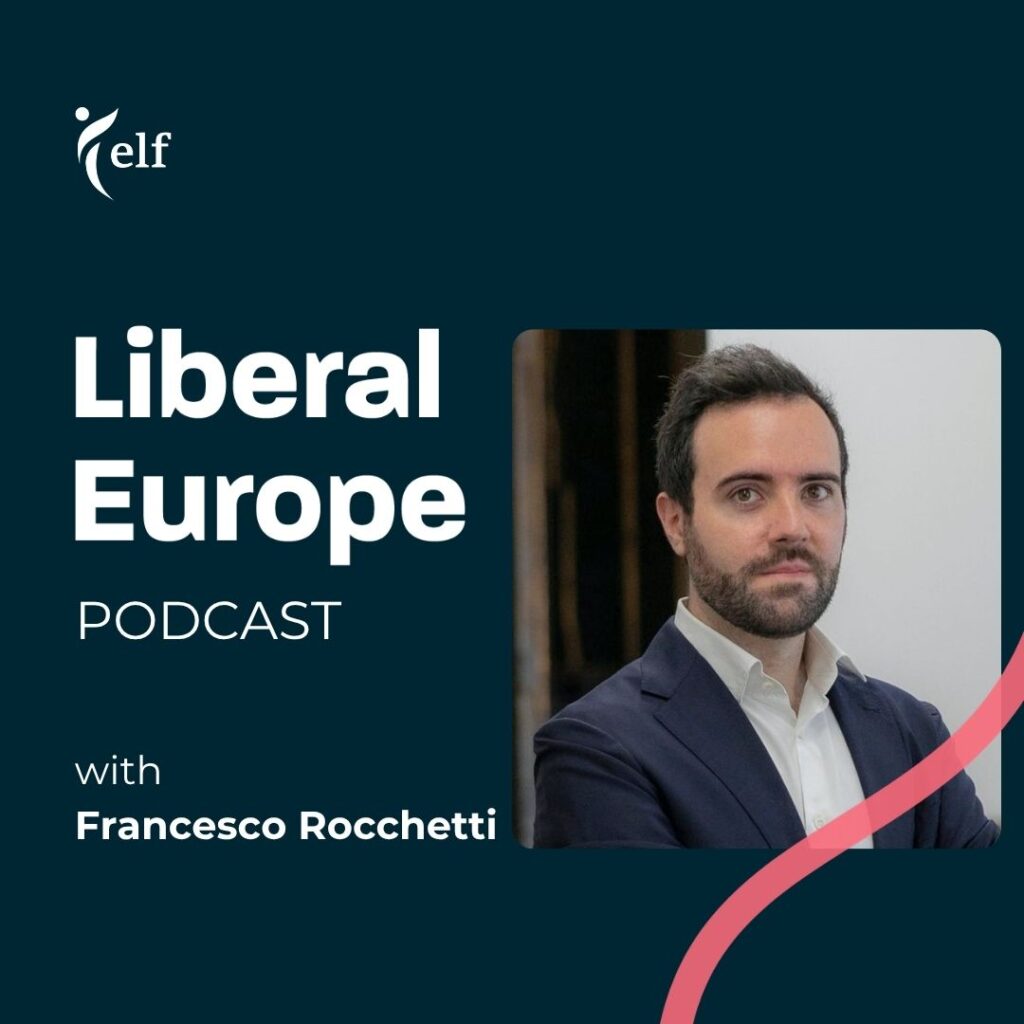
What should be a proper European response to the hybrid attacks by Russia on European territory? How should we view the post-American Middle East and its relationship with Europe? What role is Italy playing today within the EU and what are (and what should be) the country’s ambitions? And what is the current EU policy on migration? Leszek Jazdzewski (Fundacja Liberte!) talks with Francesco Rocchetti, the Director of the Europe’s Futures Initiative (EFI). He previously served as Secretary General of the Italian Institute for International Political Studies (ISPI) in Milan and Director of the Rome MED Dialogues.
Leszek Jazdzewski (LJ): Can you briefly explain what the ‘Europe’s Futures Initiative’ is and what specific qualities make it unique within the world of think tanks?
Francesco Rocchetti (FR): I like to call it a startup in the world of ideas. We created this to help Europe imagine and then decide its own future, and it has three qualities that make this claim credible and difficult to replicate.
First, the perspective that we have is a bit different. We have more than forty members from over twenty countries. The ‘Europe’s Futures Initiative’ is deliberately reading Europe from Vienna, but also from a Mediterranean port, an eastern frontier, an Atlantic hedge, a Balkan capital, all at the same time. Where most institutions speak from a single capital, our method is to hold several vantage points within one conversation. This is the first quality.
The second is where and when we are born. We were founded basically this year, and we do not proceed from the optimism that followed 1989 or the confidence in early globalization that was present in the early 2000s. We began from the Europe of war, of technological rapture, of climate pressure, and democratic anxiety. We are young, and this gives us a totally different perspective on things.
Third, which is the most difficult part, is that we want to be and to work in the space where Europe struggles the most: between analysis and action, between expert debate and public language. We aim to combine timely analysis with convening capacity and especially public advocacy. Of course, these are still on paper.
LJ: Where do you perceive the biggest deficits in the current debate regarding issues like enlargement and democracy that your initiative could effectively address with new ideas?
FR: Democracy is perceived as the most boring thing by people. When you mention ‘democracy’, people start sleeping. At the same time, we need to understand more and more that this is under attack, especially in European countries now.
We thought thatbdemocracy was under attack outside of Europe, and we were watching those countries, saying that democracy in the world is weakening. Now we are seeing it also within the European Union or the European continent, and that is where we should act the most. It is going to be very difficult because people feel democracy is a very boring thing because we are used to it.
LJ: How do you see the intensifying hybrid threats from Russia—including drone incursions, cyberattacks, and foreign interference—impacting the internal cohesion of the European Union, and what are your thoughts on how the migration crisis has historically shaped the fragmented management of Europe’s borders?
FR: The ‘Europe’s Futures Initiative’ is a very young creature, and while I am not super young, I do remember many other European crises or moments of momentum in which we saw an external threat that needed to be tackled. Most of the time, if we exclude the response to the war in Ukraine, Europe was not united in its response.
For a part of Europe, ‘hybrid warfare’ and ‘hybrid interference’ are still not recognized as a major issue, especially in Southern and Western Europe. I come from Italy, and while for the Minister of Defense it is a real issue, if you poll the population, this threat is not perceived at all. This lack of shared perception is not the first time we have witnessed this dynamic. I remember the 2010s and the migration crisis, and how differing regional perceptions ultimately led Europe to not respond to the issue at all. When these hybrid threats become closely tied to the full-scale invasion of Ukraine and become significantly larger, we will have a unified European response. Until then, we will not really see one.
Regarding the Mediterranean, if you look at the physical map, it is geographically central to Europe, but if you look at the political map, it is politically peripheral. For centuries, the Mediterranean was understood as an interconnected system defined by trade, empire—such as the Roman Empire and many other empires born there—religion, and migration. It has functioned this way across the same sea for a long time.
Contemporary Europe has broken that cohesive system into separate bureaucratic piles. We dictate that migration belongs to interior ministers, energy belongs to economic ministries, Israel and Palestine belong to foreign policy, climate belongs elsewhere, and so on. Basically, we do not have a unified Mediterranean policy; instead, we have a collection of what I call Mediterranean anxieties.
We are anxious about our energy relations with these countries, we are anxious about the migration flows coming from them, and we are anxious because we cannot solve the Israel-Palestine relationship with Europe. This collection of anxieties has brought us exactly to where we are today. We created a common territory inside Europe through the existence of the European Union, but we failed to create a true common border.
If we look at the borders, we know that the eastern border is currently defended, and Europe is able to defend that specific border today. However, we rent out the management of our southern border. Our overall border management is very fragile and entirely inconsistent, and that is the largest and biggest failure of Europe right now.
LJ: What is your evaluation of the Pact for the Mediterranean and the creation of a Commissioner for the Mediterranean within the European Commission, and what should a realistic European strategy look like given the immense diversity and geopolitical leverage of North African countries?
FR: In Brussels, a new portfolio can mean two things usually. First, it can mean that a problem has finally become important. Second, it can mean that nobody else wants to own it.
On the Mediterranean, we are more on the second option than the first. When the Commissioner for the Mediterranean was created, it was out of a political pact and not out of a priority. Therefore, the Pact for the Mediterranean recognizes that Brussels sees the problem, but institutional recognition is not necessarily a strategy, and we are not giving a strategy to it. The Pact for the Mediterranean is more descriptive of the problem, and it does not give a solution for now. Am I complaining that we have a Commissioner for the Mediterranean? No. Am I complaining that maybe we did not put enough energy into that and we rushed into publishing something? I would say a bit, yes.
Europe often assumes that it has a greater bargaining power there because it is richer and larger. We always assume that, since we are Europe, the power in negotiation is on our side. But we realized, and we are realizing, that Europe needs cooperation on migration, energy, and security sometimes more than these countries do. North African governments know this, and they have learned to price this cooperation. They have learned to turn our fears into their bargaining power.
We have seen this in Ceuta recently, but as Italy, we have experiences in the past with Tunisia and with Libya. Those governments were basically sending out migrants at sea if we were not behaving well, or if they wanted to threaten us. This is not a new instrument, but we have to understand that cooperation at the border is not a neutral service; it is leverage for North African countries.
North Africa is a very diverse picture because we have countries that are relatively stable. For different reasons, you take Morocco and Algeria. Algeria is an energetic power with a lot of gas, and they are selling a lot of gas, especially to Italy, creating huge energy relations. Morocco has a more dynamic, advanced economy, and we have seen the kind of relationship it has with Spain.
Then you have Tunisia, a totally different country with a super weak economy that is hugely dependent on Algeria. You have Libya, where foreign influence and interference is huge, and it is much greater from non-European countries than from European countries compared to before. Finally, you have Egypt, this giant with a lot of weaknesses, but also a demographic giant which sits on the biggest river of the continent, facing water problems with its neighbors, migration problems, and with Palestine and Israel right next to it.
It is a very diverse picture just if we look at North Africa. Of course, it cannot be a unique kind of approach. They have different needs, they have different leverage, and we need to understand them, go with them, and enter negotiations with them in different kinds of ways.
LJ: How do you analyze the evolving dynamics of the post-American Middle East, the shifting alliances involving the Gulf countries, and the complete lack of a meaningful role for the European Union as a bloc in this configuration?
FR: If you look at Europe as the European Union, we are not playing any role, and we should not expect the European Union to play any meaningful role since it does not have any basic competencies on that. We should not be deceived any time we see it not playing that role, because we have not given to the European Union the power to act as a bloc in foreign policy and many other areas.
If we look at how European countries individually are behaving there, there is a very pragmatic approach to it. You can see it from the economic relations we have been establishing along the last years in North Africa, and in the Gulf especially. To understand the Gulf, we first need to understand that the Gulf lies between East and West, and they are not choosing Europe because they do not need to choose Europe. They do not want to choose anybody. They are trading. They are global middle powers that have chosen to trade with whoever wants to trade with them. They have great relations in Asia, just as they have in Europe. This allows European countries—especially those who have economic power and firepower—to have very good ties with them.
If we look at the Gulf, the approach has been to forget everything related to human rights, which was the initial approach to the Gulf ten years ago. Now economic ties are very strong with many countries. I mentioned Italy, I mentioned France, and I can mention Germany. The amount of trade with them is very good, and the relationship between leaders of these countries is also very good. It is a totally different kind of approach than the one we have with North Africa or the rest of the Middle East, and it works. In 2024, there was the first EU-GCC summit. It was super good, with very good relations between the leaders. It is a different world.
LJ: Do you think that Europeans should and could do more regarding the conflict in Gaza and their relationship with Israel?
FR: We are slaves of our past. The previous century and what it has given us still shapes part of the European agenda. However, it does not shape European minds anymore. People and politics are growing their distance in this regard. Politics is playing still as if we were in the 19th century, and of course, maintaining the kind of relationship we historically had with Israel, whereas people in most European countries are not doing so anymore.
This shift is partly because they were not part of that history. They were born after, so they do not remember, know, or feel that history. It is also partly because of what they have seen and experienced in the last years. The devastation witnessed in Gaza has brought a huge portion of the European population to draw different political conclusions from the same historical memory.
LJ: Given that Giorgia Meloni has recently become the longest-serving prime minister, what is the secret to her political success and her ambition for Italy within Europe? Additionally, in light of Mario Draghi’s report and the creation of the ReIN group, what narrative or vision does his legacy offer for the future economic development of a Europe navigating multiple systemic crises?
FR: When looking at Giorgia Meloni, there are three things to realize. First, she was able to transform a far-right approach to politics into a very pragmatic approach. The economic agenda of Italy has not changed from Mario Draghi to Meloni. This is a huge achievement for someone coming and campaigning on that platform.
Second, she was able to punch above her weight in foreign policy. The impact she had was much bigger than Mario Draghi and much bigger than previous prime ministers because of the political situation, but also because of her ability to find a good place. This has been slightly lowered in the last few months after the damage in relations with Donald Trump, rather than with the United States as a whole.
Third, she keeps her popularity because she has not done anything meaningful on the economic agenda in the last four and a half years. In terms of economic reforms, you have not seen anything new in Italy, which politically is wise. Italy, especially in the previous fifteen years, experienced a huge amount of reforms or attempts at reforms.
The only one she tried to do was a constitutional change, and she failed.尊 Apart from that, she did not touch the economic agenda much. She continued on the Draghi agenda and on the agenda that Italy had in the past without much change, and this has paid off politically because she has not damaged her credibility and her approval rates too much. It is not necessarily bad, but that is what it is. We should be honest about that.
The story of Mario Draghi works because it plays on the willingness to make Europe great again. It plays on the idea that we were not only a power in the past, but we will be a power in the future. It is a positive story. We have seen this already. His figure plays an incredible role in bringing people together, and his credibility is so high that he can afford to do things.
The ReIN group is a way to continue to have an influence on the European Union agenda with his report. Because the report was written two or two and a half years ago, it was aging. It is a way to have influence on the European Union agenda. It is not certain this is what was necessarily needed. If change was truly desired, Mario Draghi would need to be at the helm of the European Commission. You do not change Europe with a group. We know that the actual change happens within institutions, not outside, especially in Europe.
We should not overestimate the ReIN group. It is a kind of lobbying group for the Draghi report, and this is why he brought together mostly his friends. We should not even over-criticize his group because Mario Draghi is almost eighty years old. This is his generation. He has grown up in a Europe that is different from the one we see today, where Central and Eastern Europe is a big part of the story. It is possible to forgive him because it is in honor of his story and his life.
What is required for changing now is to put the best people in the right places and not to underestimate what good people can do. Sometimes in politics, we have seen individuals who are not the best appointed to the top spots, and that is what we lack. When we see the government in the United States and look at whom they appoint, we often think that an appointee is a major figure. Even if they do not perform well subsequently, that remains part of the story. The brightest minds might not be the best policymakers. This is what has been lacking. When we looked at the last commission and saw whom they appointed for many countries, we wondered if that person was truly the best individual to be placed there during a critical moment for Europe.
Francesco Rocchetti will be a guest during this year’s edition of the Freedom Games, a festival of ideas co-organized by the European Liberal Forum on October 23-25, 2026, in Lodz, Poland. Find out more: igrzyskawolnosci.pl/event/igrzyska-wolnosci-2026
This podcast is produced by the European Liberal Forum in collaboration with the Movimento Liberal Social and the Fundacja Liberté!, with the financial support of the European Parliament. Neither the European Parliament nor the European Liberal Forum are responsible for the content or for any use that be made of.