



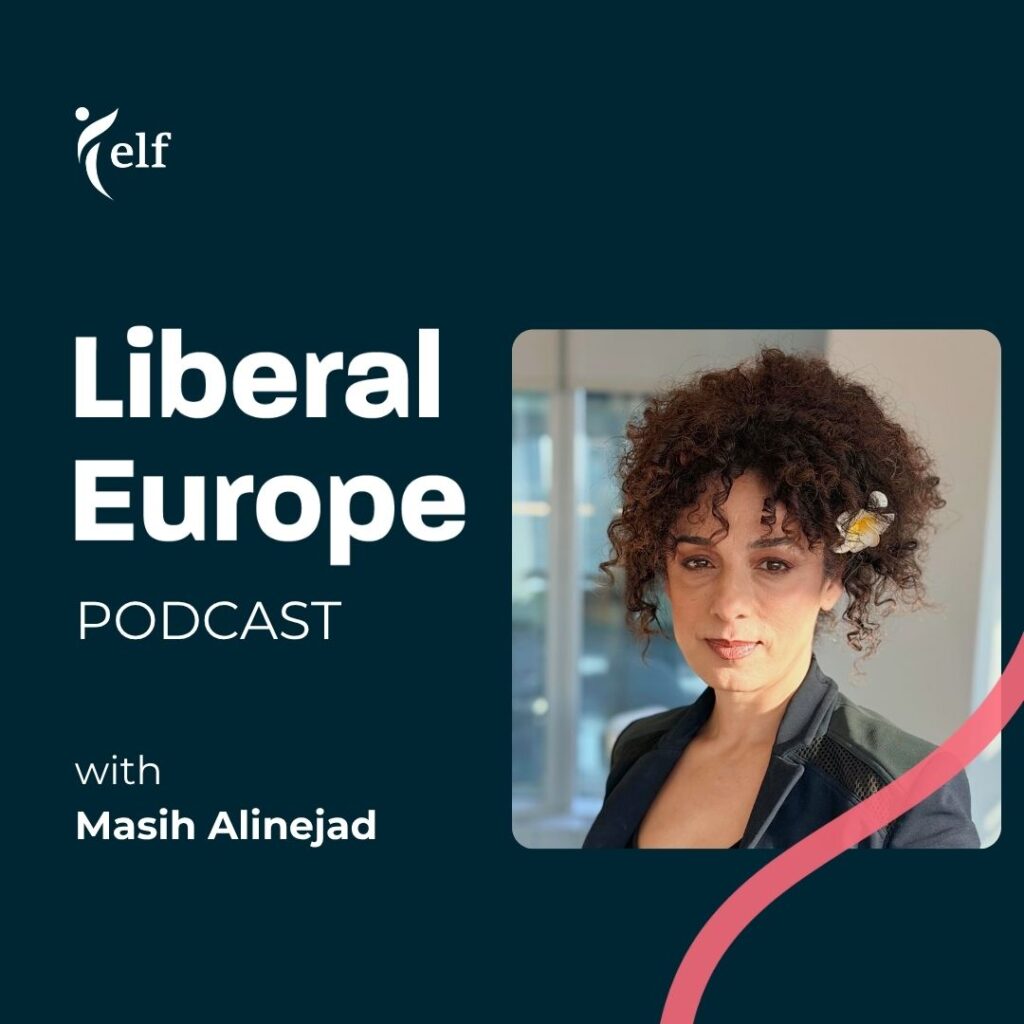
Are women’s rights compatible with religion? How have women’s rights evolved in the Islamic Republic? Has the recent conflict involving Israel, the United States, and Iran brought Iran any closer to freedom? And what is the endgame? Leszek Jazdzewski (Fundacja Liberte!) talks with Masih Alinejad, an Iranian-American journalist and human rights activist, widely recognized as one of the most prominent voices for women’s rights and democratic freedom in Iran. Having survived three foiled assassination plots orchestrated by the Iranian government, which led to federal convictions in New York in 2025, Alinejad continues her fearless advocacy for women’s rights, freedom of expression, and an end to gender apartheid. On October 23, Masih Alinejad was awarded the Medal of Freedom as part of the 2026 Freedom Games, presented by the Liberte! Foundation.
Leszek Jazdzewski (LJ): In your book, The Wind in Your Hair, you write about wanting to feel the wind in your hair as a young girl, just as your brother did. What exactly does that desire signify within the context of your upbringing?
Masih Alinejad (MA): For most of your audience, this may be very basic, and I want to get their attention by giving them an example. If they want to get ready and go to an event tomorrow, what is the first thing that they do? They use a mirror to make themselves beautiful, to do their hair, or to wear any kind of dress that they want to. Basically, they do this to represent their true self.
In my country, Iran, from the age of seven, girls and women use a mirror to make themselves into the person that the Islamic Republic and the government want them to be. That is the reality. When I talk about feeling the wind in my hair, it is not just about removing a small piece of cloth. It is about gaining my identity back from a barbaric regime like the Taliban or the Islamic regime.
That is my fight, and I started my revolution from my family’s kitchen. When you want to say no to a government, you have to start from your home, where my father used to force me to cover my hair. As you see, I have too much hair, and it was not that easy. But it was all about being my true self. It is all about saying no to the backward mullahs who want us to follow their own lifestyle. That is how I started the campaign My Stealthy Freedom and the White Wednesdays campaign to invite women to remove their hijab, to say no to those who want to force them to choose their dress code, and to say no to the Islamic Republic.
LJ: Why is the Iranian regime so fundamentally invested in enforcing these strict dress codes and laws upon women?
MA: This is about controlling the whole society. If they control half of the population, that is the way to control the whole society. Compulsory hijab is just one of the most visible symbols of oppression.
Beyond compulsory hijab, think about the broader reality. If you are a woman, you cannot sing. Right now that I am talking to you, Parastoo Ahmadi, a phenomenal singer in my country, received seventy-four lashes simply for singing. Therefore, the hijab is the visible symbol of oppression of a gender apartheid regime. Consider actions like men and women shaking hands or hugging. I cannot even believe it myself in the 21st century, but public hanging and public execution are considered blessings under the Islamic Republic. Conversely, if a man and a woman hug each other in public, in a movie, or in a theater, you can receive lashes and you can be banned from doing your job. That is the reality.
A lot of people in the West say that this is their culture and that we should not talk about it. This is an insult to a nation because this is the culture of ISIS. This is the culture of the Taliban and the Islamic States trying to control men and women by lashing them. Even if you say that you do not want to be a Muslim, that you do not want to follow Sharia laws, and that you do not want to follow the Islamic dress code or any kind of Islamic ideology, you do not have any other option. You do not choose to be a Muslim in Iran or in Afghanistan. You are born into a Muslim family, you are automatically a Muslim, and if you say that you do not want to practice Islamic laws or that you want to walk out from Islam, you will get hanged. You will be executed under Sharia laws, which designate you as a muhareb or a murtad.
Do not get me wrong; I am not against Muslims. My beautiful mother is a Muslim woman. She wears a hijab, but she never forced me to wear a hijab. That is the true culture of my country and nation, not the culture of the Islamic Republic, the Taliban, or ISIS.
LJ: Do you think that the hijab is still the central symbol of the fight for women’s rights, or has something else replaced it following the widespread protests where many people were killed?
MA: Since I launched my campaign, the main slogan was not just abolishing the morality police or compulsory hijab laws. All I heard from Iranian women was that this was like the Berlin Wall. If you tear this wall down, then it will get easier to bring the wall of dictatorship down.
When we say no to compulsory hijab, when you see Iranian women burning headscarves in public, they have a simple message. They want to have a secular democracy. That is why they sacrifice their life. They want to have a normal regime that separates religion from politics and from the state. You know the kind of normal government that you take for granted everywhere in the West. That is the message, and that is why when Nika Shakarami, only sixteen years old, was leading the uprising in Iran during Woman, Life, Freedom by burning her headscarf, her message was clear. She wanted to get rid of the whole regime.
That is why when the Bloody November took place in my country across more than one hundred cities, when people took to the street to protest against the Islamic Republic, they said that loud to the Western countries that we just want to have a normal life, and that is why they got killed. Recently, in a January uprising, only in two days, the regime literally killed a massive number of people simply for demanding freedom and demanding to have a secular democracy. It is beyond sad that we do not even have the real number.
Recently, I actually invited the blinded women to the Council of Europe. I am going to invite them to be with me in Poland as well. These are the women in the front line of the uprising, blinded by the Islamic Republic. Why? You think they just wanted to show their hair and feel the wind in their hair? No. Our fight is all about bringing down the dictatorship in our country. I am sure that when you see the women who lost their eyesight, you will get the strength and power from them saying that the regime could manage to take our eyesight, but not our hope, and we are more determined than ever to end this regime.
LJ: What is your position on the recent military conflict involving Iran, the United States, and Israel, and do you think it has the potential to bring Iran closer to freedom?
MA: Let us be very clear. Iranian people never wanted to have a war. They never asked for a war. Which nation asks other countries to bomb them? This is the war that is being imposed on us, the Iranian people, by our own government.
When you go to every single person in Iran and ask whether they want to have nuclear weapons, they say no. This is the regime that the United States gave many chances to during the Obama administration and during the Biden administration to negotiate with them. What happened? They cheated. They always hide their nuclear activities. They know how to lie. They know how to bypass international laws, and they brought my country into this war.
To be honest, my heart is broken for every single unarmed person being killed during this war. As I told you, my people had hope from the beginning when Ali Khamenei was dead, or when the high-ranking members of the Revolutionary Guards were the targets of this war. But when innocent people were the targets of this war, I was loud enough to criticize President Trump and to criticize the Israeli government. When you promise that help is on its way, then finish the job without targeting innocent people, because these people are the allies of the United States, they are the allies of the Israelis, and they are the allies of everyone in the West.
It is heartbreaking for me to see that now my people are being abandoned. They are stuck in the middle of two governments; the West is just talking about the Strait of Hormuz, and the Iranian regime is talking about their own survival. Who is talking about the mass executions right now? My job is to echo the voice of millions of Iranians, especially those who are on death row. My people are not calling death to America or death to Israel, and that is why I call on all Western leaders, not just the United States of America.
Where is Europe? Where is the United Nations? In 2005, the United Nations passed a resolution to protect the lives of civilians when they face military weapons. Instead, the United Nations literally gave a chair to the Islamic Republic at the Human Rights Council to monitor human rights globally. This is a slap on the face of the Iranian people.
The real war is still going on inside Iran, defined by the mass executions and a regime that actually went hospital by hospital, door to door, to finish off the wounded ones. This is a regime that actually executed teenagers recently, and this is the real war that no one talks about. I believe that my people can end this regime, but with empty hands, it is impossible. That is why I think the call should go to all leaders of democratic countries to support the people of Iran to end this regime. If they want to end endless war in the region, we have to end the root cause of this war, which is the greatest sponsor of terrorism, the Islamic Republic.
LJ: What is the legacy of the Iranian revolution of 1979, and do you believe there is genuine potential for a modern democratic revolution that can successfully dismantle the resilient Ayatollah regime?
MA: When I talk to those who were part of the Islamic Revolution, they always tell me that their goal was to gain more political freedom because some of the authors and intellectuals were actually being tortured in prison by SAVAK. When I ask them about what they achieved, most of them say that not only did they not gain more political freedom, but they also lost the social freedom that we already had.
Women were able to choose their own lifestyle. Women were able to sing, to dance, to participate in different kinds of sports, and to enter stadiums. We basically lost all of that, and now we face a brutal regime killing teenagers, lashing women, raping women in prison, and sending their killers beyond their own borders as well. This is a regime using transnational repression and expanding their acts of terrorism everywhere. We do not have a normal relation with the West.
That is why I believe there should be a lesson that if we want to bring this regime down, we need to be sure who is going to replace it and what kind of government we are going to have. For that, we believe in fair and free elections. A lot of people sacrificed their lives to have a fair and free election to choose their own kind of government. It is very heartbreaking to see that the Shah’s regime could have been reformed. People overthrew the Shah’s regime, but regarding this regime that should be gone and overthrown, some in the West believe that we can reform it. No. Let us make it very clear. This is a barbaric regime like ISIS, it cannot be reformed, it should be gone, and we must have a secular democracy. That is the message of millions of people inside Iran, and thousands of people who actually sacrificed their lives during six major uprisings since 2009 took place in Iran.
LJ: What is your perspective on Reza Pahlavi, the son of the former Shah, and what kind of influence or relevance do political emigres outside Iran actually hold for the future of a potential caretakers government?
MA: We are in a very crucial moment. I remember during 2022 when Mahsa Jina Amini was killed and people took to the streets, I myself reached out to all of the political figures, including the son of the last Shah of Iran. I reached out to the Kurds, to the Baloch, and to the Nobel Peace Prize winners of my country to bring them all together. I am a dissident, and my job is to bring everyone together, just like the way that I united women against compulsory hijab or my campaign United Against Gender Apartheid. What matters to me is unity.
He is one of the political figures who said that he is ready to lead the opposition to have a transition from dictatorship to democracy. I think you should ask him whether he was able to bring all the different diverse political parties together or not. He was the one who actually called people to take to the street in the January uprising, and people had hope. Some named him in the streets.
What is the result now? President Trump and his administration said that help is on its way. If he is leading the opposition, he needs to talk directly to the Western leaders, including the United States, and ask where the help is now that the mass executions are taking place. In my opinion, we need to empower the leaders inside Iran and the people inside Iran by putting pressure on the United Nations and the Western leaders to deliver their promises and to take action. Otherwise, by saying that I am ready to lead but not actually making the killers accountable, and not holding the leaders in the West who promised a lot accountable, we just put the lives of innocent people at risk.
When it comes to ending this regime, every political leader, every dissident, and ordinary people inside Iran, from Kurdistan to Tehran to Balochistan, across Iran, are united. But are we ready to have a united political front and a united coalition? I doubt it. I strongly believe and I call on all leaders to think about the lives of innocent people and be united to talk to the leaders of democratic countries and make them accountable for the promises that they made during the uprising.
LJ: Being an immigrant yourself, how do you evaluate the migration crisis from Muslim-majority countries into Europe, and what do you see as the definitive solution to the global backlash this has created?
MA: When Leopoldo López, the opposition leader from Venezuela, and Garry Kasparov, the Russian chess champion who is the biggest enemy of Vladimir Putin, created the World Liberty Congress – a platform to bring together dissidents, activists, and leaders of pro-democracy movements from sixty authoritarian regimes – our message was clear. If the West does not join the pro-democracy movements in authoritarian regimes to help them overthrow and end dictatorship across the globe, they will face the backlash themselves.
The situation you are facing now in Europe, and all over the world, is a mass crisis of people trying to leave their countries. The dictators are united from Russia to China to North Korea and the Islamic Republic all over the world, but democratic countries are not as united. Dictators are providing military weapons and surveillance technology to each other. At the United Nations, they are voting and backing each other, and Autocracy Inc. is growing bigger and bigger. Their network is growing bigger and bigger.
When you look at the G7 countries, when it comes to designating the IRGC as a terrorist organization or supporting Ukraine to fight the alliance of dictatorship, they are not as united as the dictators. Vladimir Putin is not alone; this is a war being supported by North Korea and the regime of Iran. The fact that G7 countries are not as united as dictators is bringing more crisis to the West.
I am a legal immigrant, and I believe that America is a land of dreams for all of the people living in authoritarian regimes, but our biggest dream is to go back to our country, to live in our own countries. I am representing the dissidents from Africa, Hong Kong, China, Russia, Venezuela, Iran, and all over the regions. Their dream is to go back to their own countries. When we ask democratic countries to help us, we do not ask them just to protect us or to help us get rid of dictatorship. We ask them to protect their own national security. We ask them to protect their own countries. It is beyond sad when I see that they downplay our cause and victimize us instead of joining our fight against authoritarianism. That is how you help your country, and how you protect democracy and the national security of the West.
LJ: Is it possible to successfully combine state-centered religion with the preservation of women’s rights, or is complete secularization an absolute necessity for women’s rights to exist in a stable environment?
MA: I strongly believe that if we do not have a secular democracy, women cannot be respected in any form of religious government. Any kind of religious government cannot respect women’s rights, women’s bodies, or women’s identities. It is a joke when I hear some in the West say that we should let the women of Afghanistan deal with their own problems because it is a Muslim country and it is their culture.
Women get kicked out of school and are not allowed to get an education under Sharia laws under the Taliban. You call it our culture? In my country, women face lashes simply for being women and are kicked off all the stages. We have beautiful, phenomenal singers in my country who are not allowed to sing. This is the religion actually making decisions over our bodies. We cannot have a voice as a woman.
Some in the West, on the left and among liberals, try to educate us, unfortunately, in the global feminist movement, while downplaying our cause. In the name of a white savior complex or cultural relativism, they keep quiet. You do not see any women’s march for the women of Afghanistan or the women of Iran who are being kicked out from everywhere. In Africa, they use rape as a weapon of war against women, and you do not hear anything in the West about this. That hypocrisy kills me, especially since I have witnessed how high representatives of the European Parliament wore a hijab and bowed to the Islamic Republic, not just inside Iran under the excuse of respecting the law of the land, but on Western soil. They wore a hijab and bowed to Taliban and Islamic Republic officials on Western soil to negotiate with them. If you cannot stand for your own rights, you cannot negotiate with an Islamic state and talk about solving bigger problems. If they do not allow you to choose your own lifestyle, and when you do not have control over what you put on your head, they are not going to allow you to think about bigger problems.
This is the hypocrisy, just like in New York, where politicians celebrated hijab day. But when it comes to killing women for not wearing a hijab, there was no celebration or recognition of those women who say no to the hijab. I see some Western female politicians wearing a hijab in solidarity with a Muslim minority. Do we see any Muslim women removing their hijab to show their solidarity with the women getting lashes in Iran? No.
When it comes to women’s rights, sometimes the MAGA people in America and far-right people say it is not their problem and to let them deal with it. They do not know that the Taliban, the Islamic Republic, Al-Qaeda, and ISIS care about ruining and crushing democracy everywhere. The far left, by sympathizing with the Islamists, with Hamas, and with Hezbollah, and by wearing a hijab in the name of diversity and respecting the other’s culture, do not know that the same Taliban, ISIS, and Islamic Republic are trying to expand their ideology everywhere. They will come after them on Western soil as well.
My message is very clear. When it comes to women’s rights, and when it comes to fighting for equality, put your political agenda away. Put women first. That is how you can call yourself a true feminist. Otherwise, you are literally empowering the Taliban and the Islamic Republic to kill more women in the Middle East. You are empowering the Taliban, Al-Qaeda, ISIS, and Islamist terrorists to expand their ideology everywhere, and to come after your own daughters on your own soil in Western countries.
This podcast is produced by the European Liberal Forum in collaboration with the Movimento Liberal Social and the Fundacja Liberté!, with the financial support of the European Parliament. Neither the European Parliament nor the European Liberal Forum are responsible for the content or for any use that be made of.