




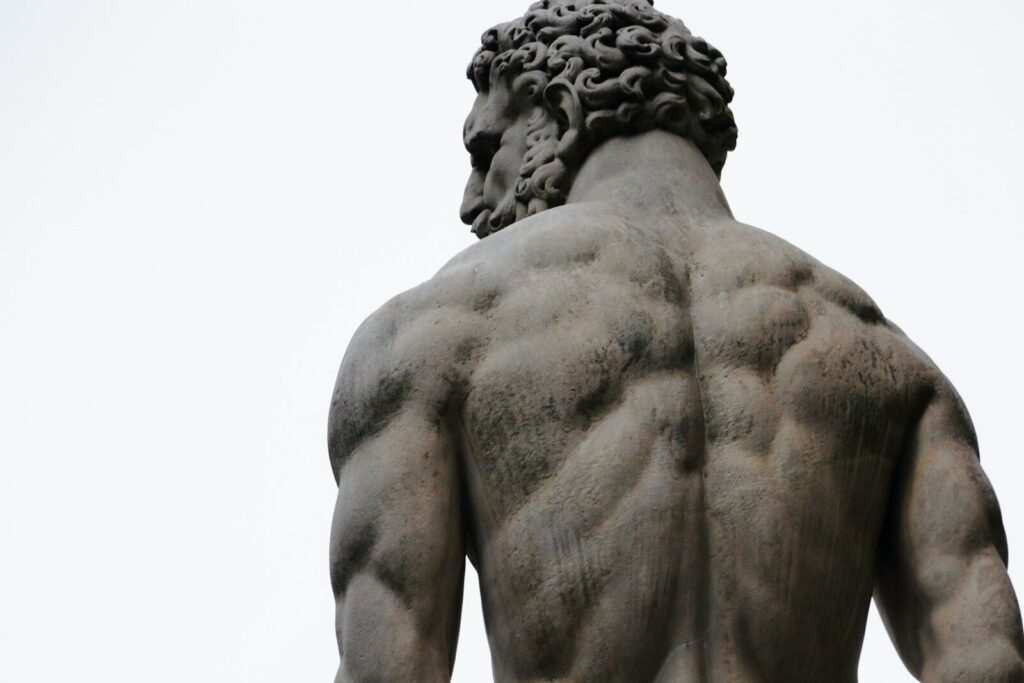
Today, we delude ourselves that when we stand before the High Court awaiting its final verdict, we are facing Themis — blindfolded, holding the scales and sword, the embodiment of ideal justice that disregards social status. Yet, these judges are not blind at all. They are not, because they can clearly see Donald Trump standing before them with a gun aimed at them. It is difficult to play the role of Dworkin’s “Hercules” in such a situation.
Our lives are essentially a continuous belief in myths and fairy tales. Since the dawn of time, we have been accustomed to constructing hidden narratives to explain certain truths of existence. We believe in them for many reasons, but above all, because we like to delude ourselves. In ancient times, we deluded ourselves into thinking our fate depended not merely on our own meager abilities, but on all-knowing gods watching over us from high atop Olympus. We deluded ourselves that a policy of appeasement would satisfy the insatiable Hitler and avert the outbreak of a potential war.
Today, we delude ourselves that when we stand before the High Court awaiting its final verdict, we are facing Themis — blindfolded, holding the scales and sword, the embodiment of ideal justice that disregards social status. Yet, these judges are not blind at all. They are not, because they can clearly see Trump standing before them with a gun aimed at them. It is difficult to play the role of Dworkin’s “Hercules” in such a situation.
The fact that liberal democracy is in crisis is, essentially, nothing new. The deepening of social divisions is an ongoing process that has been unfolding for decades, and pro-Russian populist fringe parties are doing nothing to slow it down.
Yet, in Eastern Europe — and particularly in Poland — we tend to attribute any signs of a crisis in democratic institutions to an “immature democracy.” Is it impossible, then, to establish firm foundations for a liberal democracy — one that respects the principles and mechanisms of the separation of powers as outlined by Montesquieu — within the span of thirty years? Apparently so. Does a country with such deeply rooted democratic traditions, born of a rebellion against European authoritarian colonialism, have the right to offer the same explanation?
The United States has long portrayed itself as a bastion of democracy and its ultimate pioneer. Since the groundbreaking promulgation of the world’s first constitution — the American one — subsequent socio-economic and political transformations have not undermined the essence of American democracy. It seemed that no globalist threat could shatter such a solid, deeply rooted foundation. For years, the system was seen as embodying Ronald Dworkin’s premise that a judge is like Hercules.
It was indeed Ronald Dworkin who posited that the ideal judge is like Hercules. His profound knowledge of the law and the entire legal system enables him, in even the most complex situations, to discover that single, ideal, and uniquely correct solution. To this end, Hercules would weigh various rules and principles against the prevailing legal framework, integrating the specific facts of the case into the analysis. He would treat the entire legal system — encompassing statutes, judicial rulings, and executive orders — as a unified whole, a single coherent path. This idea — or, from today’s perspective, perhaps more of a myth — had a tangible impact on reality. It was American democracy that laid the groundwork for the emergence of such a myth, for the existence of a figure as legendary as Judge Hercules.
For a long time, this myth was reflected in American reality in one way or another. For a long time, but not forever. For times changed, and with them, the rules of the game. In the USA, those rules were changed primarily by one person: Donald Trump. He treated the judiciary with utter contempt, crushing any Dworkinian assumptions. Donald Trump subscribes to a far more dangerous idea — the idea of realism. Not legal realism — which is, of course, a completely different concept — but realism in the sense of an absolute lack of attachment to any legally defined and functioning institutions.
Trump plays not by idealistic principles, but according to a brutal calculus of self-interest. He does what benefits him. And if something does not benefit him, he usually raises his voice — expressing this in the most “diplomatic” way possible. A Dworkinian judiciary, for instance, is of absolutely no use to him; after all, it is essentially a set of checks and balances that significantly curtail executive power.
In this context, Trump simply presents judges with a fait accompli. Rumors about him re-registering as a candidate for the next presidential election, or other decisions that blatantly violate existing law, only underscore his unyielding nature — one that brooks absolutely no dissent. To him, the rulings of judicial “Herculeses” are nothing more than obstacles. They hold no binding force that would compel him to respect them. Indeed, he never hides his criticism of rulings that displease him, going so far as to accuse judges of outright treason.
Perhaps this is what we needed? Following rulings that did not serve Trump’s interests, we often hear statements the likes of which no one had voiced before. He has given concrete expression to certain thoughts that — to avoid controversy — previously remained unspoken. He calls things exactly what they are, plainly and directly. He refers to “his” judges as his own and openly states the expectations he placed upon them. Before we panic, then, we should recall the words of other thinkers — those more skeptical of Dworkin’s lofty, universal ideals.
One such thinker is Mark Tushnet. Although he never explicitly stated that judges were radically politicized, he did not rule out the possibility that they operated under a form of coercion — a “gun” to the head, even if he never used that specific term. Mark Tushnet — like the Critical Legal Studies movement as a whole — firmly maintained that there is considerable room for discretion in the interpretation of the law. He gained this insight while serving as a law clerk to a Supreme Court Justice during a high-profile, controversial case involving fundamental social values that had captivated the entire United States. His views were profoundly shaped by the political pressure — whether direct or indirect — weighing upon the bench during that case.
Thus, Donald Trump — likely quite unwittingly — revitalized our academic discourse. Through his brusqueness, irritability, and lack of political decorum, he exposed a truth long obscured by the illusion of a democratic utopia: the fact that a judge is not Hercules, but merely a mortal human being cowering before the barrel of a political gun. It is simply a pity that it took such a massive wave of populism for us to discover this.
Written by Jakub Andrzej Luber – a Law student at the University of Warsaw and an active member of the academic community, focusing particularly on electoral systems and their impact on populism. Erasmus+ Programme specialist. Trainer in public speaking and Oxford-style debating. Advocate for a green Europe free from the far right.
The article was originally published in Polish at: https://liberte.pl/trump-morderca-herkulesa/