


What should we know about organized crime and corrupt rule of oligarchs in Slovakia? Should we be afraid of Slovak nationalism? And why do Slovaks dislike the West?
The 1990s brought several significant changes for Europe. On January 1, 1993, Czechoslovakia was dissolved, and as a result, the Czech Republic and Slovakia have since been independent states of the Central and Eastern European region. The focus of European public discourse is not always on Slovak domestic politics, but the assassination attempt on Prime Minister Robert Fico in 2024 has shocked the continent.
The current process of negotiating salary increases for public servants should also be seen in the context of international comparisons. Slovakia spends the most on salaries in the whole V4, not only as a share of total public administration expenditure but also as a share of GDP. In these comparisons, Slovakia spends more than the EU average.
In its program statement, the government announced its intention to increase the progressivity of personal taxation. In the budget plan, it already speaks specifically of the intention to \"introduce 3rd and 4th personal income tax rates from 2025,\" which is expected to increase public revenues by EUR 78 million. A 3rd rate of 30% is to apply to annual personal income above EUR 80 000.
After the rising number of immigrants in 2015, the implementation of the Common European Asylum System became a priority for EU member states. Nevertheless, it has been documented by many studies that the V4 group countries drifted away from these intentions. During 2016, the members of the Visegrad group worked together as a united bloc on migration issues in Brussels.
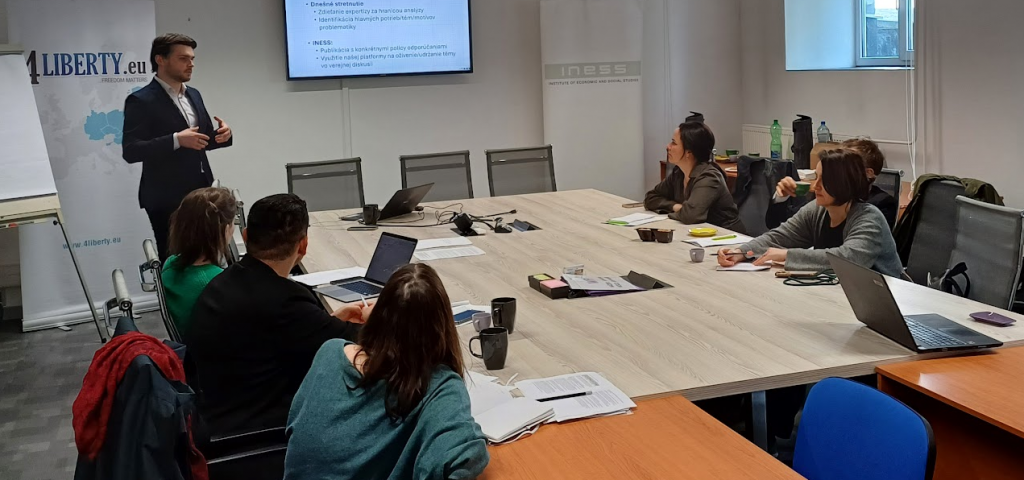
On April 17, 2024, INESS organized a roundtable on the upcoming analysis of high infant mortality in Roma communities. After the presentation of the analysis prepared by Matej Bárta, the participants discussed various aspects of the issue. Our ongoing project, supported by the Friedrich Naumann Stiftung, aims to support and improve policies to reduce extremely high infant mortality with the help of educational change.
We all want higher wages for less work. This explains why the four-day working week is such a popular topic in the media. But it is even less of a justification for the emotions that run high when the subject is discussed. These, in turn, prevent rational argumentation and consideration of all the problems with this popular proposal.
Recently, a Slovakian newspaper published a commentary about tighter regulation in the healthcare sector. The question remains what exactly does he mean by the word \"tighter regulation\"?
Slovak Prime Minister Robert Fico said at Davos that Slovakia could become a country that will experiment with a four-day working week. It is a flattering topic and so several media immediately picked up on it.
Slovakia\'s new government has finally succumbed to the Sweet Tax Temptation, as we called it in our last publication. The Ministry of Finance has published a preliminary announcement describing its intention to introduce the tax. You read that right; it is not the Ministry of Health that is in charge of the health of the population and the sustainability of health spending.