



editorial partner Liberte! Friedrich Naumann Foundation

work

Why Does Lithuania Have Twice Poland’s Unemployment Rate?
Economy
Why Does Lithuania Have Twice Poland’s Unemployment Rate?
Unemployment insurance should serve as a financial cushion when someone unexpectedly loses their job, rather than as a system that encourages people to remain outside the labor market at others’ expense. Yet, Lithuania spends around five times more of its GDP on unemployment-related benefits than Poland, while its unemployment rate is more than twice as high. Poland’s experience shows how much labor-market rules and incentives can matter.
When Unemployment Pays More Than Work: Lithuania’s Benefit Trap
Economy
When Unemployment Pays More Than Work: Lithuania’s Benefit Trap
The new agreement of Lithuania’s governing coalition includes a commitment that “people who work must not be worse off than those who do not”. According to experts at the LFMI, this principle is particularly relevant when assessing the unemployment insurance system. Yet in Lithuania, unemployment can still be more financially rewarding than work, especially in lower-skilled and lower-paid jobs.
Is Labor Market about Conflict or Creating Value?
Economy
Is Labor Market about Conflict or Creating Value?
Anthropologist Clifford Geertz famously described culture as a web of narratives. The way societies understand the labor market is one such narrative — and it matters, because the story we choose shapes how we regulate and manage economic life.
Will Collective Labor Conflicts Undermine Economic Growth?
Economy
Will Collective Labor Conflicts Undermine Economic Growth?
According to the explanatory note of the draft law, strike activity in Lithuania remains consistently low, while in countries such as France, Italy, and Belgium, strikes are a common and effective tool for defending workers’ interests. But do collective labor conflicts actually improve workers’ well-being in the long run?
Join Online Roundtable on Workforce Freedom and Innovation
Think Tank News
Join Online Roundtable on Workforce Freedom and Innovation
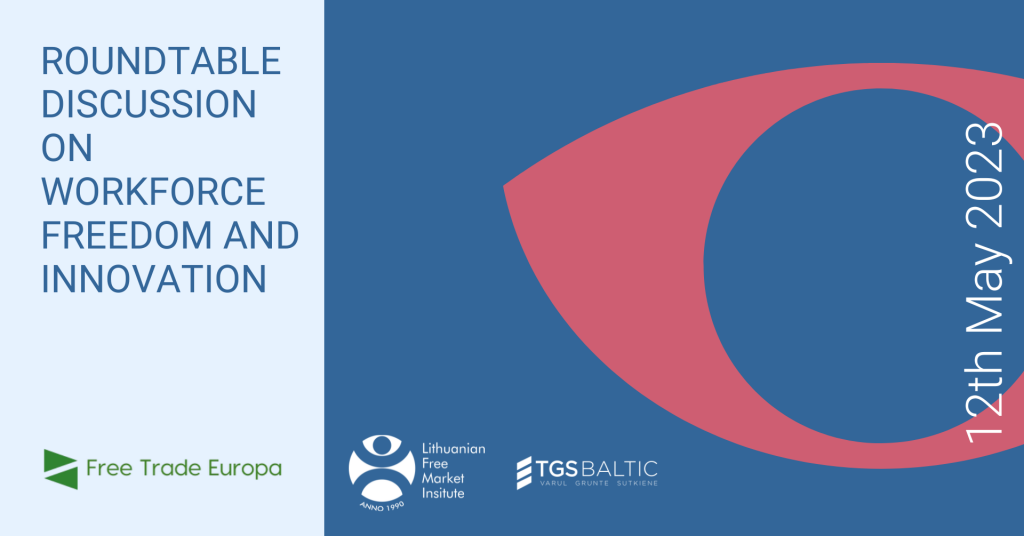
The Lithuanian Free Market Institute, together with its partners Free Trade Europa and law firm TGS Baltic, is holding a roundtable discussion to discuss new forms of work that have been created via digitalization and the changing nature of employment that is being sought by platforms and individuals alike.